
Scaling Laws in the Social Age: How Human Behavior Rescues Wireless Capacity
Impact of Social Interaction on the Capacity of Hybrid Wireless Networks
This paper investigates the throughput capacity of Hybrid Wireless Networks (HWNs) by integrating a dual power-law social interaction model. It employs a Max-L-hops routing policy and analyzes how social group size factors (α) and destination selection preferences (β) impact network scalability, achieving a per-node throughput of Θ(W) when base stations are sufficiently dense.
TL;DR
For decades, researchers feared that wireless ad hoc networks wouldn't scale—that as more users joined, the "relay burden" would eventually crush the network (the infamous Gupta-Kumar limit). This paper provides a more optimistic outlook: by modeling Social Interaction through a dual power-law distribution, the authors demonstrate that realistic traffic is localized enough to significantly boost throughput, even allowing hybrid networks to reach a constant per-node capacity.
The "Uniform Traffic" Fallacy
In the early 2000s, the academic consensus was pessimistic. If you have nodes and everyone talks to anyone at random, each node spends all its energy relaying others' data. The result? Per-node throughput vanishes at a rate of .
However, humans aren't random. We have "social groups." We talk to people we know, and we usually know people who are physically or socially close to us. This paper argues that ignoring this Social Feature leads to a massive underestimation of what wireless networks can actually handle.
Methodology: The Double Power-Law Insight
The core contribution lies in how the authors define a social connection. They move beyond the "q-neighbors" model to a more nuanced two-step process:
- Social Group Formation (): The probability that a node belongs to source 's social group is proportional to .
- Destination Selection (): Within that group, the source doesn't pick a target at random. It picks based on . This defines the "intimating degree"—we talk to our "closest" friends most often.
Architecture & Routing
The paper uses a Hybrid Wireless Network (HWN) model, combining an Ad Hoc layer with a Cellular layer (Base Stations).
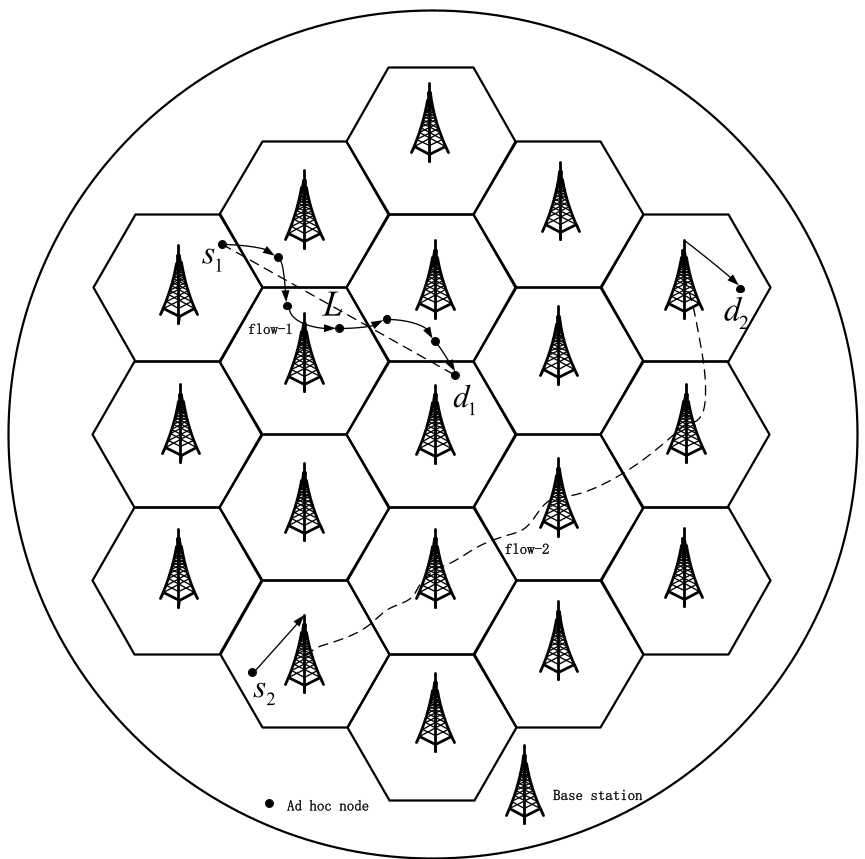 Figure: The network is divided into squares for TDMA scheduling. The Max-L-hops policy dictates that if a destination is within L hops, it uses Ad Hoc mode; otherwise, it jumps to the nearest Base Station.
Key Results: Localism is Efficient
The authors derive capacity for two social group sizes: (large, global groups) and (small, tight-knit groups).
- The Impact of : When the destination selection factor increases, the traffic becomes highly localized. This reduces the average number of hops , meaning data stays within a small "neighborhood," freeing up the rest of the network's bandwidth.
- The Base Station Sweet Spot: If the number of base stations keeps pace with , the network is "scalable"—meaning the throughput per person doesn't drop even as the crowd grows to infinity.
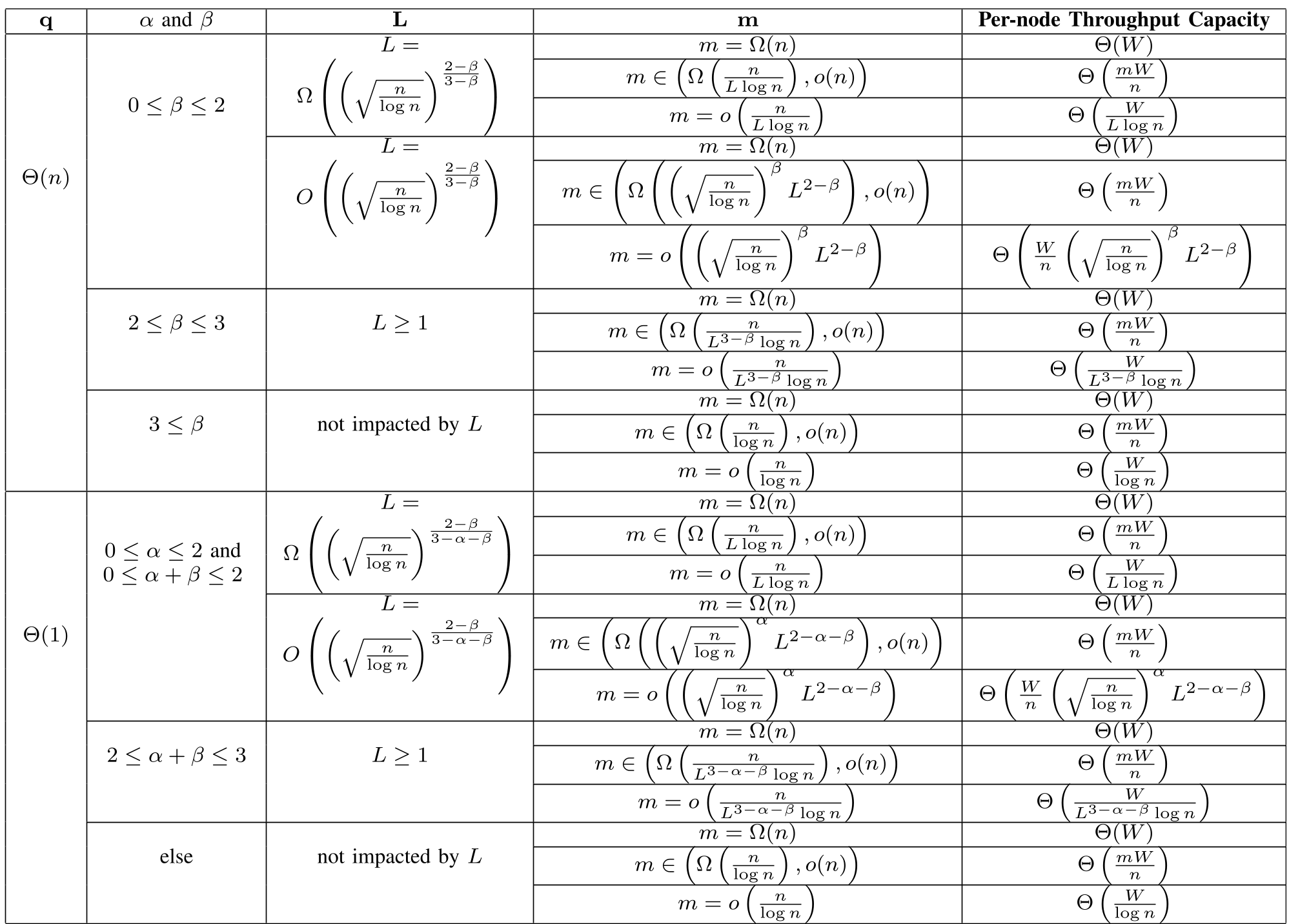 Table: Summary of Scaling Laws. Note how capacity becomes independent of the routing parameter when is sufficiently high (>3).
Deep Insight: Is Infrastructure Excessive?
One of the most provocative findings is shown in the visualization of factors and .
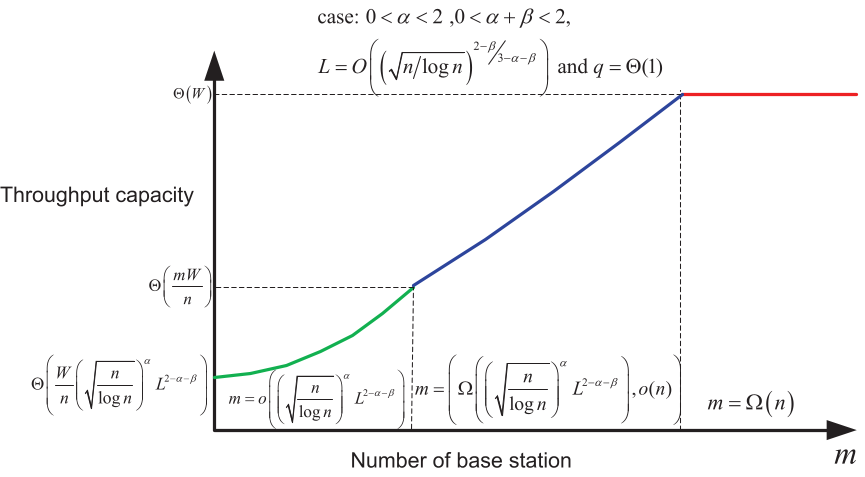 Figure: As social factors and increase (moving towards highly social/localized behavior), the throughput capacity increases and the dependence on the cellular layer actually decreases.
Why? Because if everyone is only talking to their immediate neighbors, the Ad Hoc layer is theoretically "perfect." You don't need expensive Base Stations if your data only needs to travel 1 or 2 hops to reach its target.
Conclusion & Critical Analysis
This work elegantly bridges the gap between Social Science (Small-World Phenomenon) and information Theory (Scaling Laws). By proving that the "intimating degree" () dominates throughput more than group size (), it gives network architects a new variable to optimize for.
Limitations: The model assumes static nodes. In the real world, nodes move (mobility) and groups evolve over time. While this paper sets a rigorous baseline for static social capacity, the "Dynamic Social Graph" remains the next frontier for HWN research.