
The Topology of Doubt: How Social Networks Shape Uncertain Opinions
Impact of Social Network Structures on Uncertain Opinion Formation
The paper introduces the Social Network Uncertain Bounded Confidence (SNUBC) model to investigate how social network structures influence the formation of uncertain opinions represented as numerical intervals. Using ER random graphs, the study demonstrates that network scale and connectivity significantly dictate the speed of convergence and the final distribution of opinion clusters.
TL;DR
In the digital age, we rarely share "exact" views; instead, we offer ranges of belief. This paper introduces the SNUBC model, revealing that the structure of our social networks—how many of us there are and how closely we are linked—determines whether our collective uncertainty survives or collapses into rigid, exact consensus.
Problem & Motivation: Beyond Rigid Numbers
Classical opinion dynamics models like DeGroot or Hegselmann-Krause (BC) treat opinions as single points (e.g., "0.7"). However, human cognition is naturally fuzzy. We might say, "I think the policy impact is between 0.3 and 0.5."
While modern social media provides the "pipes" for these opinions, previous research failed to bridge the gap between uncertainty (interval opinions) and topology (network structure). The authors identify a critical gap: How does a dense network vs. a sparse one change the way we resolve our doubts?
Methodology: The SNUBC Framework
The authors propose the Social Network Uncertain Bounded Confidence (SNUBC) model. The core innovation lies in the interaction between two types of agents:
- Uncertainty Tolerant (V^U): These agents "speak" in intervals. They accept the uncertainty of others and update their own interval boundaries (Lower and Upper) based on their peers.
- Uncertainty Non-Tolerant (V^W): These agents cannot handle intervals. When they listen to a "fuzzy" peer, they randomly pick an exact point within that peer's range to update their own view.
The Interaction Rule
Opinions evolve only if the Euclidean distance between two agents' intervals is within a specific bounded confidence level (ε). The network itself is modeled as an Erdős–Rényi (ER) random graph, defined by the number of nodes () and the connection probability ().
 Note: The above reflects the mathematical logic where the lower (L) and upper (U) bounds of an opinion are updated weighted by trust (β) and neighboring influence (w).
Experiments & Results: The "Peak" of Stability
The researchers conducted 500 independent simulations across varying scales ( to ) and connectivity probabilities.
1. The Connectivity Threshold
A striking finding is the behavior of Stable Time (T). As the network becomes more connected, the time to reach a steady state first increases and then decreases. It peaks at the connectivity threshold . This is the moment the network shifts from isolated clusters to a "giant component," creating the most complex interaction environment.
2. Opinion Fragmentation
As connectivity () increases:
- Number of Clusters (NC) decreases.
- Extremely Small Clusters (RENC) vanish.
- Uncertainty collapses: Higher connectivity forces more interactions with "non-tolerant" agents, which effectively "squeezes" the interval widths until more agents hold exact opinions.
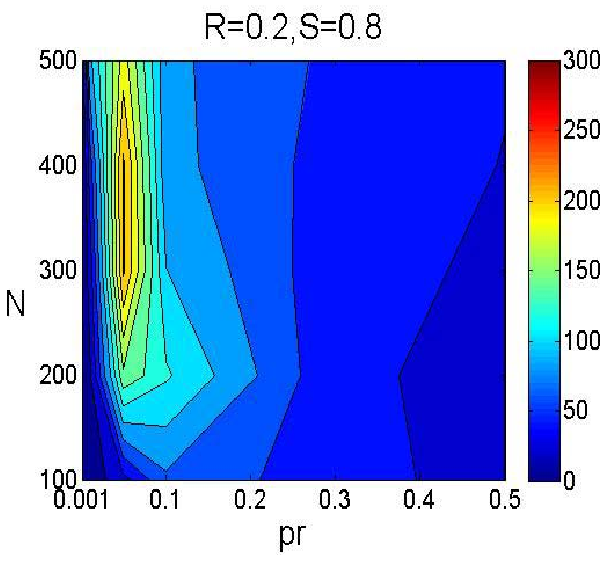 Figure: The impact of connectivity on the number of opinion clusters (NC) shows a clear downward trend as communication becomes more pervasive.
3. The Scale Paradox
The study found that in larger populations (increased N):
- The ratio of people holding uncertain opinions actually decreases.
- However, those who do remain uncertain hold wider ranges of uncertainty.
- Reasoning: In larger networks, the average degree increases, leading to more frequent "precision-forcing" encounters with non-tolerant agents, while isolated groups that do survive tend to preserve high internal fuzziness.
Critical Analysis & Conclusion
Takeaway
The paper effectively demonstrates that connectivity is the enemy of uncertainty. In highly connected societies, the pressure to conform to exact values (often driven by those who don't tolerate nuance) reduces the overall "gray area" in public discourse.
Limitations & Future Work
While the ER random graph is a standard baseline, real-world social networks are rarely random; they are Scale-Free (with massive influencers) or Small-World. The authors acknowledge that future research must test if these outcomes hold when "Power Users" or "Opinion Leaders" dominate the topology. Furthermore, the "honesty" assumption is a limitation—in reality, agents may strategically hide their uncertainty to appear more confident.
This work provides a vital foundation for governments and platform moderators to understand how the "wiring" of a social network can inadvertently silence nuanced, uncertain viewpoints in favor of rigid polarization.