
The Power of Balance: How Friend-Enemy Triads Govern Opinion Spreading
Impact of Structure Balance on Opinion Spreading in Signed Social Networks
This paper introduces a mathematical model to characterize opinion spreading in signed social networks by incorporating the theory of structural balance. It proposes a novel metric called "User Influence" and provides a closed-form theoretical derivation for its estimation in Erdős-Rényi (ER) networks.
TL;DR
In signed social networks—where links can be positive (friends) or negative (enemies)—information doesn't just flow; it reacts to the local social "climate." This paper proposes a mathematical framework that incorporates Structural Balance Theory into opinion diffusion models. By deriving a theoretical measure of User Influence, the authors show how the harmony or tension in social triads determines the ultimate reach of an opinion.
Motivation: Why Signed Networks Matter
Most classical diffusion models (like Independent Cascade) treat social graphs as simple pipelines. However, real-world platforms like Epinions, Slashdot, or Wikipedia are Signed Networks. A user is more likely to accept an opinion if it comes from a "friend of a friend" but may reject it if it involves a "friend of an enemy."
The core structural intuition is:
- Balanced Triads: (Friend of Friend = Friend) or (Enemy of Enemy = Friend). These enhance spreading.
- Unbalanced Triads: (Friend of Enemy = Friend). These depress spreading.
Methodology: Modeling the "Discussion"
The authors move beyond simple node-to-node probabilities. They suggest that when User B tries to influence User C, the success depends on their mutual relationship with a third User D.
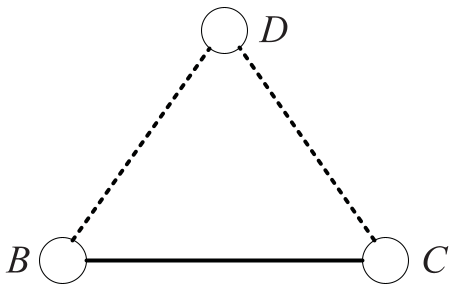
The success probability is a weighted sum of three scenarios:
- Balanced (): High probability of success.
- Neutral (): No mutual acquaintance (null link).
- Unbalanced (): Low probability of success.
The Mathematical Engine: Generating Functions
To solve the "chain reaction" of forwarding, the paper defines User Influence () as the average number of times users are influenced by an original spreader of type . Using Probability Generating Functions (PGF), they derive a recursive relationship:
Through matrix inversion and differentiation, they arrive at a clean, linear result: User Influence is proportional to the user's friend count, scaled by the network's global connectivity and balance factors.
Experimental Verification
The authors validated their theoretical "User Influence" formula against discrete simulations. They tested different social environments by varying (friendship density) and (probability that a missing link is actually an "enemy" link).
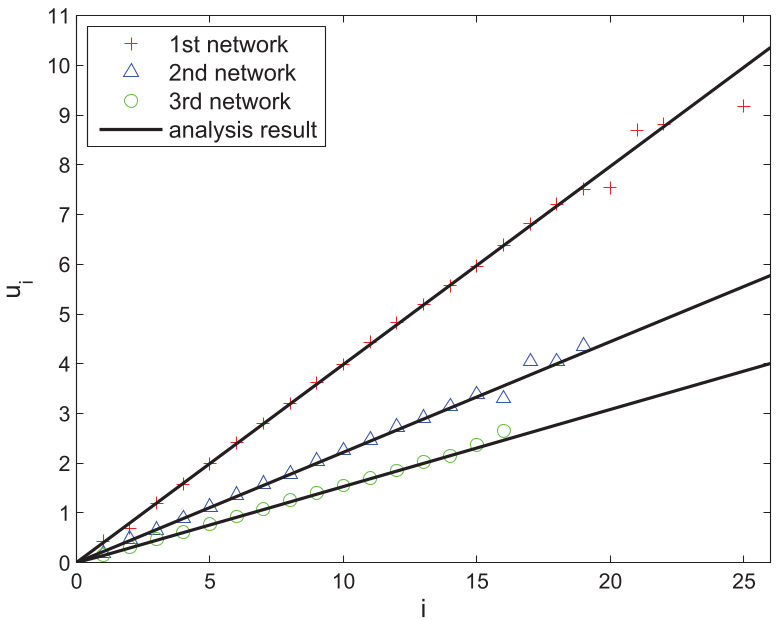
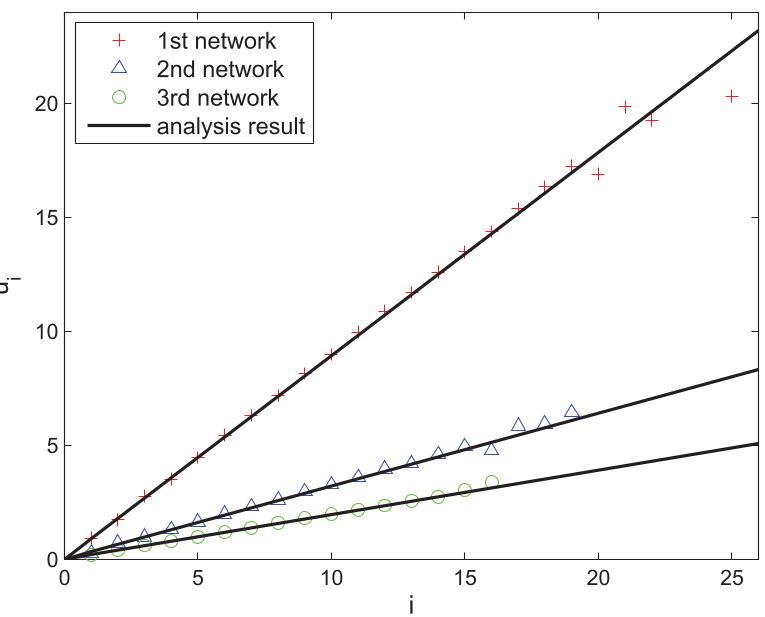
The results (the dots represent simulations and the lines represent the theory) show a near-perfect match, confirming that the PGF approach accurately captures the dynamics of signed spreading.
Critical Insight: The "Enemy" Effect
The most striking takeaway is the impact of (the unbalanced triad probability). Even a small increase in negative relationships can significantly dampen the viral potential of an opinion. This suggests that in highly polarized networks, the "Negative Links" act as structural insulators, preventing opinions from jumping across certain social clusters.
Conclusion & Future Directions
While this work provides a solid theoretical foundation for signed ER networks, it leaves room for exploring Clustering and Assortative Mixing (the tendency of popular people to hang out together). Future research should apply these "Balance" metrics to real-world datasets like political Twitter or product review networks to see how structural tension shapes public discourse.
Key Takeaway: To predict how an opinion spreads, don't just look at who is connected; look at whether their friends agree on who they dislike.