
Private vs. Business SNS: Understanding the Psychology of Data Disclosure
The Impact of User Diversity on the Willingness to Disclose Personal Information in Social Network Services A Comparison of Private and Business Contexts
This paper investigates the willingness of users to disclose personal information in Social Network Services (SNS) by comparing private and business contexts. Using an exploratory questionnaire (N=151), the study explores how user diversity factors—including age, gender, personality traits (FFM), and perceived locus of control (PLoC)—influence self-disclosure behaviors.
TL;DR
Why do we share our hobbies on Facebook but hesitate to list our mobile numbers on a corporate directory? This study dives into the "willingness to disclose" gap between private and professional social networks. It finds that while the context (Business vs. Private) significantly shifts what we share, deep-seated user diversity factors—like gender and personality—play a quiet but powerful role in how we project our digital identities.
The "Why": Motivation and the Professional Gap
Modern enterprises face a double whammy: a shrinking workforce due to demographic change and a shift toward flexible, non-standard employment. To survive, they need robust knowledge management. Social Network Services (SNS) are the dream solution for "expert searches," but they only work if employees fill out their profiles. The authors realized that we cannot simply copy-paste Facebook's design into the office; we need to understand the human behind the profile.
Methodology: The User-Centered Lens
The research team at RWTH Aachen University focused on User Diversity. They didn't just look at what people shared, but who those people were.
- The Framework: User characteristics (Age, Gender, FFM Personality, PLoC) served as independent variables.
- The Data Points: 15 items ranging from basic names to sensitive political and religious affiliations.
- The Contexts: Participants evaluated the same data points for both a private SNS and a business-oriented community.
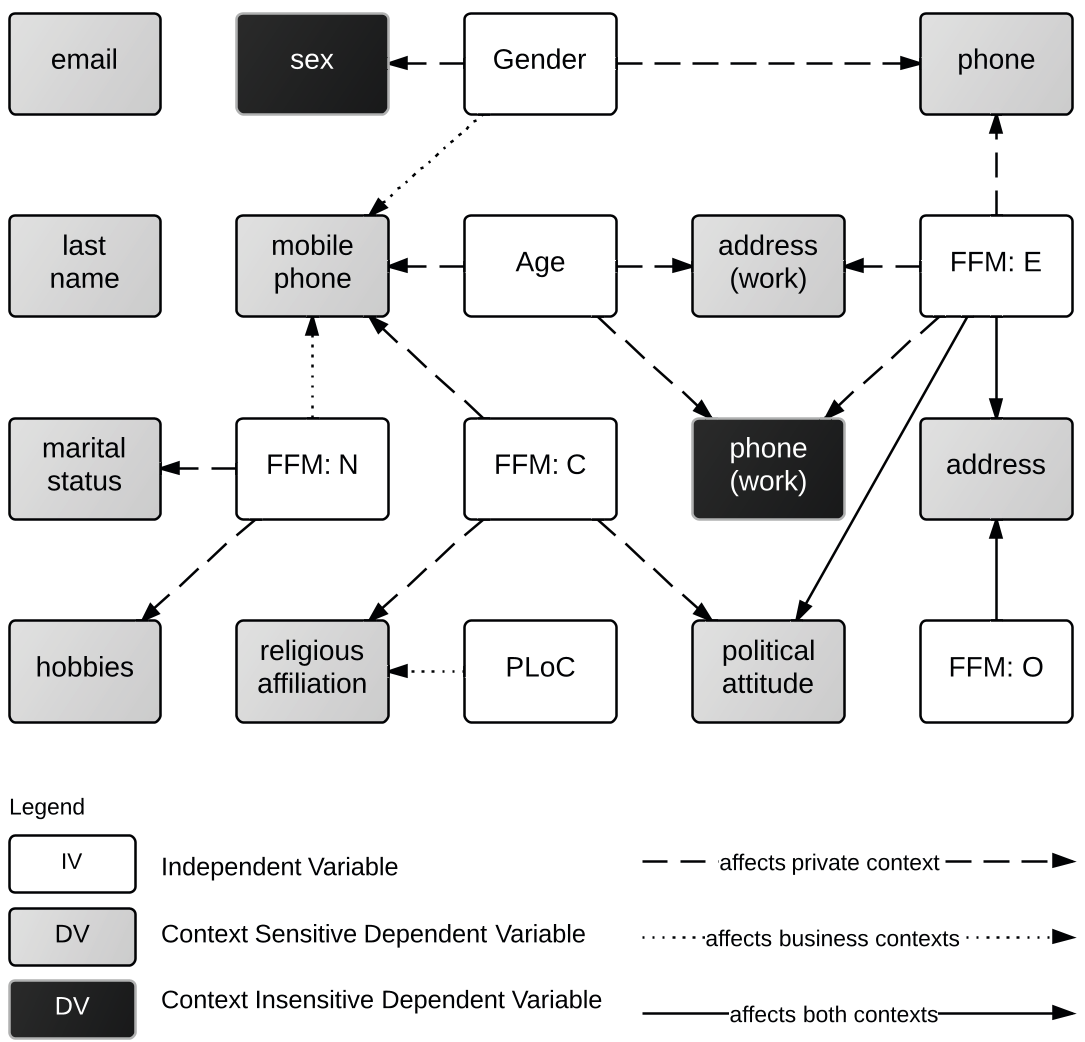 Figure: The visual overview of how user diversity traits (IV) influence the willingness to disclose (DV).
Key Insights: Professionalism Trumps Privacy?
The results confirm a massive shift in disclosure behavior once an "office" label is applied:
- Work-Related Data Floods In: Data like "work address" and "work phone" saw a near 70% increase in disclosure willingness in business contexts.
- Hobbies Take a Backseat: Interestingly, people are less likely to share hobbies in a business setting (33%) than in private (76%), likely to maintain a professional "image."
- The Gender Safety Gap: Women are significantly more cautious with phone numbers and gender disclosure. The study suggests this isn't just about privacy, but a defensive move against potential harassment or unwanted advances.
- The Personality Factor:
- Openness correlates with sharing physical addresses.
- Neuroticism surprisingly leads to higher disclosure of hobbies and family status in private contexts, perhaps as a way to seek social validation or connection.
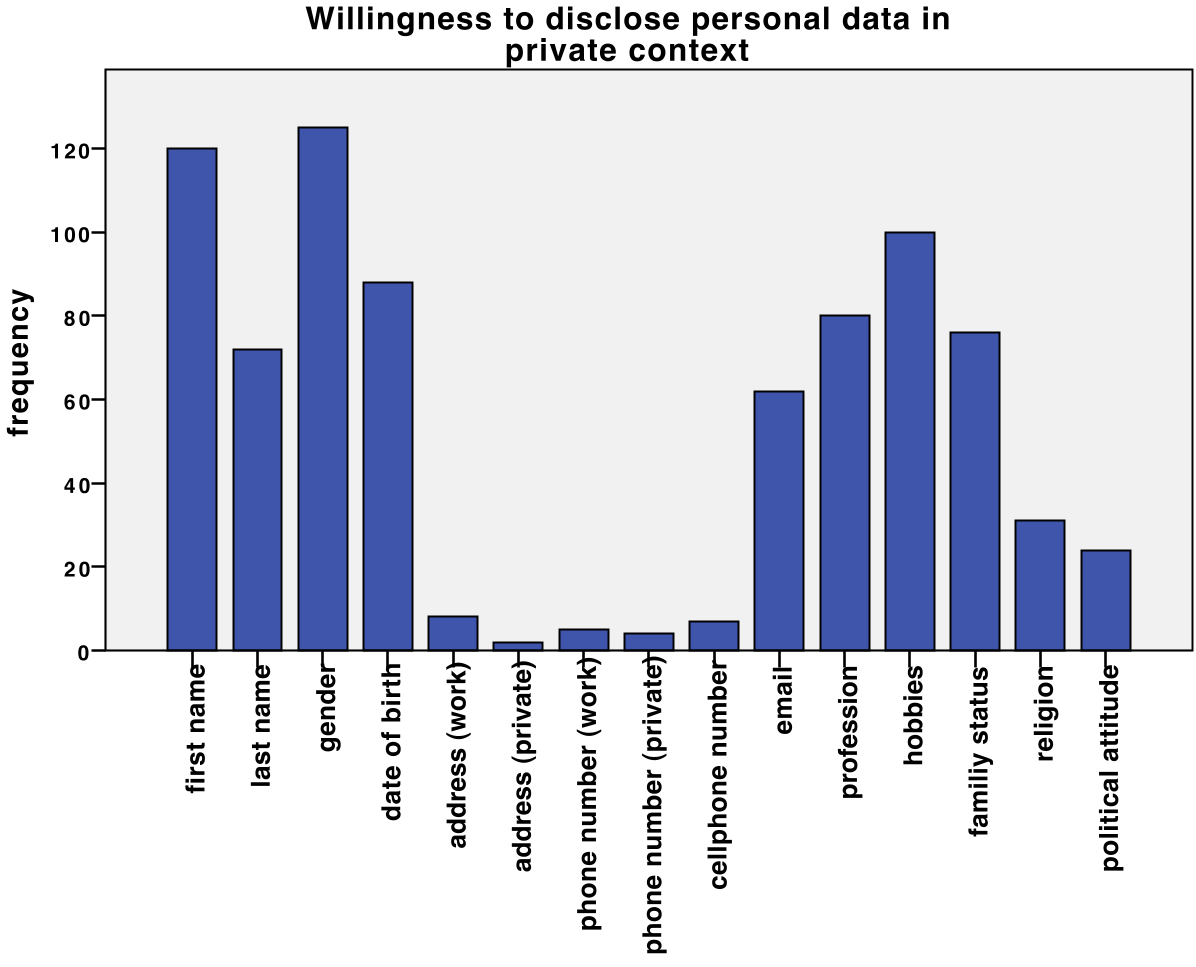 Figure: Willingness to disclose personal information in the private context.
Why Incentives Fail
One of the most striking findings was the failure of "carrots." The researchers tested several moderating factors to see if they could "buy" disclosure:
- Money: Largely rejected as an incentive.
- Positive Media: Had little to no impact.
- The Winner – Information: The only factor that consistently improved willingness to share was providing more information about how the data would be handled.
Analytical Perspective: Implications for Product Design
This paper highlights a critical "State of Control." Users who feel they have a high Perceived Locus of Control over technology (PLoC) are not necessarily more willing to share everything—they are simply more calculated in their sharing.
For developers building the next "LinkedIn for Internal Enterprise," the takeaways are clear:
- Transparency is the only incentive: Tell users exactly who sees their data and why.
- Gender-Sensitive Privacy: Allow for granular control over contact info (e.g., "Show mobile to direct team only").
- Contextual Defaults: Set default profile visibility based on the professional utility of the data point, not a one-size-fits-all "public/private" toggle.
Conclusion
Data disclosure is the lifeblood of social systems. By moving beyond "privacy" as a monolithic concept and viewing it through the lens of User Diversity, this study proves that our digital "selves" are highly adaptive. The successful business SNS of the future won't be the one with the best "features," but the one that best respects the complex, persona-driven boundaries of its users.