
The Social Heartbeat: How Dunbar Circles Dictate Our Online Presence
The impact of user’s availability on On-line Ego Networks: a Facebook analysis
This paper investigates the relationship between the structural organization of Online Social Networks (OSNs) and user availability patterns, focusing on Facebook through the lens of the Ego Network model. By utilizing a custom application to monitor 337 ego networks, the researchers validate the existence of hierarchical Dunbar’s circles and identify a significant "temporal homophily" where availability patterns are more synchronized within inner social circles.
TL;DR
The way we connect to Facebook isn't random; it’s a reflection of our most intimate social circles. This study analyzes 337 Facebook "Ego Networks" to reveal that people are significantly more likely to be online simultaneously with their closest friends (inner Dunbar circles). This phenomenon, termed temporal homophily, provides a blueprint for building more efficient decentralized social networks.
Contextualizing the Digital Ego
In the landscape of Online Social Networks (OSNs), we often focus on the "Global Graph." However, this paper zooms in on the Ego Network—the structure centered around a single individual. The researchers explore a critical intersection: social intimacy and temporal behavior. Why does this matter? If we move toward decentralized platforms (like P2P social networks), knowing when your friends are online determines where your data should be stored to ensure it stays accessible.
Motivation: The Missing Link in DOSNs
Current Distributed Online Social Networks (DOSNs) struggle with "churn"—users logging in and out. Traditional methods often treat all friends as equal when replicating data. The authors argue that this is inefficient. By identifying who you are most likely to be online with, systems can optimize data persistence. The core insight is that Tie Strength (how close you are) should predict Availability Correlation (when you are both online).
Methodology: Mapping the Dunbar Hierarchy
The authors didn't just crawl public data; they built a custom Facebook app, SocialCircles!, to monitor chat statuses every 8 minutes.
1. Structural Decomposition
Using K-Means clustering on interaction data (likes, comments, tags), they validated the Dunbar’s Circle hypothesis. They found that most users maintain a hierarchical structure of roughly 5, 15, 50, and 150 friends, representing increasing levels of intimacy.
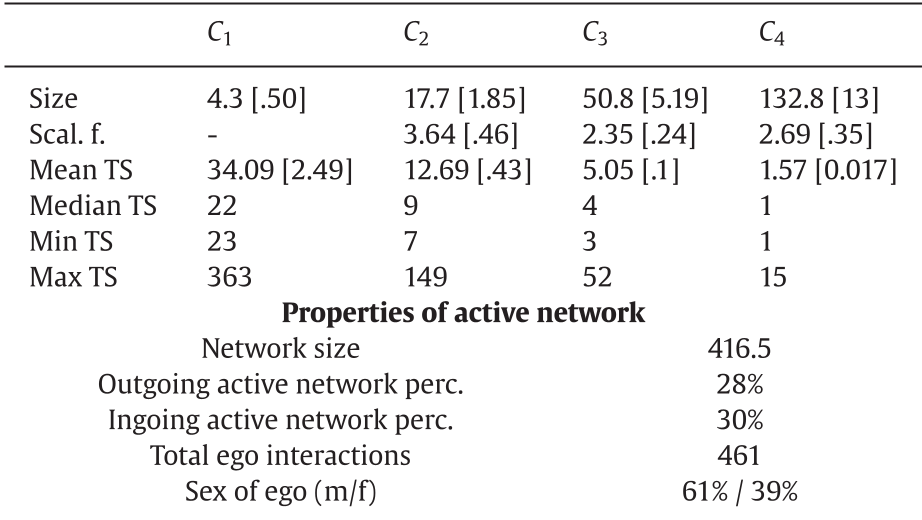 Table 1: Characteristics of the decoded Dunbar Circles (C1 to C4).
2. Measuring Temporal Homophily
To quantify the "social heartbeat," they used Cosine Similarity on binary availability vectors (1 for online, 0 for offline). This allowed them to see if the "on-off" patterns of an ego matched their friends over a 10-day period.
Key Insights and Results
The Proximity Effect
The results are striking: the closer the friend, the more likely you are to share an "online" state. The average similarity in the innermost circle (C1) was 0.23, dropping steadily to 0.15 in the outermost circle (C4), and hitting a low of 0.10 for random users.
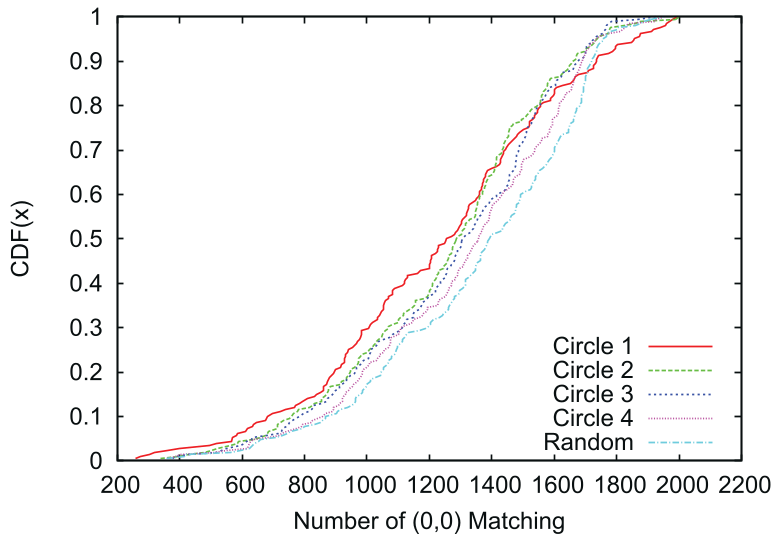 Figure 1: Average cosine similarity showing higher temporal correlation in inner circles.
The "Threshold of 10"
One of the most actionable findings is the conditional probability of being online. The data shows that an ego's probability of being online spikes when at least 10 alters from their active network are connected. This suggests a "social tipping point" for session initiation.
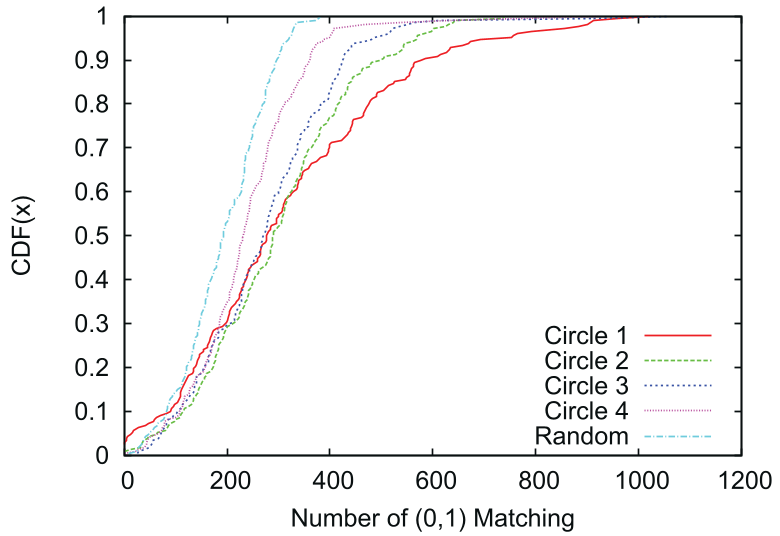 Figure 2: Distribution of matching states (0,0, 1,1, etc.) and conditional online probability.
Critical Analysis & Future Outlook
While the study is robust, it is anchored in a 2014-2015 Facebook ecosystem. Today’s "Always-On" mobile culture, where "Online" status is often persistent due to background app refreshing, might blur these patterns. However, the underlying sociological principle—that we coordinate our lives with our support cliques—remains a powerful inductive bias for technical systems.
Takeaway for Engineers: If you are building a distributed system, don't just replicate data across a random subset of nodes. Use the Ego Network structure. By placing replicas on C1 and C2 alters, you maximize the chance that the data owner and the data host are online at the same time, reducing latency and reliance on stable infrastructure.
Limitations
- Privacy Restrictions: The authors noted difficulty in accessing private message data, which may be an even stronger indicator of Tie Strength.
- Geographic Bias: Most users were from Italy/Europe, meaning the day/night patterns are specific to one time zone.
Future Work
The next frontier is applying these findings to Information Diffusion (predicting how news spreads based on when social circles wake up) and refining User Churn Models to include social dependencies rather than treating each user as an independent Markov chain.