Dynamics of Persuasion: How Temporal Signal Patterns Reshape Social Influence
Impact of Social Influence on Adoption Behavior: An Online Controlled Experimental Evaluation.
This paper presents an online controlled experiment investigating how temporal patterns of social signals (exposure) influence adoption behavior in social networks. Using a bank security officer simulation on Amazon Mechanical Turk, the study evaluates various influence strategies (Uniform, Linear, Delayed, and Early Cascades) and their ability to sway participants toward suboptimal decisions.
TL;DR
Can social pressure make you choose a worse product even when you know it's suboptimal and costs you money? This study proves the answer is "yes," but with a catch: how those social signals are timed is more important than how many people are doing it. Researchers found that early exposure and sudden "impulses" of social consensus are far more effective at changing behavior than a steady, linear increase in pressure.
Background: The Cost of Conformity
In the digital age, we rely on social signals (likes, peer reviews, "trending" tags) to navigate complex choices. Traditional academic views suggest that we adopt behaviors once a "threshold" of peers is reached. However, this study bridges a critical gap: it places social influence in a high-stakes environment where users have monetary incentives and prior knowledge of what is actually better (utility).
The Experiment: Cyber-Defense and Bot Neighbors
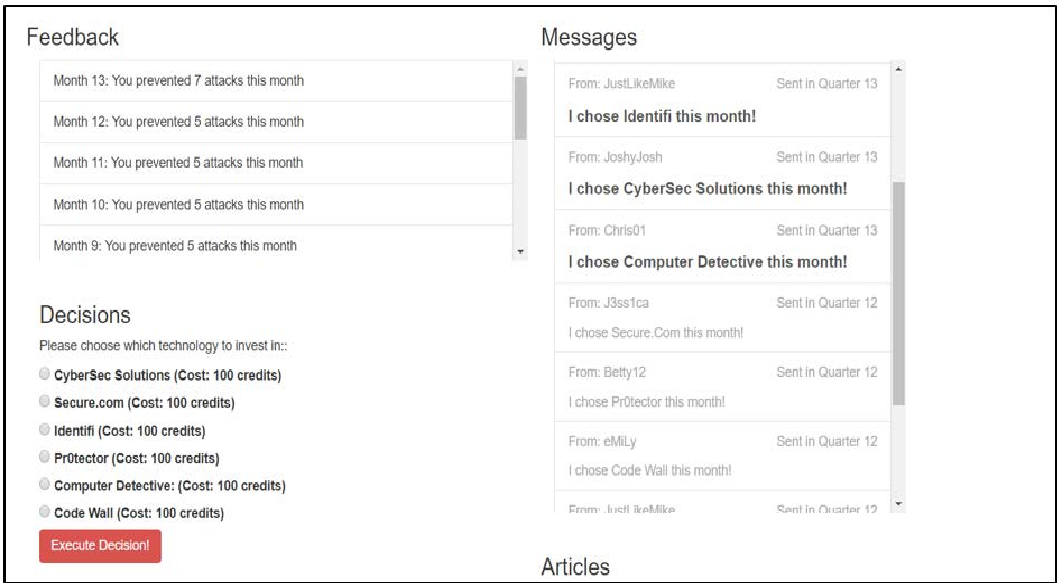
Researchers recruited 357 participants for a controlled game. Players acted as bank security officers choosing between six cyber-defense providers.
- The Catch: Only one provider was "optimal" (preventing 7 attacks), while others prevented 6.
- The Carrot: Each prevented attack earned the player real money.
- The Twist: In later rounds, players saw what their "neighbors" (actually programmed bots) chose.
Influence Patterns Tested:
- Uniform (UM): 1 peer signal consistently.
- Linear Cascade (LC): Signals increase 1, 2, 3... 6.
- Delayed Cascade (DC): Steady at 1, then a sudden surge to 4, 5, 6.
- Early Cascade (EC): A massive burst (4, 5, 6) right at the start of the influence phase.
Methodology: Decoupling Network from Pattern
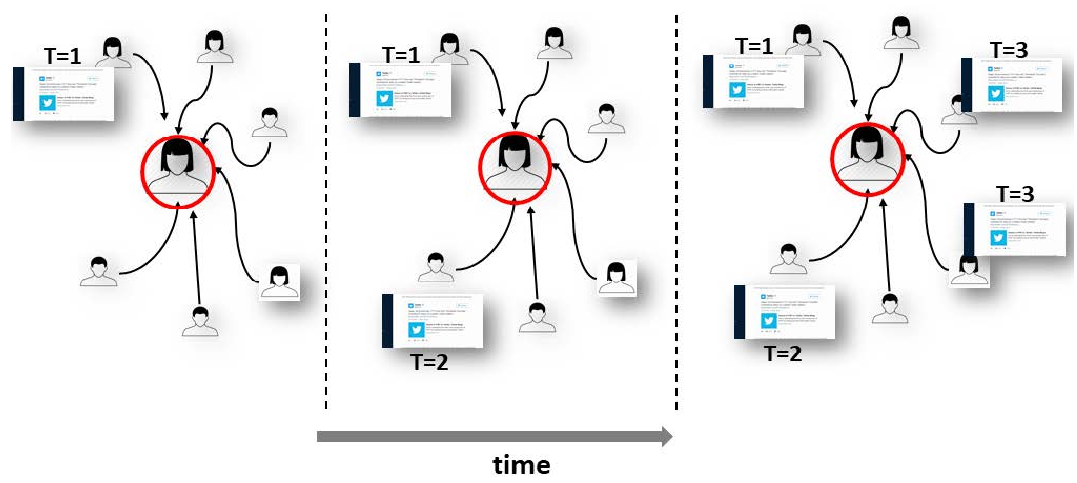
Most studies conflate "who you know" with "when you hear it." By using the CLOSE platform and bots, the authors held the network structure constant. This allowed them to treat "social influence" as a controlled variable—a temporal pattern of signals .
Key Insights: Why Timing Beats Quantity
1. The Early Bird Catches the... Conformist?
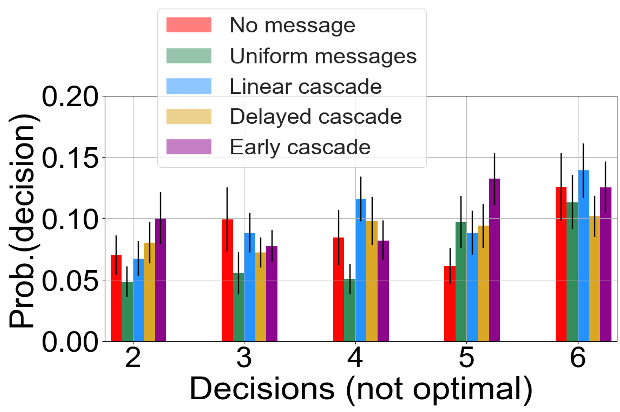
The Early Cascade (EC) group showed the highest aggregated adoption of the suboptimal choice. When people are hit with a high volume of social consensus early on, they are more likely to abandon their own reward-seeking logic in favor of following the crowd.
2. The Power of the "Impulse"
The most striking finding came from the Delayed Cascade (DC). When signals jumped from 1 to 4 suddenly, adoption rates skyrocketed by 65%.
- The Intuition: A sudden change in social consensus acts as an "alarm" or "stimulus" that forces individuals to re-evaluate their current strategy, often leading them to suspect that the "crowd" knows something they don't.
3. Linear Growth is Surprisingly Weak
Interestingly, a steady, predictable increase in social pressure (Linear Cascade) was less effective than the sudden bursts. It seems humans "habituate" to slow changes, whereas sudden social shifts trigger a stronger psychological response.
Critical Analysis & Conclusion
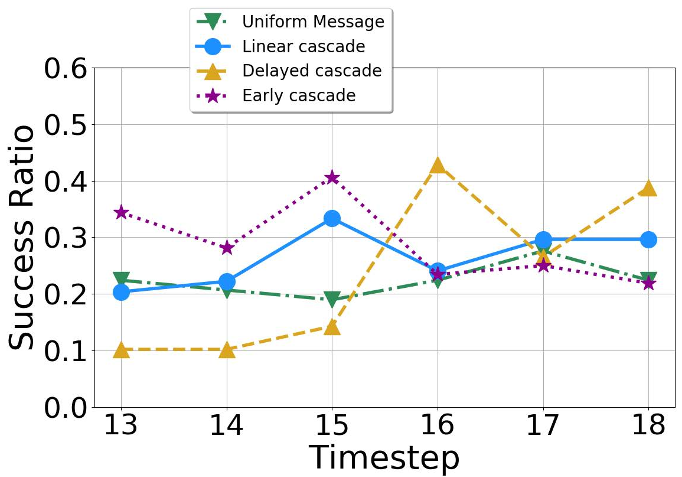
The study concludes that social influence is not just a numbers game. The "Success Ratio" (shown in Figure 9 below) highlights that participants in the Delayed Cascade (DC) eventually became more susceptible to being swayed than even the Early Cascade group by the final round.
Takeaway for Industry: Whether it's marketing a new app or implementing a security policy, the timing of the rollout matters. A slow, steady drip of influence might be ignored, but an early push or a strategically timed "burst" of social proof can override individual rational choice—even when there is a literal price to pay for being wrong.
Limitations: The study used bots to avoid network confounding, but in the real world, "who" influences you matters as much as "when." Future research should integrate these temporal patterns with high-influence "nodes" (influencers) to see if the effects compound.