
Scaling Laws of Social Hybrid Networks: How Human Behavior Rescues Wireless Capacity
Impact of Social Interaction on the Capacity of Hybrid Wireless Networks
This paper investigates the throughput capacity of Hybrid Wireless Networks (HWNs) by integrating a realistic social interaction model characterized by a double power-law distribution. Using the Max-L-hops routing policy, the authors derive scaling laws for network capacity considering social factors α (group membership) and β (destination selection).
TL;DR
In the classic theory of wireless ad hoc networks, per-node throughput vanishes as the number of nodes grows. This paper proves that social interaction breaks this curse. By modeling social groups and destination selection using a double power-law distribution, the authors show that hybrid networks (Ad Hoc + Infrastructure) can achieve significantly higher capacity, making the network "scalable" when social ties are strong.
The "Vanishing Capacity" Problem
Ever since Gupta and Kumar's seminal work in 2000, the wireless research community has struggled with a pessimistic reality: in a pure ad hoc network, the per-node throughput scales as . As you add more users, the relaying burden and interference increase so rapidly that individual bandwidth drops to nearly zero.
Hybrid Wireless Networks (HWN) were introduced to mitigate this by adding Base Stations (BS). However, most HWN models assume people talk to strangers at random (uniform distribution), which isn't how humans behave. We talk to our friends, and our friends are often (socially or physically) close to us.
Methodology: The Double Power-Law Insight
The core contribution of this paper is a more sophisticated mathematical model for social interaction. Unlike previous works that assumed uniform selection within a group, this paper introduces two layers of distance-based probability:
- Group Membership (): The probability that a node belongs to your social group decreases with distance .
- Destination Selection (): Within that group, the probability you choose a specific node as your destination also decreases with distance .
Architecture & Routing
The authors employ a Max-L-hops routing policy. If a destination is within hops, the network uses the ad hoc layer; otherwise, it offloads to the cellular layer (Base Stations).
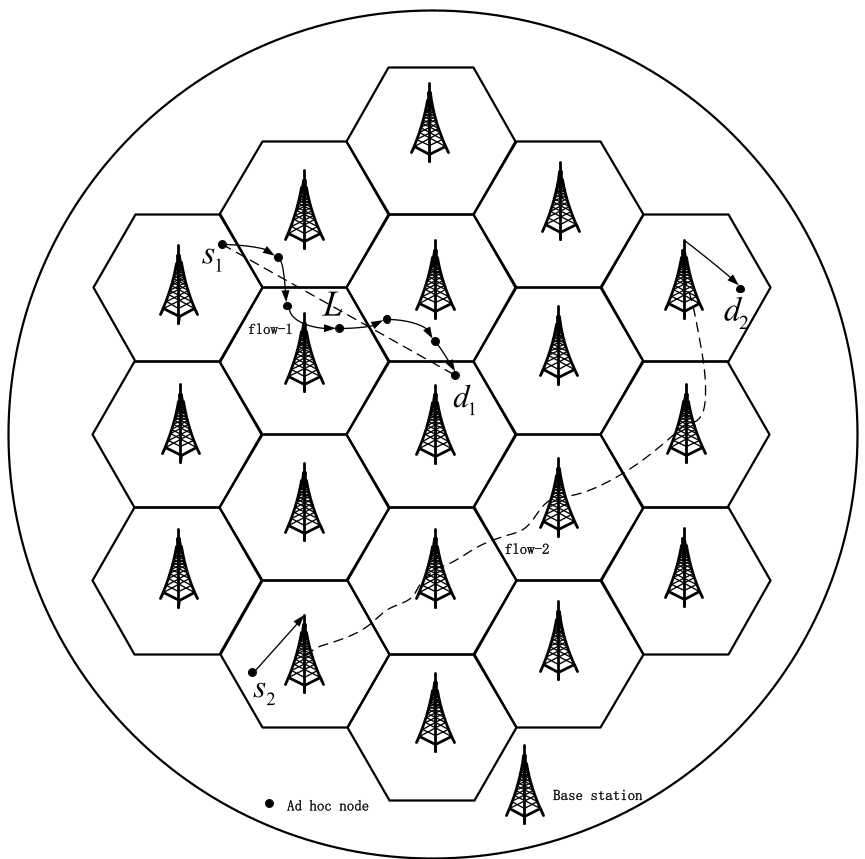 Figure 1: The network is tessellated into squares for interference management. Gray levels represent the decreasing probability of social contact as distance increases.
Key Findings: Social Interaction as an Optimizer
The analytical results, derived using Elementary Symmetric Polynomials, reveal a fascinating transition in network behavior based on the social factors and .
1. The Power of Intimacy ()
When the destination selection factor increases, users communicate more frequently with "local" social contacts. This reduces the average hop count , which in turn reduces the total interference in the network.
- Result: If , the throughput becomes independent of . The network naturally becomes efficient because traffic rarely needs to travel far.
2. Scalability and Base Stations
The paper proves that with enough base stations , the network can achieve a constant per-node throughput . Even with fewer base stations, social interaction allows the ad hoc layer to "carry its weight" much better than in non-social models.
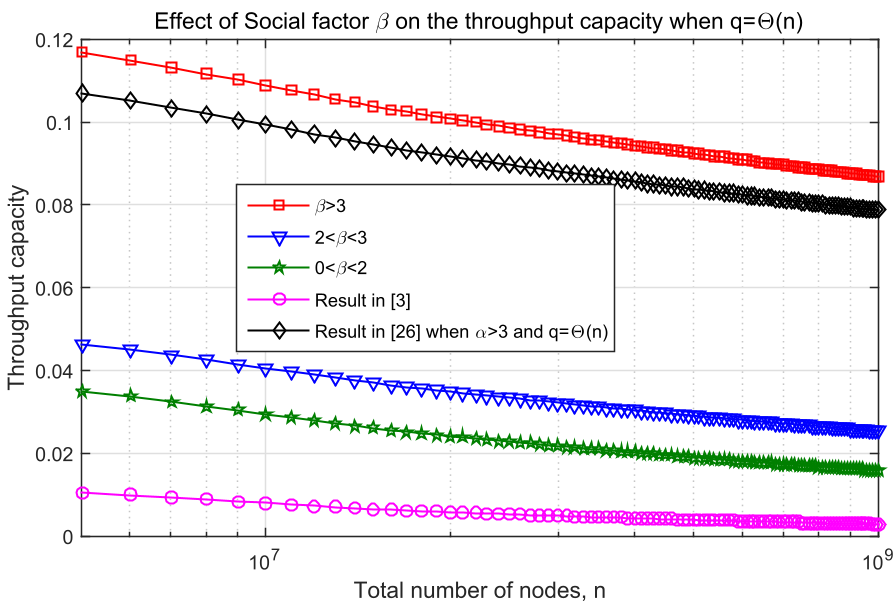 Figure 2: The effect of the social factor . As increases (more localized traffic), the throughput capacity rises dramatically compared to uniform models ().
Experimental Validation
Through numerical simulations, the authors compare their model against previous SOTA (e.g., Li et al. and Hou et al.).
- Finding: In the case (small, tight-knit social groups), the factor plays a significant role. As nodes become more selective in constructing their groups, the dependency on the cellular layer actually decreases because the ad hoc routing becomes highly efficient.
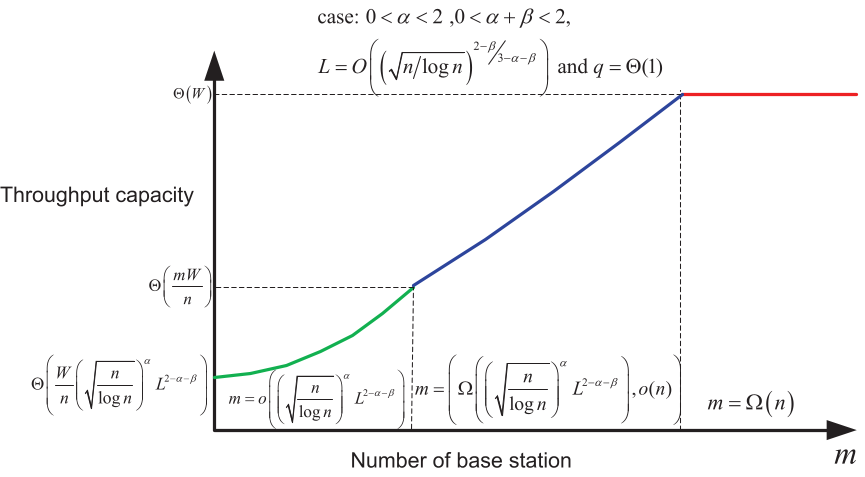 Figure 3: Throughput scaling for small social groups. High values of and lead to nearly optimal scaling.
Critical Insight & Conclusion
The "death" of capacity in wireless networks was perhaps an artifact of assuming "socially chaotic" movement. This paper suggests that the non-uniformity of human behavior is actually a feature, not a bug. By aligning network routing (the Max-L-hops policy) with social clusters, we can build hybrid networks that are far more scalable than previously thought.
Future Directions: The authors note that the mobility and evolution of social groups (groups changing over time) are the next frontiers. If social groups move together, the capacity might increase even further through "mobility-assisted" relaying.
Author Perspective: This work provides a rigorous mathematical bridge between sociology and information theory, proving that the more "cliquish" we are, the better our wireless networks perform.