
Unmasking Digital Shadows: A Deep Neural Approach to Instagram Impersonation
Impersonation on Social Media: A Deep Neural Approach to Identify Ingenuine Content
The paper introduces a deep neural approach to identify impersonation on Instagram by analyzing 2.2K accounts across politician, sports star, and musician communities. It proposes a hybrid Deep Neural Network (DNN) that integrates BERT, CNN, and LSTM layers to classify content as bot-generated, fan-generated, or genuine, achieving an accuracy of 86%.
TL;DR
Social media impersonation is no longer just about fake names; it is a sophisticated operation involving automated bots and organized fan pages. Researchers have developed a deep learning framework that integrates BERT, CNN, and LSTM to classify Instagram posts with 86% accuracy, successfully distinguishing between genuine creators, automated bots, and semi-human fan accounts.
Context & Motivation: The Identity Crisis on Instagram
Identified as a critical threat to digital trust, impersonators mimic high-profile accounts (politicians, athletes, and celebrities) to defraud users or manipulate public opinion. The challenge is twofold:
- Scale: The sheer volume of content makes human moderation impossible.
- Complexity: There is a spectrum of "fakeness." A "Fan" account might be well-intentioned but spread rumors, while a "Bot" is a programmed entity designed for mass engagement.
The authors argue that looking at a post in isolation is insufficient. They posit that identity is behavioral; therefore, detection must combine what is being said (text) with who is saying it (profile metadata).
Methodology: The Architecture of Detection
The study follows a rigorous pipeline: identification, categorization via clustering, and finally, deep learning classification.
1. Defining the Taxonomy
By analyzing 2.2K accounts, the researchers uncovered two distinct impersonator archetypes:
- Bot Impersonators: High post frequency, low follower counts, and low profile similarity. They act as "engagement machines."
- Fan Impersonators: High profile similarity (using real photos and bios), higher engagement, and often human-operated with some automation.
2. The DNN Architecture
The proposed model is a sophisticated multi-pathway network. It handles raw text through a BERT layer for semantic understanding, followed by a 1D-CNN to capture local patterns. Simultaneously, numerical features (like follower/followee ratios and engagement rates) are processed through Dense and LSTM layers.
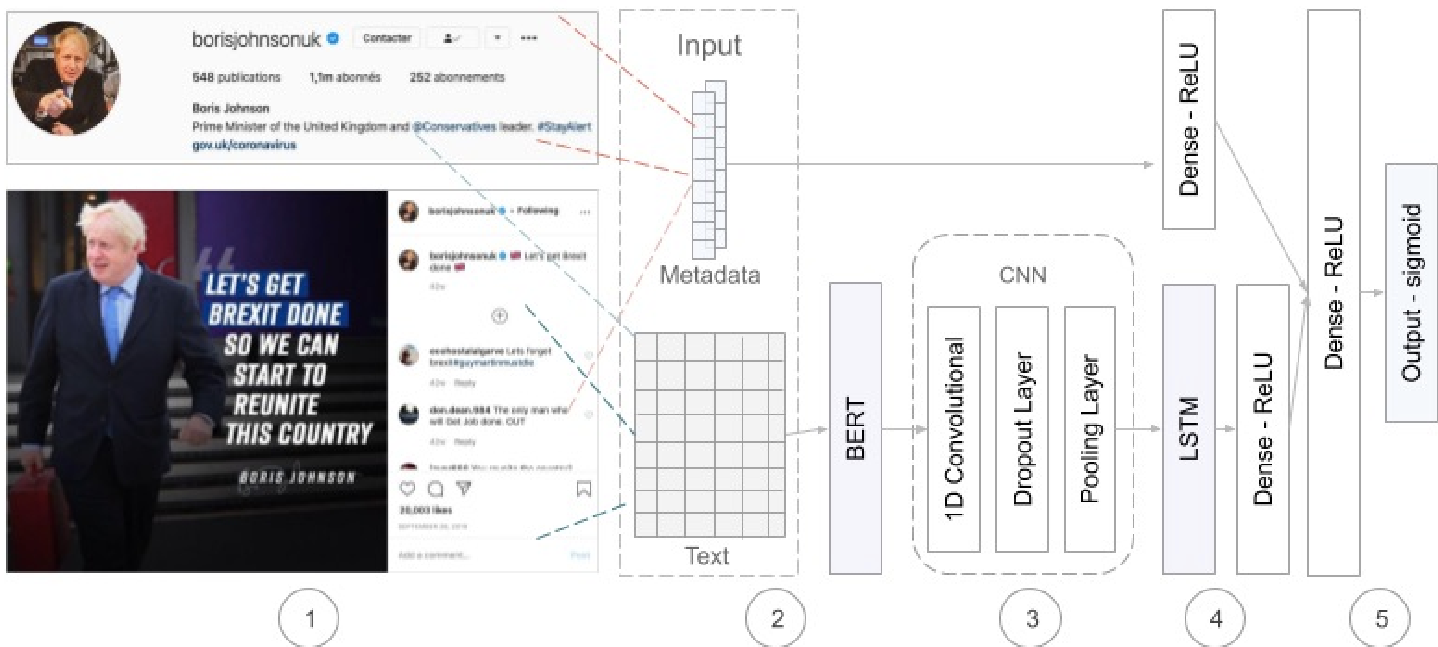 Fig 1: The proposed Deep Neural Network architecture combining text embeddings and profile metadata.
Experimental Insights: Why Data Fusion Matters
The researchers conducted an ablation-style comparison to see which components added the most value. The results were clear:
- Traditional ML (Random Forest): 76% Accuracy.
- DNN (Post Content Only): 78% Accuracy.
- DNN (Post + Profile Metadata): 83% Accuracy.
- DNN (Post + Profile + BERT): 86% Accuracy.
The 10% jump from baseline to the full model proves that Metadata is the "Smoking Gun." While bots can mimic the language of a celebrity, they struggle to mimic the organic growth and engagement patterns of a genuine account.
 Fig 2: Performance comparison across different model configurations.
Critical Insight: The "Fan" Problem
One of the most interesting findings is the existence of the "Fan" cluster. These accounts often have high similarity scores (up to 71% in profile photos). This makes them a "Trojan Horse" for misinformation—users trust them because they look like official repositories for celebrity news, even though they are unregulated.
Conclusion & Future Outlook
This work represents a shift from simple "Bot vs. Human" binary classification to a more nuanced three-way classification (Bot vs. Fan vs. Genuine).
Limitations: The study relies on publicly available API data; as platforms like Instagram restrict API access, researchers will need to pivot toward more robust scrapers or internal platform data.
Future Work: Integrating Image/Video analysis (beyond OCR) into the DNN could likely push accuracy beyond 90%, as impersonators often rely on deepfakes or manipulated media that text-based models might miss.