
The Anatomy of Influence: How Instagram Impersonators Fabricate Engagement
How impersonators exploit Instagram to generate fake engagement?
This study provides a comprehensive analysis of impersonator behavior on Instagram across three distinct communities: Politics, News, and Sports. Using a dataset of 3.8K unique impersonators, the authors categorize these entities into Fan-Pages, Ordinary-Users, and Bot-Like clusters to quantify their "Active" (comments) and "Passive" (likes) engagement patterns.
TL;DR
Impersonation on Instagram is no longer just about identity theft; it's about shifting the digital spotlight. This research reveals how thousands of fake profiles—ranging from automated bots to human-managed fan pages—systematically use comments and likes to manipulate public perception across Politics, News, and Sports. By analyzing 3.8K accounts over 7 months, the authors show that these "actors" use highly positive sentiments and automated timing to hijack the engagement of verified celebrities.
The Hidden Economy of Fake Engagement
In the current social media ecosystem, a "Verified" badge is a symbol of trust. However, this trust is being weaponized. Impersonators create high-fidelity clones of famous profiles not just to scam, but to perform "Engagement Farming." The goal is to make certain posts appear more popular than they are, or to siphon followers from legitimate stars to malicious domains.
The authors identify a critical gap: while we know bots exist, we don't fully understand the tactics they use to engage with verified content. Are they just "liking" posts? Or are they actively shaping the conversation?
Methodology: Categorizing the Deceivers
The research team tracked 12 major figures, including Donald Trump, Cristiano Ronaldo, and the BBC. They filtered interactions to find "Impersonators" (accounts mimicking the verified user) and used a multi-stage clustering approach to define three archetypes:
- C0: Fan Pages: Human-managed, high-effort profiles that often provide legitimate but unauthorized support.
- C1: Ordinary Users: Low-activity fake profiles that look like "normal" followers.
- C2: Bot-Like: Highly automated accounts used for mass-distribution of spam and engagement inflation.
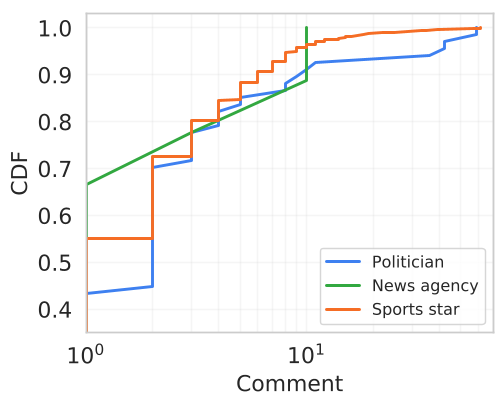
Deep Dive: Active vs. Passive Tactics
The study makes a sharp distinction between Active Engagement (Comments) and Passive Engagement (Likes).
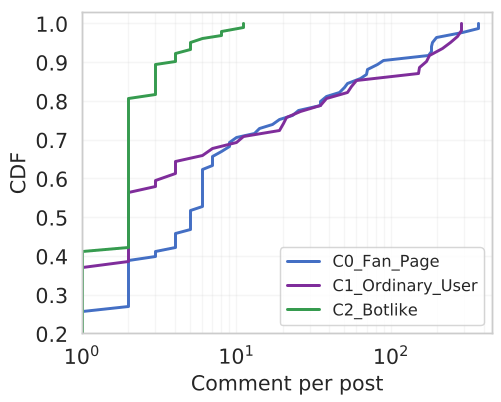
1. The Bot Strategy
Counter-intuitively, bots (C2) don't just spray likes everywhere. They are surgical. The data shows that while human-led fan pages interact with a broad range of posts, bots target specific, high-traffic posts to drop comments. They favor "Active Engagement" because text allows them to embed calls-to-action like "Follow my story" or "Check my profile."
2. Temporal Footprints
Timing is the "smoking gun" of automation. The study found that "Ordinary User" impersonators comment almost immediately after a celebrity posts, likely to stay at the top of the comment section. In contrast, "Bot-like" clusters exhibit a "fixed-hour" window behavior (typically between 1 to 10 hours post-publication), suggesting scheduled batch operations.
Semantic Analysis: What are they saying?
Using NLP, the researchers found that the content of these fake engagements is overwhelmingly positive. In the Sports community, keywords like "King," "Legend," and "Heart" dominate. In Politics, it's "Great," "Love," and "Thanks."
This "Positive Bias" is a strategic choice. Negative comments are more likely to be reported and banned. By staying positive and supportive, impersonators fly under the radar of Instagram's moderation algorithms while still achieving their goal of "Follower Farming."
Conclusion and Future Outlook
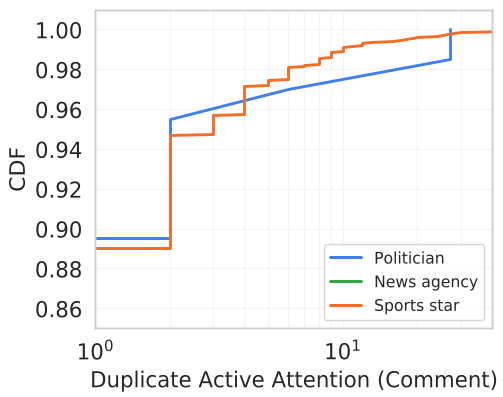
This paper serves as a wake-up call for platform integrity teams. The finding that 95% of duplicated comments share the same "publishing age" provides a clear heuristic for automated detection.
However, the challenge is evolving. As the authors suggest, the next frontier is building deep-learning classifiers that can distinguish between a passionate fan (Fan-Page) and a malicious tool (Bot-Like) in real-time. Until then, the "like" and "comment" counts on your favorite celebrity's post might be nothing more than a carefully orchestrated digital illusion.