
Implementing Federated Social Networking: Insights from the Trenches
Implementing Federated Social Networking: Report from the Trenches
This paper explores the implementation of federated social networking by integrating the Diaspora protocol into the Noosfero platform. It establishes a proof of concept (PoC) for decentralized user discovery and message exchange, demonstrating cross-platform interoperability between independent social network providers.
TL;DR
This research addresses the "walled garden" problem of social media by implementing decentralization. The authors successfully federated the Noosfero platform with the Diaspora network using a "polyglot" approach—integrating specific existing protocols (WebFinger, Salmon, RSA encryption) to allow users on different servers to interact as if they were on a single network.
Context: Centralization vs. Autonomy
Modern social networks act as central mediators. If Facebook or Twitter experiences a breach, millions are compromised. The academic and open-source community's answer is Federation: a system of interconnected, independent servers (like Email) where no single entity owns the entire social graph. However, the path to federation is riddled with "protocol wars," where OStatus, ActivityPub, and the Diaspora protocol compete for dominance.
The "Polyglot" Motivation
Why is federation so hard to implement in existing software? The authors identify that waiting for a "Common Denominator" (a single universal protocol) often fails because different networks have incompatible features (e.g., symmetric "friends" vs. asymmetric "follows").
Instead, they advocate for the Polyglot Strategy: making your application speak the language of the network you want to join. In this case, they taught Noosfero to "speak" Diaspora.
Methodology: The Core Architecture
Interoperability was achieved through two primary pillars:
1. User Discovery (The "Where?")
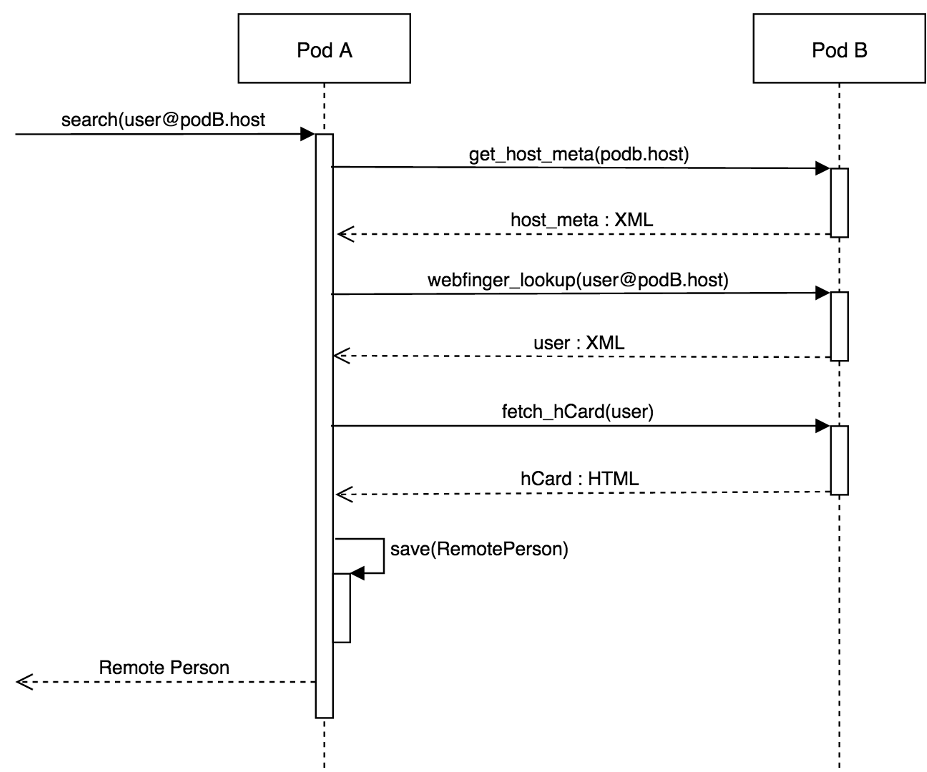
To find a user across servers, the system uses WebFinger. By querying a standard identifer like user@host, the local server retrieves a discovery endpoint, which then provides a hCard (HTML-based profile).
2. Message Exchange (The "What?")
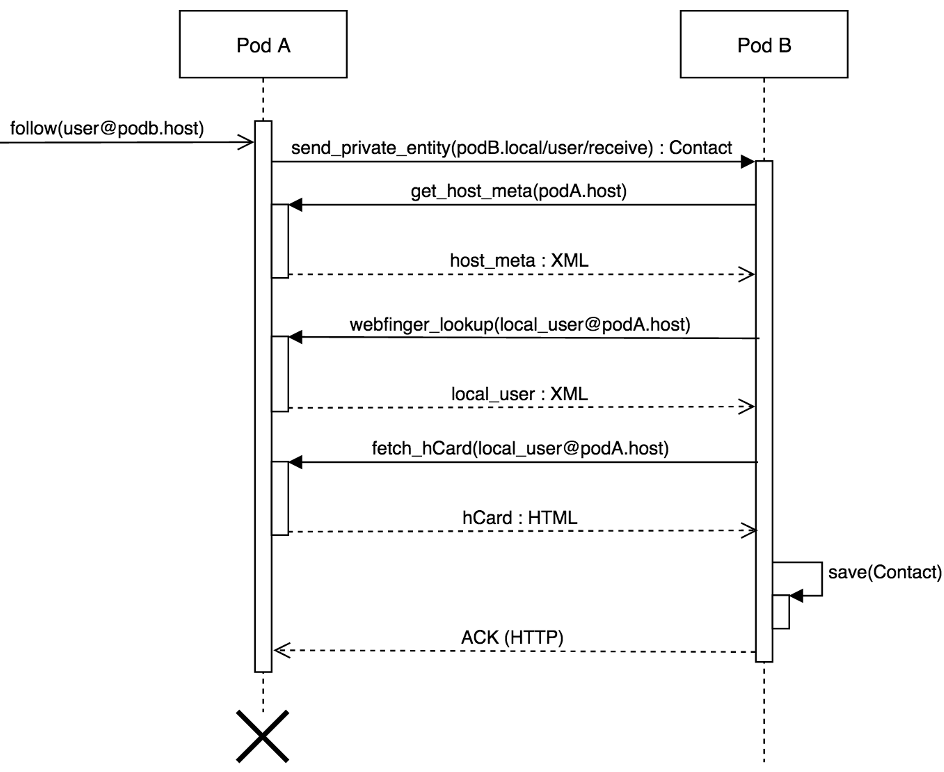
To share a status update or a "follow" request, the paper implements a subset of the Salmon protocol.
- Encryption: Every message is wrapped in a "Salmon envelope," encrypted via RSA to ensure confidentiality.
- Entities: Actions like "Retractions" (deleting a post) must be replicated locally to maintain state consistency across the federation.
Experimental Proof: Federation in Action
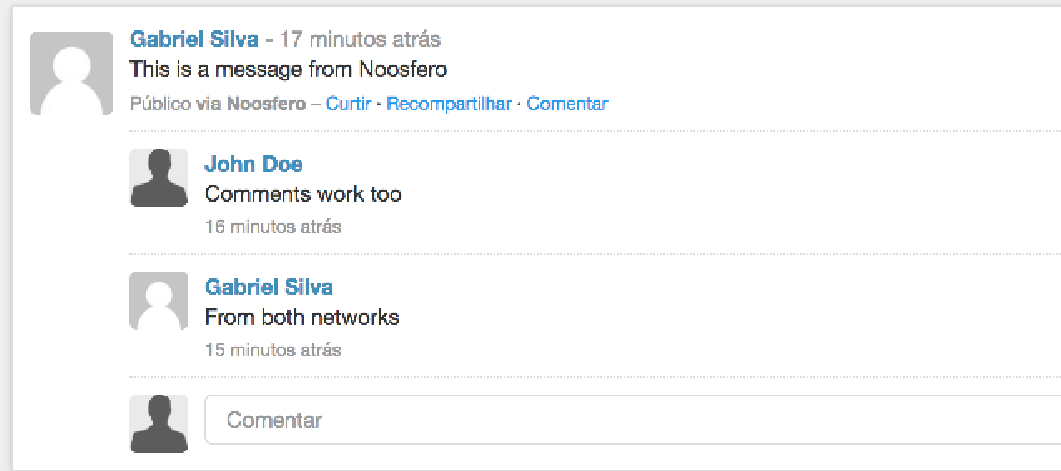
The study successfully demonstrated that a user on a Noosfero instance could search for a remote Diaspora user and have their posts appear in their local feed.
- Interoperability: Comments made on Noosfero were successfully pushed to and rendered on Diaspora pods.
- Data Consistency: The implementation handled "Retractions" (deletions), ensuring that when a remote user deleted a post, the local cached copy was also removed.
Deep Insights & Lessons Learned
Implementing federation into a legacy (non-federated) platform reveals critical engineering challenges:
- Identity Management: You must support "Remote Users"—placeholders in your database that represent people with no local password or local profile control.
- Concurrency: Encrypting messages with RSA and sending them over HTTP is slow. These must be handled in background workers to prevent blocking the user interface.
- The Relay Problem: When three servers (A, B, C) are connected but use different protocols, Server B (the polyglot) must act as a relay to ensure a conversation stays consistent across the entire group.
Conclusion
The work proves that federation is not just a theoretical ideal but a practical engineering goal for existing software. While the Diaspora protocol served this PoC well, the future of the federated web likely lies in evolving these protocols to be more robust regarding message delivery reliability and content replication. This report from the trenches serves as a roadmap for any developer attempting to break down the walls of a centralized social silo.