
The Bot Payload: Quantifying the Impact of Automated OSN Traffic on Network Systems
The Implications of Twitterbot Generated Data Traffic on Networked Systems
This paper investigates the impact of Twitterbots on network system traffic, using a sampled dataset of 722,109 tweets. By employing the Stweeler classification framework, the study quantifies the volume and nature of automated vs. human-generated content, revealing that bots are responsible for nearly 50% of the data traffic on the platform.
TL;DR
Is the internet becoming a playground for machines? This study reveals that roughly 50% of Twitter's data traffic is generated by bots. By analyzing media uploads and URL propagation, the researchers demonstrate that automated agents are no longer a marginal phenomenon but a dominant force that consumes massive infrastructure resources, necessitating a rethink of how we design networked systems.
Background: Beyond Simple Spam
For years, we viewed Twitterbots as mere "textual nuisances"—spammers or political shills. However, as social media has become increasingly visual, bots have transitioned into heavy-duty data generators. This paper shifts the focus from content sentiment to network load, asking a critical question: How much physical bandwidth is being consumed by accounts that have no human "perception" of latency or quality?
The "Invisible" Bottleneck: Problem & Motivation
Current network infrastructures (routes, CDNs, and QoS policies) are typically "human-centric." They prioritize traffic based on the assumption that a delay of 200ms might frustrate a user.
The authors identify a massive inefficiency: Bots don't care about latency. Yet, they occupy the same high-priority lanes as humans. If a bot uploads a 20MB video for marketing purposes at peak hours, it competes directly with a human user sharing a personal moment. The researchers argue that we lack the quantitative data to justify "downgrading" bot traffic to off-peak periods.
Methodology: Tracing the Digital Footprint
The researchers analyzed a dataset featuring over 700k tweets. They categorized the traffic based on the type of media handled by the Twitter API:
- Photos (JPG/JPEG): Tracked via the
media_urlattribute. - Animated Images (GIF): Processed by Twitter as video sequences.
- Videos (MP4): High-bandwidth assets.
- URLs: Analyzing domain popularity to see how bots "trigger" external traffic.

Using the Stweeler framework, they were able to separate these uploads into two distinct buckets: Human and Bot.
Key Insights from the Data
The results are a wake-up call for network engineers:
- Disproportionate Contribution: While bots made up ~42% of the accounts, they generated nearly 50% of the total traffic.
- The Media Preference: Bots are particularly aggressive with static and animated images, accounting for over 55% of all photo uploads.
- Behavioral Divergence: Analysis of URLs showed that humans prefer mobile sites (
m.youtube.com), while bots utilize desktop versions (youtube.com), likely due to the nature of the automated scripts and APIs they employ.
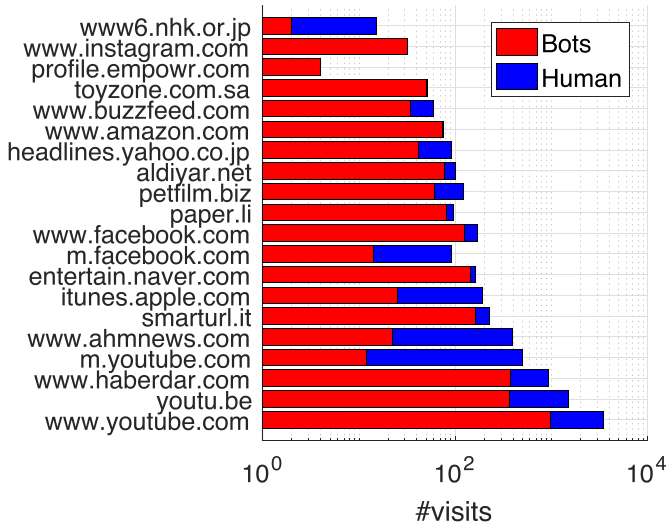
Figure 1: Comparison of uploaded media volumes. Bots (dashed/patterned) consistently rival or exceed human (solid) volumes in photo and GIF categories.
Critical Analysis & Future Implications
The core contribution of this work is the proposal for Bot-Aware Traffic Engineering.
The "Off-Peak" Opportunity
Since bots are automated, there is no technical reason they must upload media in real-time. The authors suggest that platforms could:
- Buffer Bot Uploads: Delay bot-generated media during peak congestion.
- Lower QoS Priority: Ensure human packets are routed first.
- Cost Management: Reduce the footprint on Cloud and Edge computing resources by treating machine-to-machine (M2M) traffic differently than human-to-machine traffic.
Limitations
The study relies on the Twitter Streaming API, which is a sampled subset of total traffic. Furthermore, as bots become more sophisticated (leveraging LLMs and human-like timing), the classification accuracy of frameworks like Stweeler may face new challenges.
Conclusion
As bot populations grow, our network policies must evolve. We can no longer treat all bits as equal. By identifying and de-prioritizing automated traffic, we can create a more resilient, human-optimized internet without increasing physical infrastructure costs.