
Implicit Emotional Tagging: Decoding Brainwaves to Annotate Multimedia
Implicit emotional tagging of multimedia using EEG signals and brain computer interface
The paper introduces an EEG-based Brain-Computer Interface (BCI) system for the "implicit emotional tagging" of multimedia content. By detecting P300 evoked potentials in response to emotional facial icons, the system achieves an average tagging accuracy of 80.19% across naïve subjects.
TL;DR
Researchers at EPFL have developed a Brain-Computer Interface (BCI) that "reads" your emotional reaction to a video. By analyzing P300 evoked potentials (a specific brain signal linked to attention), the system can automatically tag videos with emotions like "Joy" or "Anger" with over 80% accuracy, even for users the system has never seen before.
Background & Motivation: The Fatigue of Manual Tagging
In the era of YouTube and Flickr, metadata (tags) is the lifeblood of search and retrieval. However, most users find manual tagging—known as explicit tagging—tedious. Implicit tagging, which observes user behavior (eyes, heart rate, or brain activity), offers a seamless alternative.
The authors argue that the brain provides the most direct "ground truth" of an emotional experience. By linking brain activity to specific emotional categories, we can create a system that annotates content automatically as you watch.
Methodology: The P300 Mechanism and BLDA
The core of this research is the P300 ERP (Event-Related Potential). This is a positive "spike" in brain activity occurring roughly 300ms after a person recognizes a meaningful stimulus.
1. The Paradigm
Users watch a video and are then presented with six facial icons representing basic emotions (Happy, Sad, Surprised, Disgusted, Afraid, Angry). These icons flash randomly. When the icon matching the user's emotion flashes, their brain produces a P300 signal.
2. The Classifier: Bayesian Linear Discriminant Analysis (BLDA)
EEG data is notoriously noisy. To handle high-dimensional data without overfitting, the authors used BLDA. Unlike standard Fisher LDA, BLDA uses Bayesian regularization to automatically estimate the degree of noise and signal, making it robust enough for "naïve" subjects (users who didn't provide training data).
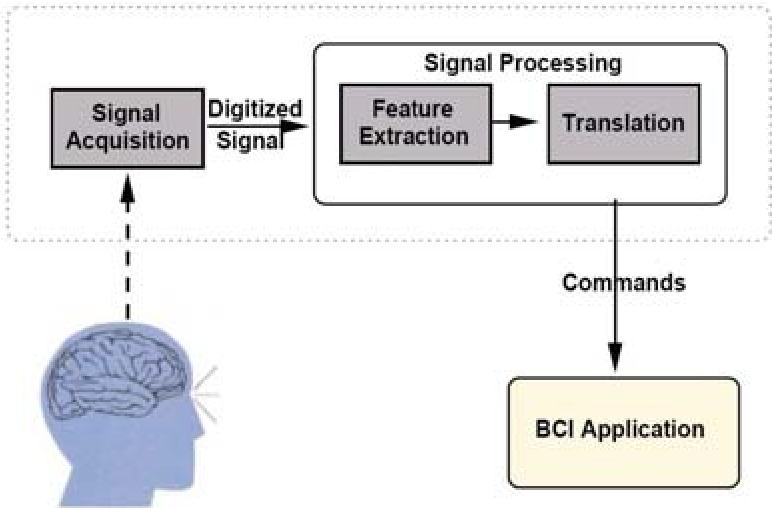 Figure: The BCI pipeline from signal acquisition to command output.
Defining "Emotional Taggability" (ET)
One of the paper's most insightful contributions is the concept of Emotional Taggability. Not all videos evoke a single, clear emotion; some are ambiguous.
The authors defined ET as a mathematical measure of how "sharply" an emotion is felt.
- High ET: A video is clearly "Joyful." The BCI finds it easy to detect the P300.
- Low ET: A video evokes mixed feelings (e.g., Sadness and Anger). The user's attention is split, and the P300 signal weakens.
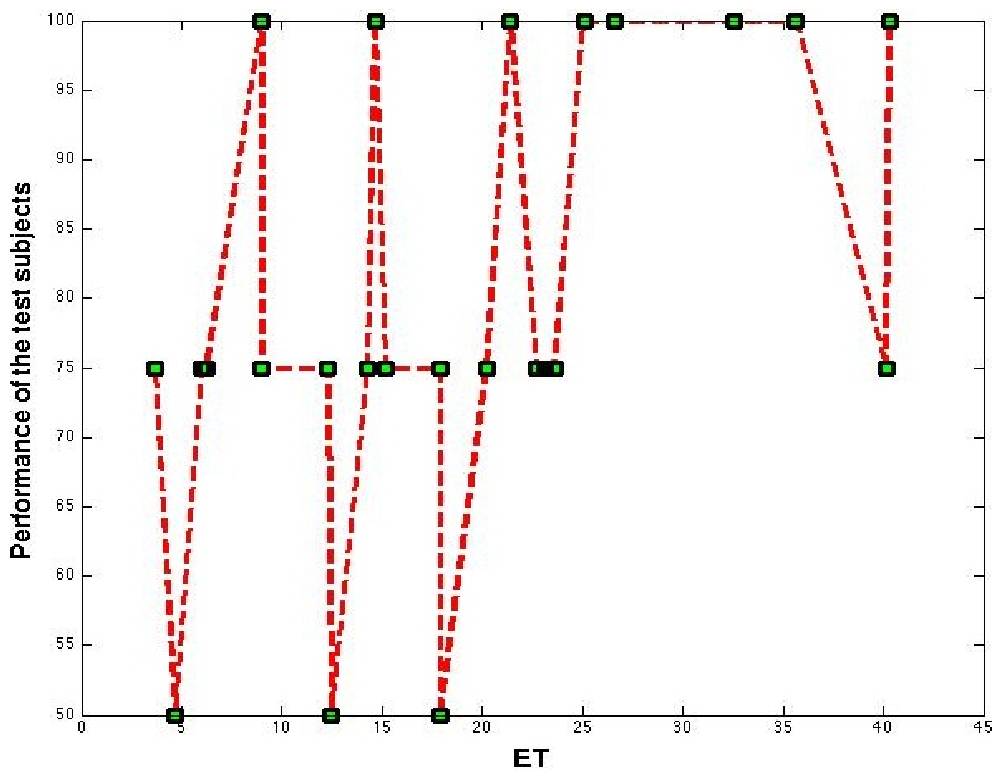 Figure: The correlation between content clarity (ET) and the BCI's accuracy.
Key Results
- Cross-Subject Generalization: The system effectively classified emotions for new users using a general classifier trained on others.
- Performance: High accuracy reached 91.67% for the best-performing subject, with an 80.19% average.
- Ambiguity Correlation: The study confirmed that as ET increases, system accuracy increases, proving that BCI performance is tied to the psychological clarity of the stimulus.
Critical Insight & Future Outlook
This paper, published in 2009, was a pioneer in moving BCI from "medical/rehabilitative" use toward "consumer/multimedia" use.
Limitations:
- Setup Time: Current EEG setups (32 electrodes) take significant time to apply.
- Fatigue: Performance dropped as sessions lasted longer (up to 90 minutes), highlighting the need for more efficient paradigms.
The Takeaway: As "dry-electrode" EEG headsets become more portable, the "Emotional Taggability" framework could be integrated into VR/AR headsets to provide real-time, subconscious feedback for content creators and recommendation engines.