
Implicit Human-Centered Tagging: Decoding Subconscious Signals for Smarter Retrieval
Implicit Human-Centered Tagging
This paper introduces Implicit Human-Centered Tagging (IHCT), a paradigm that uses a user's spontaneous nonverbal reactions (facial expressions, vocalizations, body gestures) to automatically annotate multimedia data. By bypassing manual keyword entry, IHCT aims to create more objective, statistically reliable metadata for data retrieval compared to traditional social tagging.
TL;DR
Implicit Human-Centered Tagging (IHCT) is a revolutionary approach to multimedia indexing that replaces manual, often biased keywords with automated analysis of user reactions. By monitoring facial expressions, head movements, and vocal outbursts during content consumption, IHCT creates a more robust, "honest" metadata layer that improves the accuracy of search and recommendation systems without requiring any user effort.
The Cracks in the Social Tagging Mirror
The rise of social media platforms like Flickr and YouTube brought about "Explicit Tagging," where millions of users collaboratively index the web. While democratic, this approach is fundamentally flawed. As Pantic and Vinciarelli point out, humans are rarely objective librarians. We are prone to:
- Egoistic Tagging: Using personal codes that mean nothing to the public.
- Reputation Gaming: Mass-tagging to boost visibility rather than describe content.
- Asocial Behavior: Tagging "anarchy!" or "666" on unrelated videos just to spread a message.
Because of these biases, search results often degrade into noise. The authors argue that the solution isn't better algorithms for manual tags, but removing the "manual" requirement entirely.
The Methodology: Turning Humans into Sensors
The core of IHCT lies in the Media Equation, the psychological finding that humans naturally and spontaneously display nonverbal cues to digital media as if it were another human.
1. Multimodal Signal Extraction
The system perceives the user through several channels:
- Facial Action Units (AUs): Moving beyond basic emotions to detect subtle states like "thinking" or "interest."
- Vocal Outbursts: Distinguishing "mirthful" (voiced) laughter from "ironic" (unvoiced) laughter.
- Physiological & Behavioral Traces: Combining eye-gaze tracking with head-pose estimation to measure boredom or engagement.
2. Dimensional vs. Categorical Affect
Instead of just labeling a video "Sad" or "Happy," the paper advocates for a Dimensional Approach. By mapping reactions onto a 2D space of Valence (pleasantness) and Arousal (excitement), the system can capture the intensity and nuance of a user's experience in real-time.
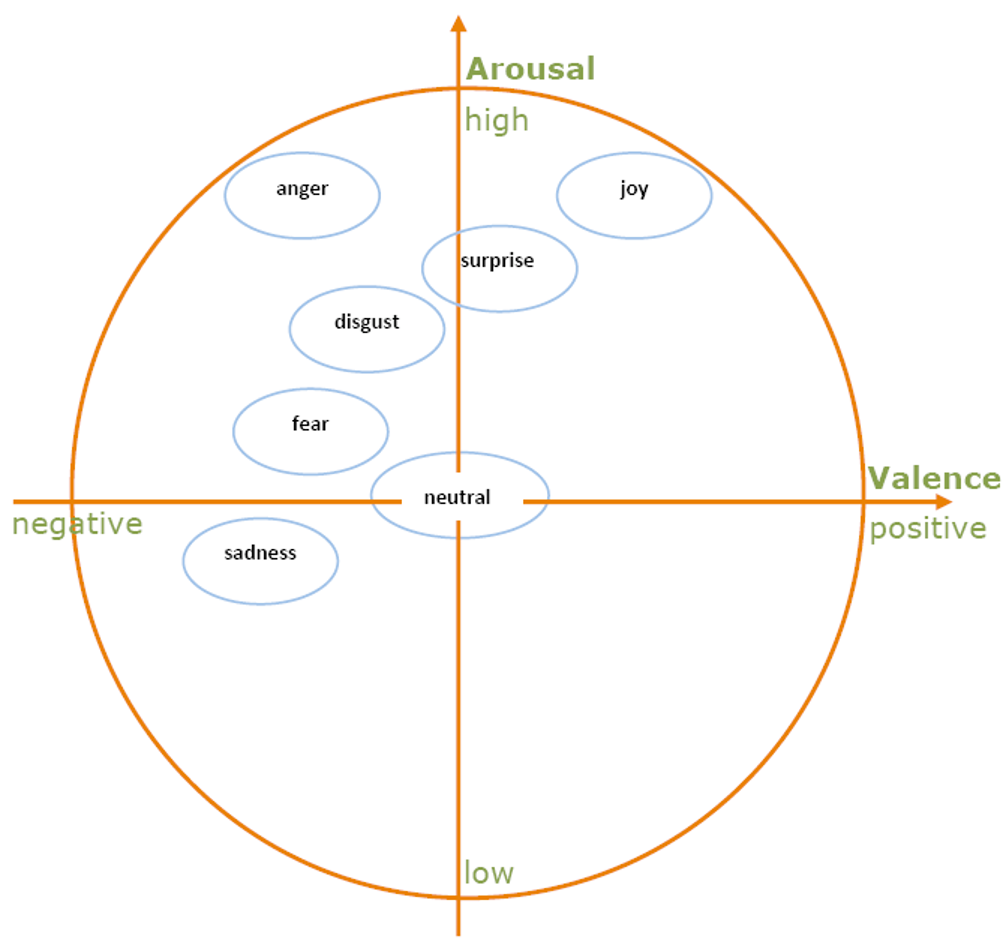 Figure 1: Visualizing how discrete emotions occupy specific coordinates in the Valence-Arousal spectrum.
Key Experimental Milestones
The paper synthesizes several breakthrough studies that validate the IHCT vision:
- Spontaneity Detection: A system using Gentle Boost and SVMs achieved 93% accuracy in telling whether a user's smile was genuine or "posed" by analyzing the temporal dynamics (onset/offset speed) of the face.
- Relevance Prediction: By analyzing facial behavior while watching videos, researchers could predict if a video was "relevant" to a user's initial query with 89% accuracy.
- Continuous Monitoring: Utilizing Long Short-Term Memory (LSTM) networks, researchers achieved over 90% accuracy in tracking the levels of arousal in a user's voice during interactions.
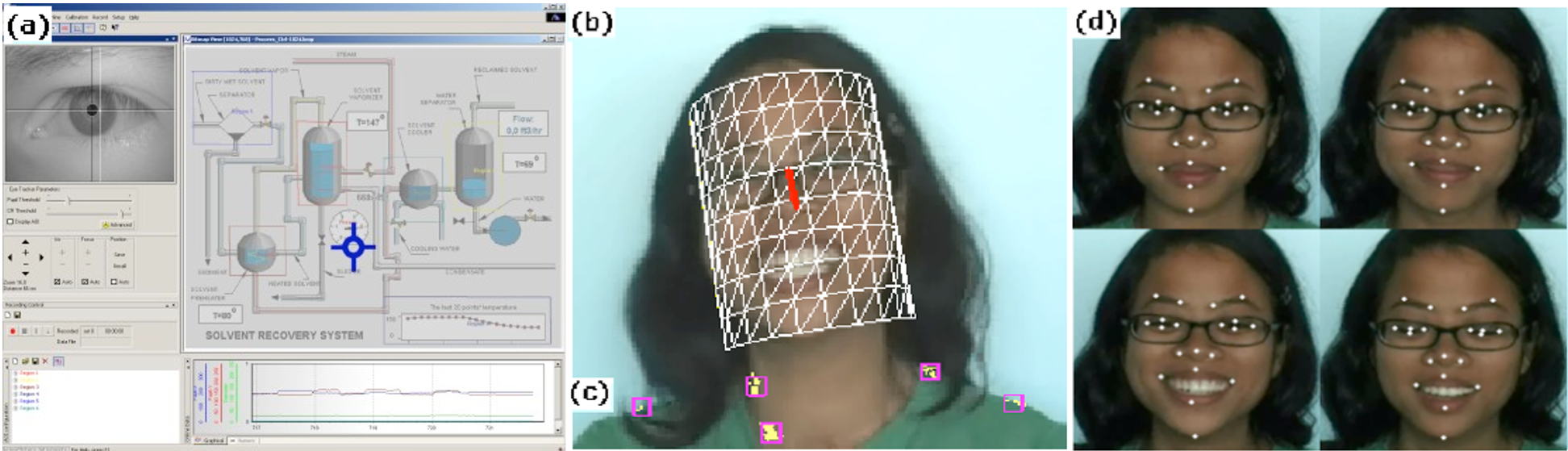 Figure 2: Examples of the tracking technologies (Eye, Head, Face) that form the hardware backbone of implicit tagging.
Critical Analysis: The Road Ahead
While IHCT offers a "statistical reliability" that manual tagging lacks, it faces significant hurdles:
- Cultural Variation: A "thumb-up" gesture or a specific laugh might signify agreement in one culture but offense in another.
- Privacy Concerns: The authors remain cautious about "behavioral surveillance." Using these patterns to build marketing dossiers rather than search indices is a major ethical risk.
- Hardware Constraints: While lab results are high, maintaining this accuracy using a standard 2026-era laptop webcam in varying light remains a challenge.
Conclusion
Implicit Human-Centered Tagging represents a paradigm shift. It moves the burden of organization from the user to the system, translating the "honest signals" of human emotion into a structured data format. For future developers of retrieval systems, the takeaway is clear: stop asking users what they think; start watching how they react.