
From Wireless Packets to Social Coupons: Backpressure for Optimal Discount Targeting
Implicit learning for explicit discount targeting in Online Social networks
The paper introduces a distributed coupon distribution framework for Online Social Networks (OSNs) that uses a "backpressure" routing mechanism to achieve explicit discount targeting. It optimizes store revenue by implicitly learning user preferences and regulating coupon injection and forwarding through multihop social interactions.
TL;DR
How do you give just enough discounts to maximize profit without wasting money on people willing to pay full price? This paper treats Online Social Networks (OSNs) as a routing fabric. By applying Backpressure Routing—a classic wireless networking concept—the authors create a system where coupons "flow" through friends toward the users who need them most. It effectively turns social sharing into an implicit learning machine for market demand.
The Targeting Dilemma: Too Much vs. Too Little
In modern retail, a two-tier pricing strategy (Marked Price vs. Discounted Price) is standard. However, the store usually operates in the dark:
- The Flooding Problem: If you mass-distribute coupons, you cannibalize your own profits because people who would have paid $100 now only pay $70.
- The Reach Problem: If you only give coupons to known customers, you miss potential buyers hidden deep within social networks.
The authors argue that social networks can bridge this gap, but only if we have a mechanism that "learns" user preferences without intrusive tracking.
Methodology: Social "Pressure" is the Signal
The core innovation is viewing coupon distribution as a flow-optimization problem.
1. Backpressure Coupon Routing
Just as water flows to the lowest point, coupons in this system flow toward "Effective Pressure" sinks. Each user maintains a "per-product queue." If a neighbor has fewer coupons than you, there is a "pressure gradient," and you are incentivized to forward coupons to them.
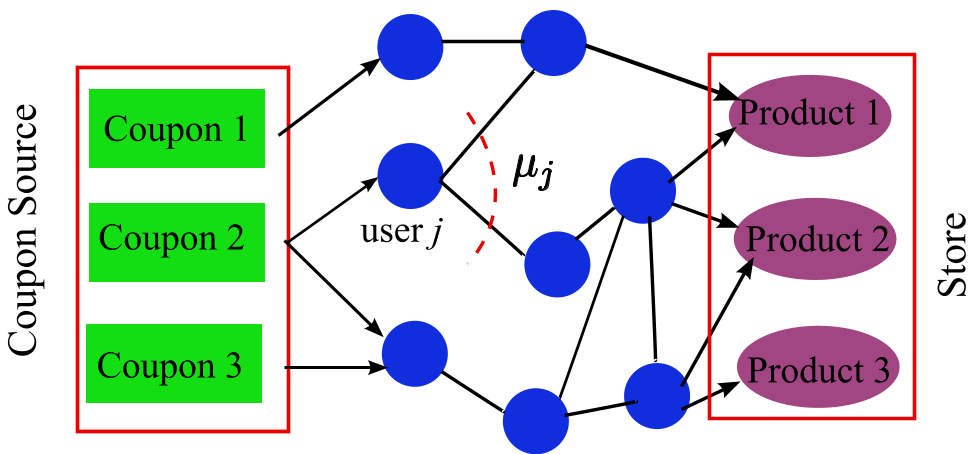 Fig 1: The system architecture involving the Store, Coupon Distributor, and Users.
2. The Two-Step Control Loop
- Small Time Scale: Coupons move step-by-step between friends based on queue differences.
- Large Time Scale: The store observes total purchases and adjusts the "Target Reward Rate." If a user starts buying less because they lack coupons, the store increases the flow; if the store is losing too much profit, it throttles the rates.
3. Incentives for the Selfish Relay
In a network, users won't forward coupons for free. The store rewards the path. Crucially, the reward is proportional to the queue difference. This ensures that rational users naturally follow the backpressure policy to maximize their own small-task rewards.
Experiments: Proving the Flow Works
The authors tested the theory using a Tree Topology and a more realistic Power-Law Topology (mimicking real social structures like Facebook or X).
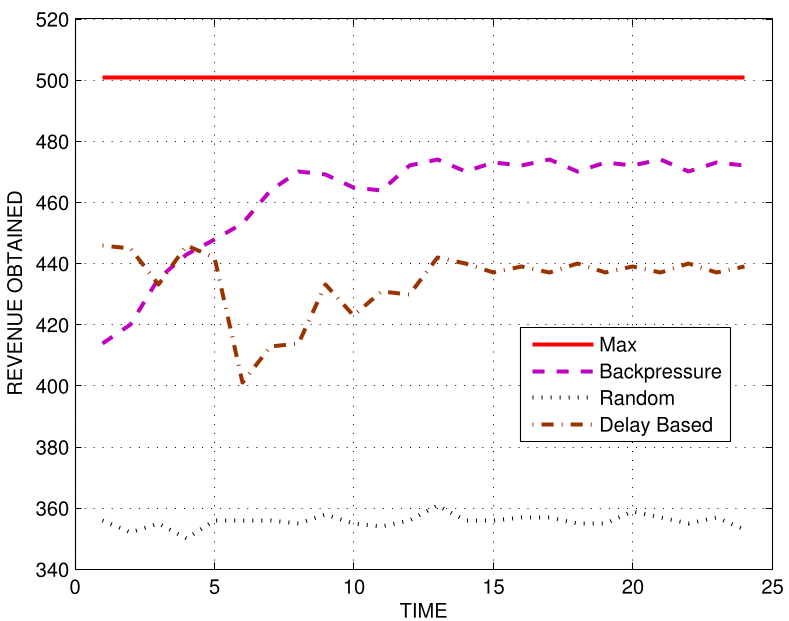 Fig 2: Revenue trajectory showing Backpressure significantly outperforming Random and Heuristic methods.
Real-world Performance:
- Near-Optimality: The Backpressure scheme consistently hit the upper bound of extractable revenue.
- Learning Curve: As shown in the simulation, the system "learns" the exact number of goods a user is willing to buy at a discount (the value) after just a few buying cycles.
- Simplicity Wins: They also proposed a Delay-based heuristic. Instead of checking queue lengths, users just send coupons to the neighbor who gets them a reward the fastest. While less "perfect" than backpressure, it still beat random guessing by a wide margin.
Critical Insight: Why This Matters
Most AI-based targeting relies on Explicit Learning (scraping data, building user profiles). This paper proposes Implicit Learning. The store doesn't need to know who you are or what you like; it only needs to provide the right incentives so that the social network's natural structure pushes the coupons to the right place.
Limitations
- Malicious Users: The paper assumes users are "rationally selfish" but not "maliciously manipulative." In the real world, "sybil attacks" (creating fake accounts to harvest rewards) would be a major hurdle.
- Topology Awareness: While backpressure is topology-independent, the speed of convergence still depends on how "connected" the network is.
Conclusion
By treating social interactions as a routing problem, this work provides a mathematically rigorous way to handle targeted marketing. It proves that we don't always need "Big Data" to find customers; sometimes, a well-designed incentive "pressure" is enough to let the customers find the coupons themselves.