
ITRA: Uncovering Implicit Social Influence through Motif-Aware Variational Auto-Encoders
Implicit relation-aware social recommendation with variational auto-encoder
The paper proposes the Implicit Trust Relation-Aware model (ITRA), a social recommendation framework that integrates Variational Auto-Encoders (VAE) with an attention mechanism. It identifies implicit high-order social relations using graph motifs to reconstruct a non-binary adjacency matrix, achieving SOTA performance in top-K recommendations.
TL;DR
The Implicit Trust Relation-Aware model (ITRA) redefines social recommendation by moving beyond simple "friend-or-not" binary links. By mining high-order motifs (3-node sub-structures) and integrating them into a non-linear Variational Auto-Encoder (VAE) via an attention mechanism, ITRA captures the influence of indirect "key opinion leaders" and varying trust levels. It significantly outperforms traditional linear models and standard VAEs on real-world datasets like FilmTrust and CiaoDVD.
Problem & Motivation: The "Binary" Trap
Most social recommender systems suffer from two major flaws:
- Indistinguishable Influence: They treat all social links as equal (binary 0/1). In reality, your "trust" in a close friend differs from your trust in a casual acquaintance or a high-profile influencer.
- Missing High-Order Links: They only look at direct neighbors. However, "a friend of a friend" (triadic closure) often signals a strong latent preference that high-order graph structures can reveal.
Traditional VAE approaches often treat social information as a separate pre-processing step or a linear constraint. ITRA aims to bring this into a fully non-linear, end-to-end neural architecture.
Methodology: High-Order Motifs and Social Attention
ITRA’s architecture is divided into three critical phases:
1. Motif-Based Relation Mining
Instead of a simple adjacency matrix , ITRA searches for 7 types of 3-node motifs (e.g., feed-forward loops, reciprocal pairs).
- Logic: If two users share many common high-order structures, their influence weight should be higher.
- Outcome: A refined, non-binary trust matrix that combines direct edges and motif-based weights .
2. The VAE Backbone with Attention
ITRA uses a VAE to learn the latent distribution of user preferences. The innovation lies in the Attention Module acting as a bridge between the Encoder and Decoder:
- Query (): The user’s own latent preference.
- Key () & Value (): The latent preferences of their trustees (friends/influencers).
- The model calculates a weighted representation based on how much a user "attends" to the tastes of their social circle.
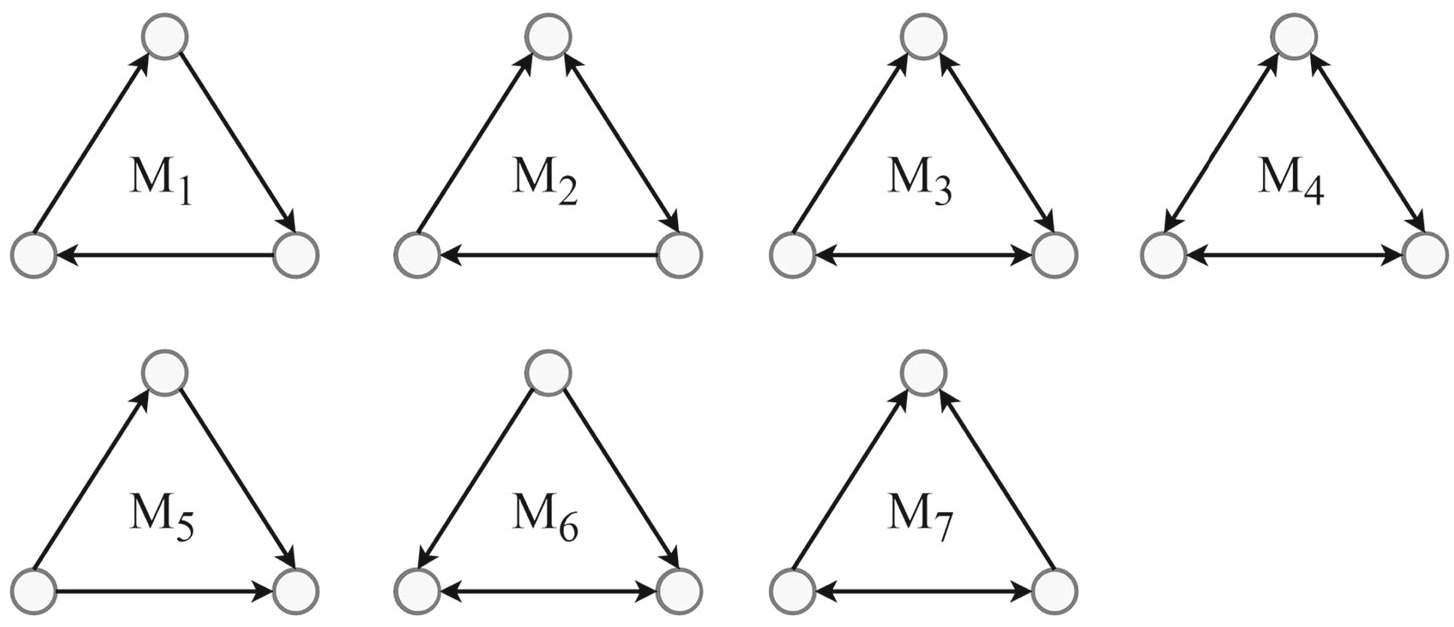 Figure: The ITRA Framework showing the flow from rating history through the inference network, social attention module, and generative decoder.
Experiments & Results
The authors tested ITRA against SOTA baselines like CDAE, CVAE, and SAMN on three datasets: Delicious (bidirectional), FilmTrust (asymmetric), and CiaoDVD (asymmetric).
Key Findings:
- Superiority in Directed Networks: On FilmTrust and CiaoDVD, ITRA consistently outperformed all baselines. In FilmTrust, it beat the second-best model by 10.49% (Recall@20).
- The Power of Non-Linearity: By using a VAE instead of the linear PMF (used in SAMN), ITRA achieved better results with shorter training times.
- Motif Sensitivity: The choice of motif matters. While worked best for CiaoDVD, was less effective for FilmTrust, suggesting that the "shape" of social influence is dataset-dependent.
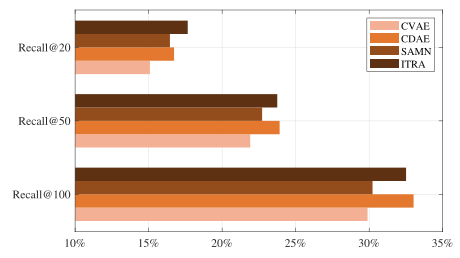 Figure: Recall and NDCG metrics across different recommendation sizes (K=20, 50, 100).
Critical Analysis & Takeaways
Why does it work? ITRA succeeds because it acknowledges that social influence is not flat. By using motifs, it mathematically captures the "radiating range" of influencers. Integrating this via an attention module allows the VAE to dynamically adjust how much it trusts the social signal versus the user's own rating history.
Limitations:
- Computational Overhead: Searching for motifs in extremely large graphs can be expensive, though it is a one-time pre-processing step.
- Bidirectional Constraints: As seen in the Delicious dataset results, if the graph is purely bidirectional, the motif search yields little gain over standard adjacency matrices.
Future Outlook: This work paves the way for integrating Hypergraphs or Heterogeneous Information Networks (HIN) into generative models like VAEs and Diffusion models, potentially capturing even more complex multi-user interactions.