
The Mindset Gap: Why Some Facebook Users Forgive Brands While Others Don't
The Effect of Implicit Theory of Personality on SNS
This study investigates how users' "Implicit Theory of Personality" (Growth vs. Fixed mindsets) influences their perception of corporate crisis management on Facebook. Using a pharmaceutical side-effect scenario, the researchers demonstrated that growth-mindset users are significantly more receptive to company apologies and less likely to spread negative Word-of-Mouth (eWOM).
TL;DR
When a brand faces a crisis on social media—like a pharmaceutical company dealing with drug side-effect complaints—not all "likes" or "comments" are created equal. This study reveals that the Implicit Theory of Personality (whether a user believes people and organizations can change) is a critical filter. Users with a Growth Mindset are far more likely to accept a company's apology, while those with a Fixed Mindset often remain skeptical, regardless of the effort put into the response.
Background Positioning
In the landscape of Media Psychology, this paper serves as a bridge between traditional personality theory and modern Social Networking Site (SNS) behavior. While previous SOTA (State-of-the-Art) research in PR focused on what a company should say, this work shifts the focus to who is listening.
The "Rigid" vs. "Plastic" Reality
The core problem addressed here is the inconsistency of corporate response efficacy. The authors argue that our "Implicit Mindsets" about human nature—our belief in whether traits are permanent (Fixed) or malleable (Growth)—act as a cognitive lens.
- The Growth Mindset Insight: These individuals value effort and believe in the potential for improvement. On Facebook, they see a company's apology as a genuine step toward systemic change.
- The Fixed Mindset Reality: These users view traits as static. A "bad" company is simply a bad company; therefore, an apology is often perceived as a hollow PR tactic rather than a sign of progress.
Methodology: Simulating the Facebook Firestorm
The researchers designed a controlled experiment simulating a pharmaceutical company's Facebook page. They presented participants with negative posts about drug side effects.
The Experimental Setup
- Group A (Control): Saw the complaints with no company response.
- Group B (Treatment): Saw the complaints followed by corporate apologies and engagement.
 Note: The study utilized a moderated mediation model to trace the path from Company Response -> Perceived Severity -> Consumer Attitude.
Key Results: The Mediation Effect
The findings were striking. While the company's response generally helped, the benefit was almost entirely driven by the "Growth" and "Moderate" mindset segments.
| Metric | Non-Response (M) | Response (M) | Significance |
|---|---|---|---|
| Perceived Severity | 8.87 | 7.75 | p < 0.05 |
| Attitude Toward Company | 2.66 | 4.03 | p < 0.05 |
| Negative eWOM | 4.01 | 3.94 | Not Sig. |
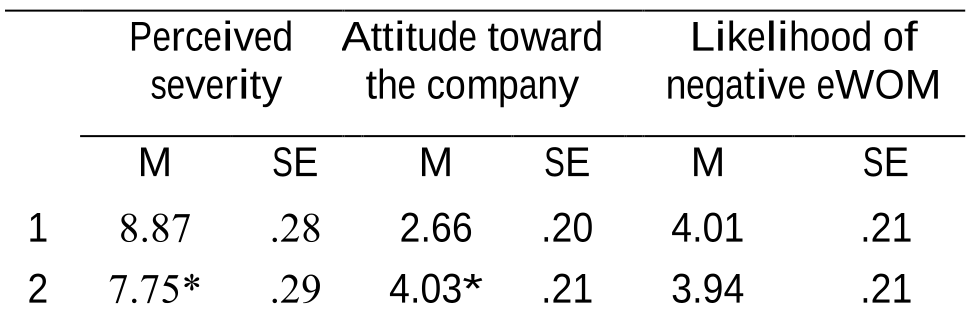
Deep Insight: For "Fixed Mindset" users, the company response had no statistically significant effect. Their perception of the crisis was "baked in" the moment they read the complaint.
Critical Analysis & Conclusion
Takeaway
This research highlights the psychological boundary conditions of crisis communication. If your target audience predominantly holds a fixed mindset, traditional "apology-based" PR might fail.
Limitations
- Sample Size: With N=75, the study is a "preliminary" look. A larger, more diverse sample is needed to see if these effects hold across cultures.
- Brand Equity: The study used a fictitious company. In the real world, a brand like Apple or Pfizer carries "prior belief" weight that might override mindset effects.
Future Outlook
The next frontier for this research involves Tailored Interaction Strategies. Could AI-driven sentiment analysis identify a user's mindset based on their comment history? If so, companies could theoretically deploy different response styles (e.g., data-driven for fixed mindsets vs. growth-oriented for growth mindsets) to maximize the effectiveness of their reputation management.