
Scaling the Human Sensor: Asymptotic Efficiency in Social Sensing
15492_The Importance of Being Earnest Social Sensing With Unknown Agent Quality.
This paper investigates parametric estimation in social sensing networks where individual agent quality (e.g., reliability or bias) is unknown. It defines the fundamental Fisher Information Matrix (FIM) bounds and introduces two likelihood-based algorithms—Expectation-Maximization (EM) and a closed-form Fisher Scoring method—to achieve SOTA estimation efficiency.
TL;DR
Social sensing transforms humans into "sensors," but their reliability is often a black box. This paper provides the mathematical "scaling laws" for estimating agent quality. It proves that as you add more agents, the collective intelligence allows the system to perform as if it already knew the ground truth—a phenomenon called Clairvoyant Convergence. The authors introduce a fast, closed-form Fisher Scoring estimator that matches the accuracy of heavy iterative models (like EM) with a fraction of the compute.
Problem & Motivation: The "Unknown Quality" Trap
In the era of "Big Data," we rely on crowdsourced information—from social media reports to geo-tagging. However, unlike hardware sensors, human "agents" have unknown biases and varying levels of earnestness.
Existing literature either simplifies these agents into binary "reliable/unreliable" buckets or relies on complex convex optimizations that don't scale well. The authors identify a critical gap: How does estimation accuracy scale as we increase the number of agents () and the number of tasks ()? Most importantly, can we reach a performance ceiling where the unknown nature of the truth no longer hinders our estimation of the agents themselves?
Methodology: The Core Intuition
The paper shifts the focus to a Parametric Model. Each agent has an attribute . When faced with a state of nature , the agent produces a report following a probability .
1. The Clairvoyant Benchmark
The authors define the Clairvoyant System—an idealized scenario where the true state is known. In this case, the Fisher Information Matrix (FIM) is diagonal, meaning each agent's quality can be estimated independently.
2. The Many-Agents Theorem
The most profound contribution is Theorem 1. It mathematically proves that for a large number of agents, the uncertainty about the "truth" vanishes for the purpose of estimating agent quality. The FIM of the actual system converges to the FIM of the Clairvoyant system.
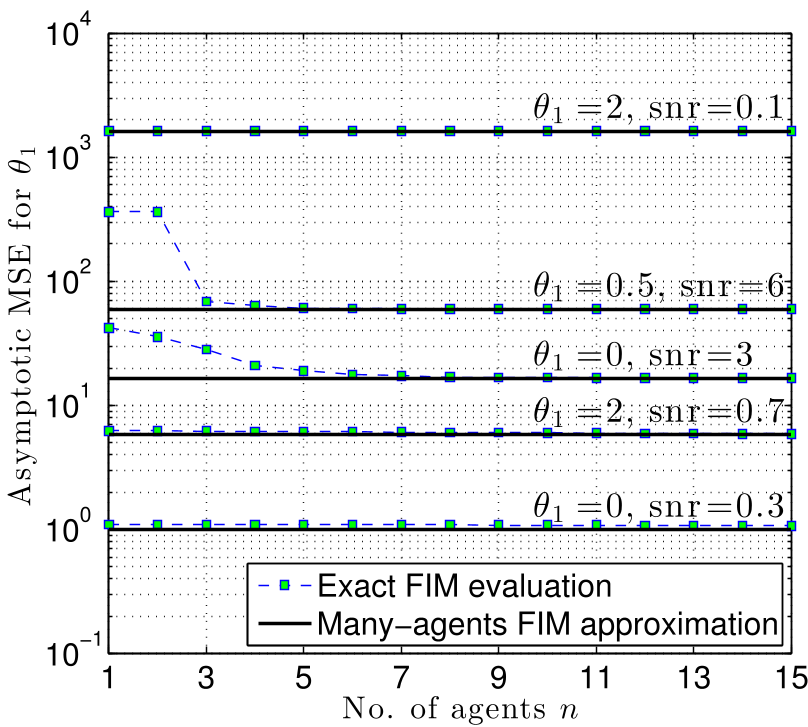 Fig 3: The inverse FIM entry shows that as the number of agents increases, the error decreases and converges to the dashed Clairvoyant line.
3. Fisher Scoring: Efficiency Without Iteration
While the Expectation-Maximization (EM) algorithm is the standard for latent variables, it is iterative and slow. The authors propose the Fisher Scoring Estimator:
abla \ln p(x(m); ilde{ heta})$$ This is a "one-step" MLE. It starts with a simple "local" estimate and uses a single Taylor-expansion-based correction to capture the global dependencies across the network. ## Experiments: Breaking the "More Information is Better" Myth The authors tested their model on two scenarios: **Binary Decision Makers** and **Agent Bias Estimation**. ### Key Finding: The SNR Paradox In the binary case, one might assume that a higher Signal-to-Noise Ratio (SNR)—better agents—always leads to better estimation of their attributes. **The paper proves this wrong.** * At very low SNR, estimation is easy near the decision boundary (high sensitivity). * As SNR increases, the "peak" of information softens, making estimation less sensitive to specific agent parameters. 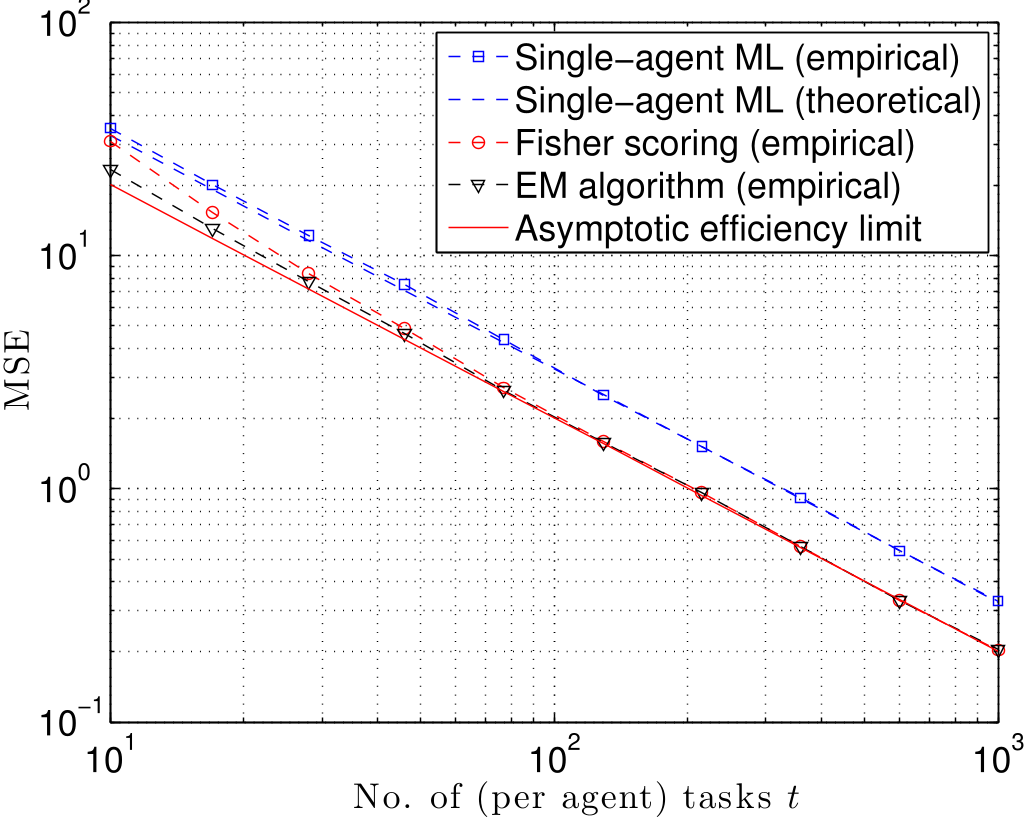 *Fig 4 & 6: The comparison between Single-Agent MLE and the proposed joint methods (EM/Fisher Scoring). Note how the red and blue markers align perfectly with the theoretical SOTA bound.* ## Critical Analysis & Takeaways The beauty of this work lies in its **asymptotic guarantees**. It tells practitioners exactly when they can stop worrying about the "latent" part of the problem: 1. **Complexity**: If $n > 10$, you can likely use the simplified "Many-Agents" Fisher Scoring formula (Eq. 33), which eliminates matrix inversions. 2. **Scalability**: The Fisher Scoring method is additive over time (tasks), making it perfect for real-time streaming social data. **Limitations**: The model assumes independent agents. In real social networks, agents influence each other (herding behavior). Future work must address how network topology and agent-to-agent communication warp these Fisher Information bounds. ### Final Conclusion This paper provides the rigorous statistical backbone needed for high-assurance social sensing. By treating "human error" as a mathematical parameter $ heta$ and proving the convergence to clairvoyance, it moves social sensing from a heuristic "crowdsourcing" trick to a robust branch of estimation theory.