
Re-evaluating Collaboration: Why Repeated Developer Ties Predict OSS Success
The Importance of Social Network Structure in the Open Source Software Developer Community
This paper investigates the correlation between social network structure and long-term popularity in Open Source Software (OSS) projects using longitudinal data from SourceForge. By analyzing developer-developer ties and project activity percentiles, the authors prove that repeated collaborations among developers are strong indicators of project success.
TL;DR
Contrary to previous academic skepticism, social network structure is a vital predictor of success in Open Source Software (OSS). By tracking thousands of projects over four years, this study reveals that developers who "stick together" across different projects significantly increase the odds of long-term project popularity.
Background: The Controversy of Social Capital
In the mid-2000s, researchers like Hinds argued that social network structure had no real impact on whether an OSS project succeeded or failed. This was counter-intuitive—industry lore always suggested that "strong teams" make "strong products." This paper identifies the flaw in that earlier logic: prior studies looked at static snapshots of networks, whereas the real magic happens in the evolution of the network over time.
Methodology: Mapping the Developer DNA
The authors leveraged the SourceForge Research Data Archive (SRDA) to build a bipartite network of developers and projects. The key innovation was the "Repeated Tie" metric.
1. The Bipartite Approach
By connecting developers to the projects they contribute to, and then connecting developers who work on the same project at the same time, the authors filtered out noisy connections.
2. The Success Metric: Activity Percentile
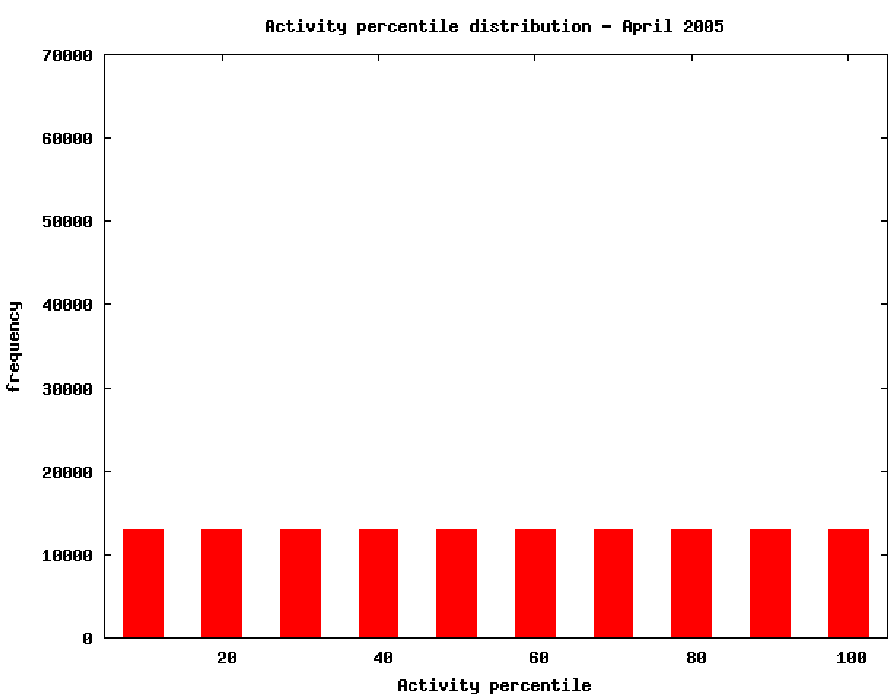
Instead of subjective "success" (which is hard to quantify), the paper uses Activity Percentile, a composite score of:
- Traffic: Downloads and hits.
- Development: CVS commits and release frequency.
- Communication: Mailing list and forum activity.
The "Success Gap": A Statistical Bifurcation
One of the most striking findings is the long-term behavior of projects. When analyzed over 50 months, projects don't just "fade away" linearly. Instead, they split into two clear camps.
- The Survivors: Projects that stay in the upper 50th percentile and remain active.
- The Deprecated: Projects that sink toward zero activity.
After approximately two years, a "gap" appears in the data where almost no projects exist between the 43rd and 54th percentiles. This suggests that OSS projects reach a "breaking point": they either achieve critical mass or become ghost towns.
Key Insight: Repeated Ties as a Filter
The data supports two critical hypotheses:
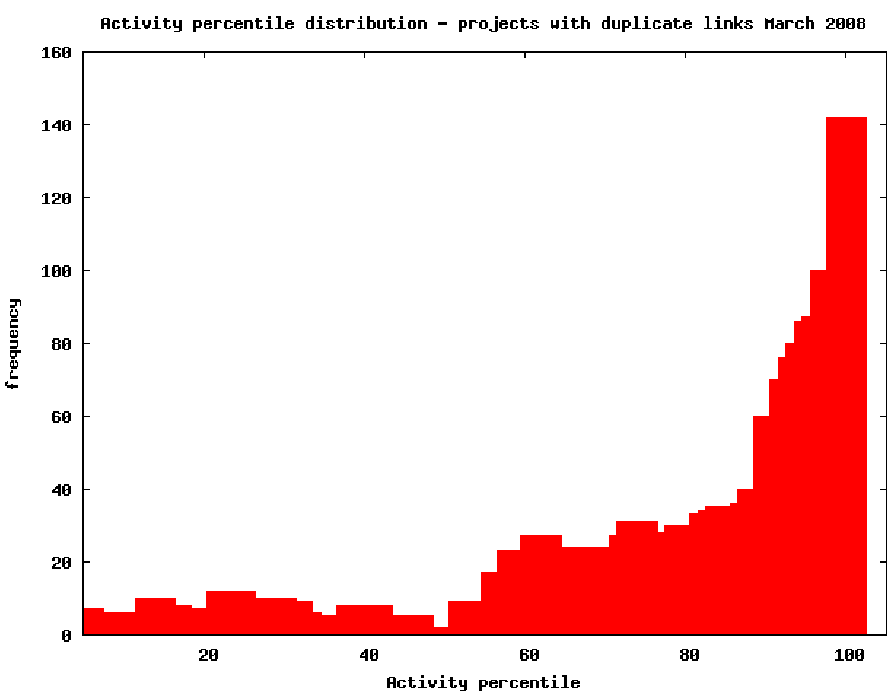
- Popular projects are statistically more likely to feature developers who have worked together before.
- Repeated collaborations are more likely to result in a popular project than a team of strangers.
Only 1.42% of developer links in the study were repeats, but these links were disproportionately concentrated in high-popularity projects. This implies that successful collaboration breeds "social routines" that decrease the friction of starting new, complex software ventures.
Critical Analysis & Conclusion
This paper serves as a vital correction to the "static network" fallacy. It proves that the history of a developer’s relationships (their social capital) is just as important as the code itself.
Limitations
- Data Source: The study is limited to SourceForge and CVS logs, ignoring "invisible" community members like bug reporters and feature requesters who don't commit code.
- Modern Context: In the era of GitHub and Git, the cost of contribution is lower, and networks are more fluid. Whether "repeated ties" hold the same weight today remains an open question for future researchers.
Final Takeaway
For project founders, the lesson is clear: Network history matters. If you want a project to survive the "two-year gap," recruiting a core team with a history of shared success is your best statistical bet.