
Words vs. Images: Decoding the "Textual Primacy" in Social Media Impressions
Which Post Will Impress the Most?: Impression Formation Based on Visual and Textual Cues in Facebook Profiles
The study investigates the competing roles of visual and textual cues in impression formation within Social Network Sites (SNS). Utilizing two experiments, the researchers demonstrate a "Textual Primacy" effect, showing that textual comments have a more significant influence on perceived extroversion than profile photos in the context of Facebook.
TL;DR
Is a picture really worth a thousand words on Facebook? According to research from the University of Haifa and Wisconsin-Madison, the answer is: Probably not. While we might think our photos do the talking, this study reveals that textual cues—the actual words we write—have a far more dominant role in how strangers perceive our personality (specifically our extroversion) than the images we post.
The Power of the "Anchor": Textual vs. Visual Cues
For years, psychologists have debated whether we "judge a book by its cover" (Visual Primacy) or by its content (Textual Primacy). Visuals are vivid and immediate, but they are often ambiguous. Text, though requiring more cognitive effort to process, provides a solid, unambiguous characterization.
The researchers identified a gap in existing literature: previous studies often presented these cues separately or used "non-normative" images (like a group photo where a solo photo is expected) which skewed results. This study sought to place these cues in a realistic, simultaneous context to see which one truly "wins" in the mind of the observer.
Methodology: The Mock Facebook Environment
To solve this, the authors designed high-fidelity experiments:
- Study 1: Presented 113 participants with photos and text snippets (congruent and incongruent) outside of any social platform.
- Study 2: Created 12 variations of a mock Facebook profile for 291 participants. These variations manipulated:
- Visuals: Photos showing introverted vs. extroverted activities.
- Texts: Comments written by the profile owner.
- Social Proof: The number of "Likes" (Many, Few, or None).
Key Findings: Why Text Dominates
The experiments yielded a consistent result: The effect of text was significantly stronger than the effect of pictures.
- The Deciding Factor: In "incongruent" conditions (e.g., a photo of a lonely beach paired with an extroverted caption like "I love the racket here!"), participants leaned heavily on the text to form their final judgment.
- Warranting Theory and "Likes": The study found that "Likes" act as a "warrant"—information that the profile owner cannot easily manipulate. When a user was perceived as "manipulative" (trying too hard to look cool), participants ignored the photos and looked at the "Like" count to find the "truth."
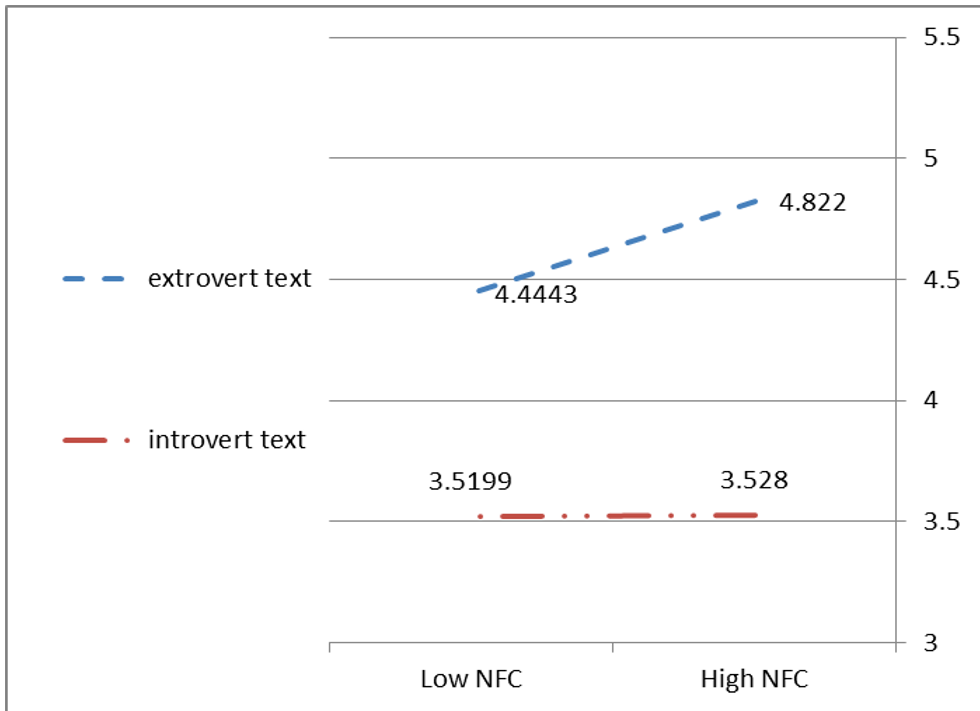
- Need for Cognition (NFC): As seen in the figure above, individuals with a high "Need for Cognition" (those who enjoy thinking deeply) were even more sensitive to textual cues, particularly when the text was extroverted.
The Heavy User Advantage
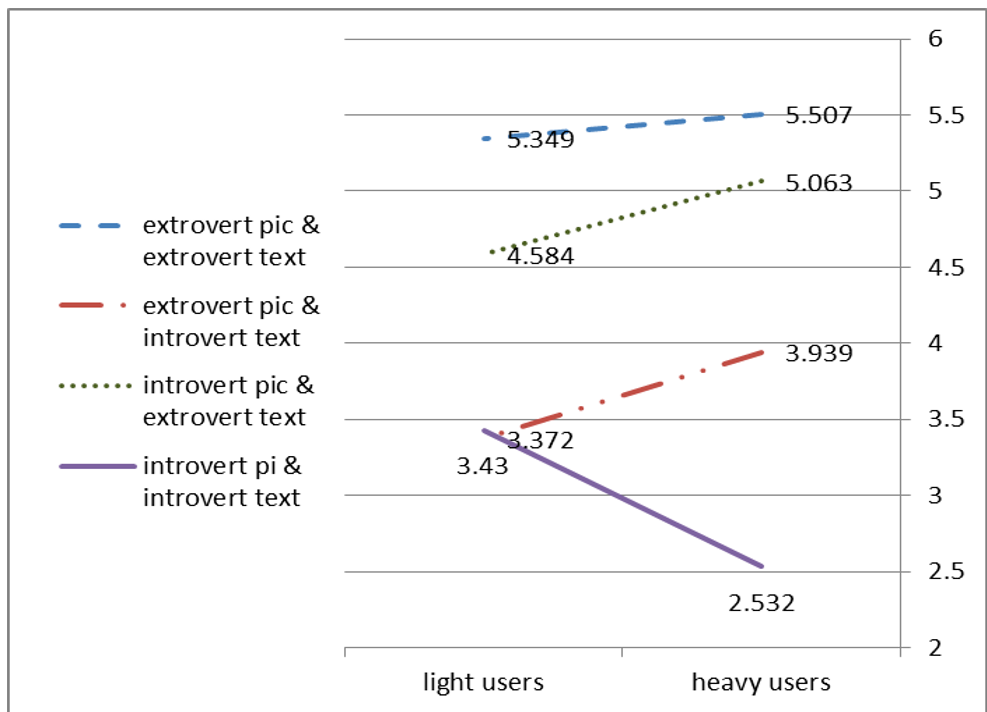
An interesting insight from Study 2 (visualized above) is that Heavy Facebook Users process information differently. They are more "skilled" observers who account for both pictures and text. Light users, perhaps overwhelmed by the interface, default almost entirely to the text to simplify their decision-making process.
Critical Analysis & Takeaways
The core contribution of this work is the debunking of unconditional "Visual Primacy." In the complex architecture of a social media profile, text acts as the semantic anchor.
Limitations:
- The study primarily focused on extroversion. Whether text holds the same power for traits like "attractiveness" or "trustworthiness" remains an open question.
- The data skewed toward female participants, which might influence social perception styles.
Future Outlook: In an era of AI-generated avatars and deepfakes, the "Warranting Theory" highlighted here becomes more relevant than ever. We are likely to see a shift where "third-party signals" (Likes, verified badges, and others' comments) completely override the content generated by the user themselves.
Final Summary: Next time you post to impress, remember: your caption might be doing more work than your filter.