
Improving Peer Cooperation: Leveraging Social Credits and Proximity in P2P Networks
Improve peer cooperation using social networks
2009-06-01
Summary
Problem
Method
Results
Takeaways
Abstract
This paper proposes a social-network-based incentive mechanism for P2P systems, extending prior methods by integrating credit transfer and proximity-aware routing. The core method utilizes balance, trust, and hop count to optimize peer selection and discourage behaviors like freeriding and whitewashing.
## TL;DR
This research transforms the "wild west" of unstructured P2P networks into a structured social economy. By introducing **Credit Transfer** and **Proximity-aware Routing**, the authors tackle the chronic issues of freeriding and inefficient data path discovery, successfully reducing network debt and shortening query latency simultaneously.
## Problem & Motivation: The Tragedy of the P2P Commons
In unstructured P2P networks like Gnutella or BitTorrent, anonymity is a double-edged sword. While it permits easy entry, it invites **Freeriders**—users who consume bandwidth without contributing. Studies have shown that over 70% of Gnutella users contribute zero resources. Furthermore, malicious nodes use **Whitewashing** (re-joining with a new ID) to erase a history of bad behavior.
The authors argue that existing incentive models fail because they don't value physical "Proximity." Choosing a cooperative neighbor is good, but if that neighbor is 10 hops away from the data, the network remains inefficient.
## Methodology: The Social Fabric of Credits
The paper models the P2P network as a directed graph where edges represent "Friendships" defined by three distinct criteria:
1. **Balance ($B_{jk}$)**: The net service difference between two peers.
2. **Trust ($T_{jk}$)**: The total volume of interaction, signifying a long-term relationship.
3. **Proximity ($P_k$)**: The distance (hop count) from a neighbor to the target data.
### The Credit Transfer Mechanism
The most innovative contribution is the **Credit Transfer**. If Peer A wants data from Peer B, but Peer B refuses because Peer A is "in debt," Peer A can find a mutual friend (Peer C) who owes Peer A a debt. Peer A can then "transfer" that debt to Peer B, effectively paying off its obligations using social capital.

*Figure 1: Balance and trust dynamics in a P2P social network.*
### Server Selection Strategy
Peers use a weighted decision function $Q_{jk}$ to choose which friend to query:
$$Q_{jk} = w_1( ext{Balance}) + w_2( ext{Trust}) + w_3( ext{Proximity})$$
This ensures that routes are chosen not just based on who is "nicest," but who is "closest" to the data.
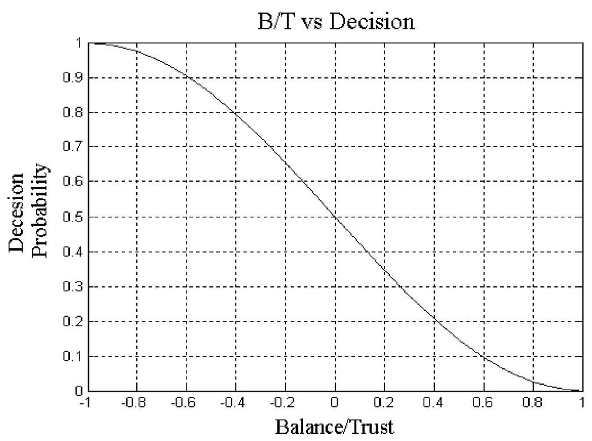
*Figure 4: A scenario where credit transfer (node i using node k's debt to pay node j) enables the best path selection.*
## Experiments & Results
The authors simulated a 100-node network with varying turnover rates (peers leaving and joining).
* **Debt Reduction**: The average network balance remained significantly closer to zero, indicating that the credit transfer mechanism effectively "recycled" debt to keep the economy moving.
* **Efficiency**: The average hop count to reach a data source was consistently lower than the baseline baseline algorithm.
* **Resilience**: The query satisfaction rate stayed remarkably stable even when 50% of the network was replaced by new peers.
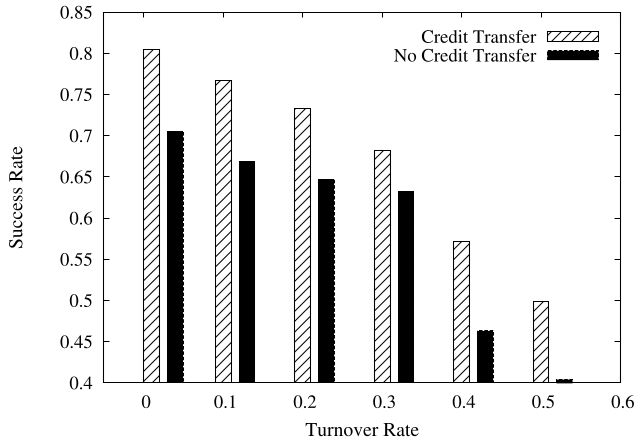
*Average hop count showing a significant reduction in network latency using the proposed method.*
## Critical Analysis & Conclusion
The addition of **Proximity** to social-credit models is a vital bridge between social engineering and network engineering. By allowing peers to trade credits via mutual friends, the system mimics real-world social economies, making it harder for freeriders to exist without contributing.
**Limitations**: The current model assumes peers will truthfully acknowledge credit transfers. In a truly hostile environment, a peer might deny a transfer occurred.
**Future Outlook**: The authors suggest incorporating secure authentication (like certificates) to enable "stranger-to-stranger" credit transfers, which could pave the way for more robust decentralized sharing protocols.