
IA-NSGA-ES: Balancing Industrial Efficiency and Green Manufacturing via Hybrid Evolution
Improved Adaptive Non-Dominated Sorting Genetic Algorithm With Elite Strategy for Solving Multi-Objective Flexible Job-Shop Scheduling Problem
This paper introduces IA-NSGA-ES, an improved adaptive non-dominated sorting genetic algorithm with an elite strategy specifically designed for the Multi-Objective Flexible Job-Shop Scheduling Problem (MOFJSP). The method integrates simulated annealing into the elite selection process and utilizes a twofold objective weighting approach to optimize completion time, carbon emissions, and machine load simultaneously.
TL;DR
The paper presents IA-NSGA-ES, a major upgrade to the standard NSGA-II algorithm aimed at the Multi-Objective Flexible Job-Shop Scheduling Problem (MOFJSP). By combining adaptive genetic operators with a Simulated Annealing (SA) elite strategy, the authors achieve a dual victory: slashing carbon emissions by up to 44% while significantly accelerating production convergence.
Problem & Motivation: The Flexibility Trapped by Complexity
In the world of smart manufacturing, the Flexible Job-Shop Scheduling Problem (FJSP) is the ultimate puzzle. Unlike traditional JSP where one operation is tied to one machine, FJSP allows operations to be processed on any available machine with varying efficiencies.
While this flexibility is great for business, it creates a massive, non-deterministic polynomial (NP-hard) search space. Previous solutions (SOTA) like the original NSGA-II often:
- Get stuck in local optima (premature convergence).
- Ignore the environmental cost (carbon footprint) of machine idling and power variances.
- Generate poor-quality initial populations that waste computational cycles.
The authors' insight was to move beyond simple "survival of the fittest" by adding a thermodynamic filter—Simulated Annealing—to ensure only the truly elite individuals reach the next generation.
Methodology: The IA-NSGA-ES Architecture
The core of the algorithm rests on four pillars of improvement:
1. Hybrid Population Initialization
Instead of starting with 100% random guesses, the researchers use a constructive heuristic for 50% of the population. This utilizes a weight aggregation function to "prime" the evolution with candidates that are already somewhat optimized for completion time and carbon emissions.
2. Adaptive Evolutionary Operators
Standard Genetic Algorithms use fixed crossover () and mutation () rates. IA-NSGA-ES uses Adaptive Adjustment, where probabilities change based on the population's fitness variance. If the population is too uniform, mutation rates spike to prevent "inbreeding" and stagnation.
3. Simulated Annealing (SA) Elite Strategy
This is the method's "secret sauce." In standard NSGA-II, parents and children are simply merged. Here, child individuals undergo a Metropolis sampling process. Even if a child is slightly worse than a parent, it might be accepted based on a "temperature" probability, allowing the algorithm to "jump out" of local valleys.
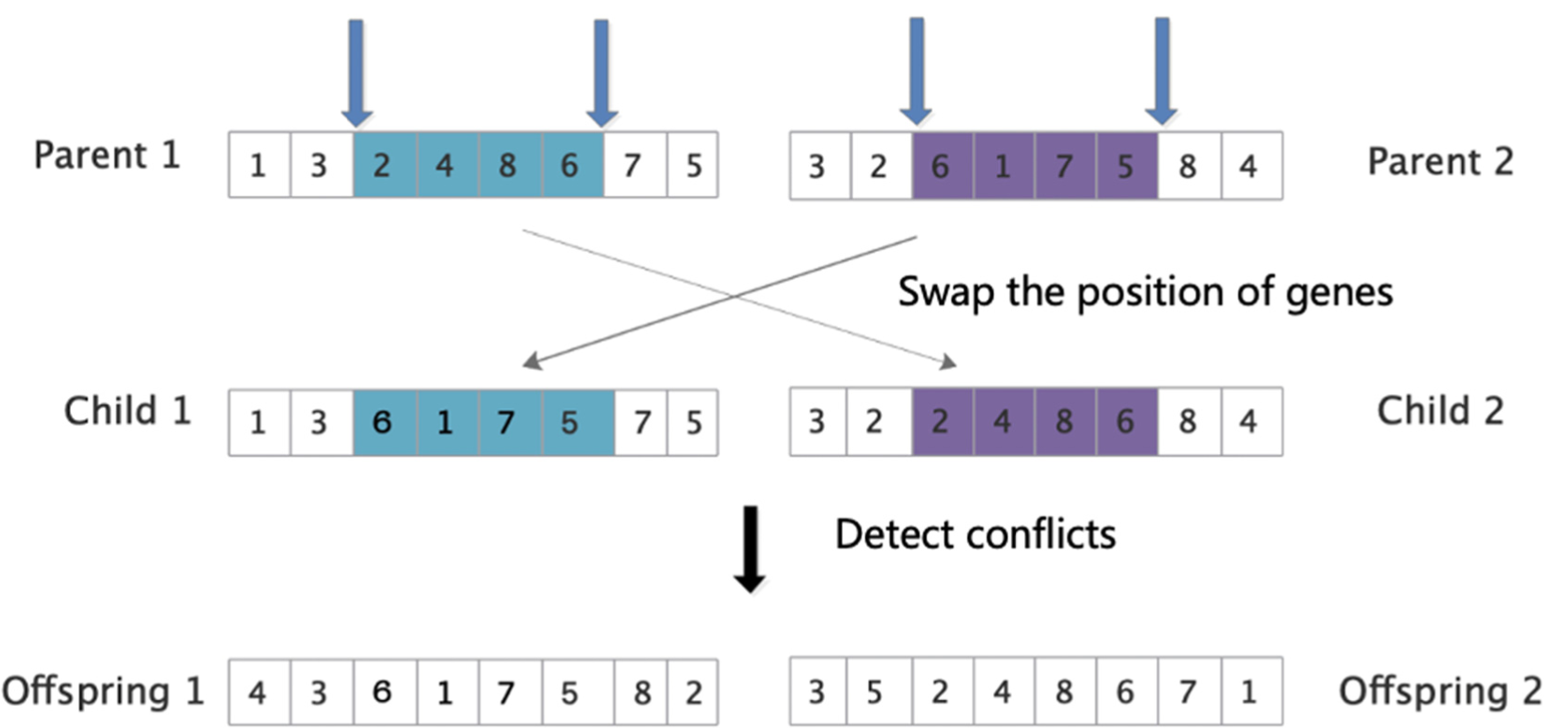 Figure 1: The Partial-Mapped Crossover (PMX) used to handle the two-layer chromosome coding (Process and Machine).
Experiments & Results: Performance and Environmental Impact
The algorithm was tested on standard benchmarks (FT and LA series) and a real-world shutter factory case study involving 8 machines and 8 jobs.
Quantifiable Gains
- Carbon Reduction: Compared to standard NSGA-II, the algorithm reduced carbon emissions by 12% to 44.4% across different test instances.
- Convergence Speed: On the ZDT1 benchmark, the convergence time was slashed by 58.5% compared to Adaptive NSGA.
- Diversity: Variance results showed that IA-NSGA-ES maintains a much better "spread" of solutions, ensuring that decision-makers can choose from a diverse Pareto front.
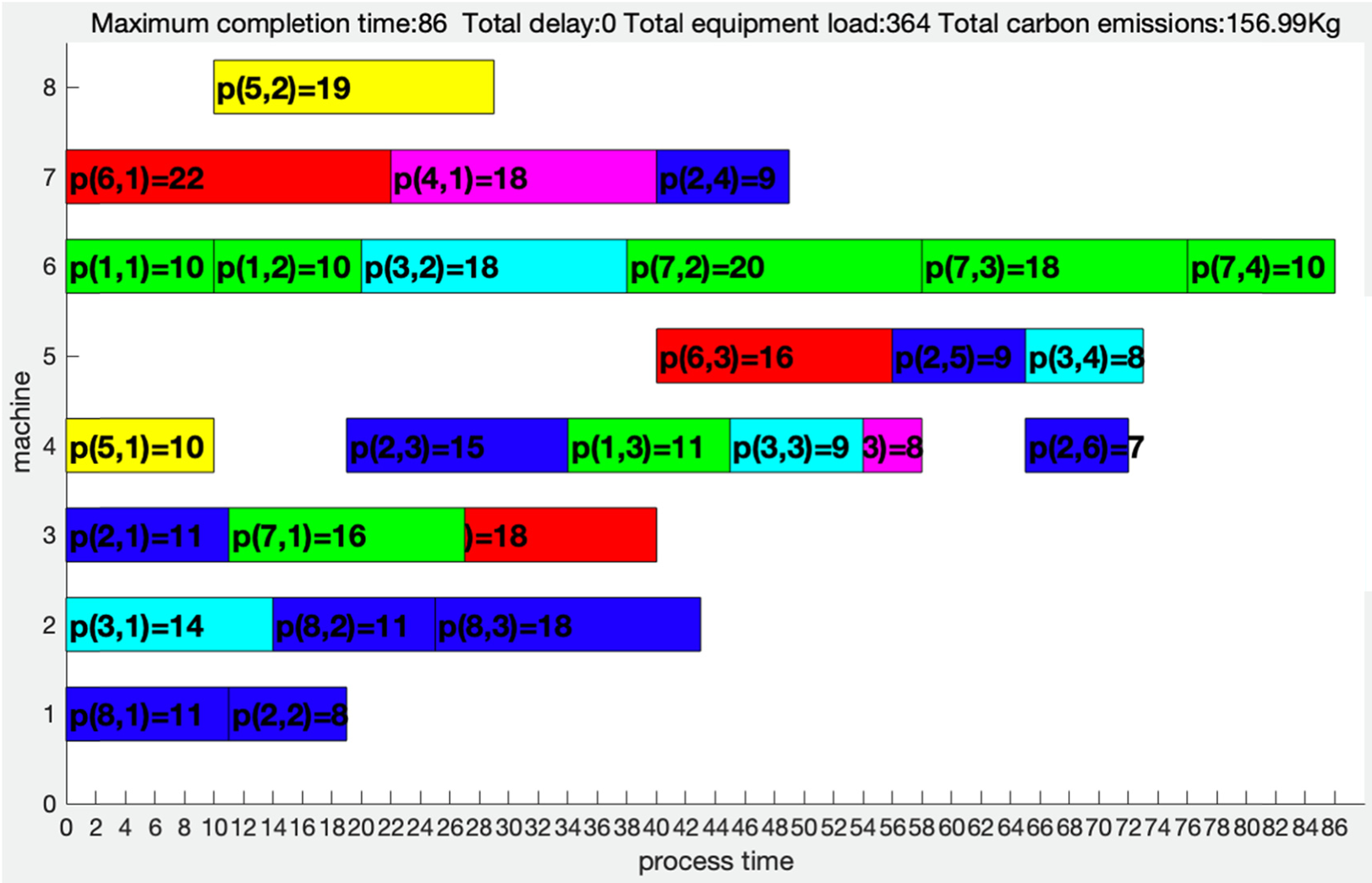 Figure 2: The Gantt chart output for an 8x8 factory problem, demonstrating high machine utilization with minimized idle gaps.
Critical Analysis & Conclusion
Takeaway
IA-NSGA-ES proves that "Greening" a factory doesn't have to break the schedule. By refining the Exploration-Exploitation trade-off through Simulated Annealing, the researchers created a robust tool for real-time industrial optimization.
Limitations
While the algorithm shines on convex Pareto fronts (ZDT1), the authors noted that on non-convex or non-connected sets (ZDT2/ZDT3), the average performance is comparable to existing ANSGA. There is still room to improve the crowding distance logic for fragmented solution spaces.
Future Outlook
The next step for this technology lies in dynamic rescheduling—updating the GA in real-time when a machine breaks down or an emergency order arrives. Integrating these genetic algorithms with Deep Reinforcement Learning (DRL) for faster real-time inference remains a promising frontier.