
Improved Ant Colony Algorithm: Breaking the Efficiency Bottleneck in Social Network Clique Mining
Improved Ant Colony Algorithm for Finding the Maximum Clique in Social Network
This paper introduces an Improved Ant Colony Algorithm (IACA) specifically designed to solve the Maximum Clique Problem (MCP) in complex social networks. By integrating a dual-node selection strategy and a local search improvement mechanism, the method achieves State-of-the-Art (SOTA) accuracy on the DIMACS benchmark and real-world social datasets.
TL;DR
Finding the "Maximum Clique"—the largest fully connected subgroup—is a fundamental yet NP-hard challenge in social network analysis. This paper presents an Improved Ant Colony Algorithm (IACA) that overcomes traditional stagnation issues. By alternating between a probabilistic "Roulette Wheel" and a frequency-based "Complement Strategy," and adding a greedy local improvement step, the researchers achieved significantly faster convergence and higher accuracy across standard DIMACS benchmarks and real-world collaboration networks.
The Challenge: Stagnation vs. Speed
In the context of Big Data, social networks comprise millions of nodes and complex relationships. The Maximum Clique Problem (MCP) is critical for identifying cohesive subgroups (e.g., in protein-protein interactions or citation analysis).
Previous Ant Colony Optimization (ACO) methods faced a "rich-get-richer" problem: ants follow pheromone trails so strictly that they stop exploring new possibilities, falling into local optima. While increasing diversity helps, it usually kills the algorithm's convergence speed. The authors set out to solve this trade-off.
Methodology: Two Core Innovations
1. Dual-Selection Strategy (Exploration)
Instead of relying solely on pheromone intensity, the algorithm maintains a table recording how often each node has been selected.
- Exploitation Phase: Uses standard roulette wheel selection based on pheromone ().
- Exploration Phase (Complement Strategy): Specifically selects nodes that have appeared the least in previous iterations.
By alternating these strategies (using a control ratio between and ), the algorithm forces ants into "uncharted territory," preventing early stagnation.
2. Local Clique Refinement (Exploitation)
To boost convergence, the authors don’t wait for the pheromone to naturally "accumulate" around a good solution. Instead, they apply a local swap:
- Identifies a node in the current clique that can be replaced by two other connected nodes .
- This greedy swap immediately increases the clique size, providing a higher-quality "baseline" for the next pheromone update.
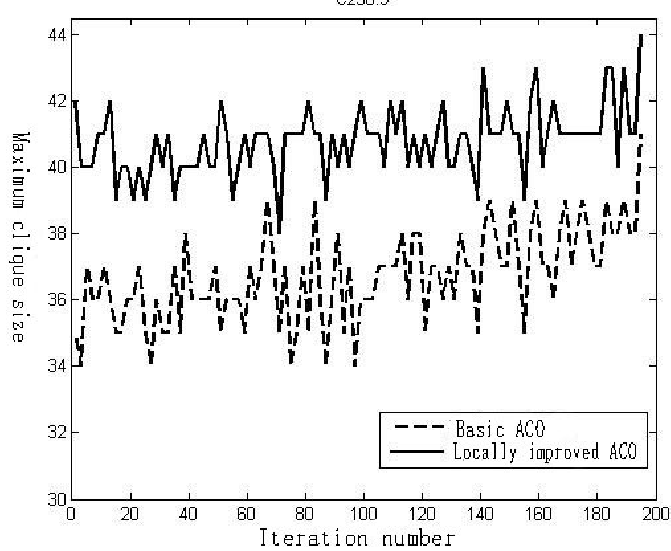 Figure: The solid line shows the rapid growth in clique size when Local Improvement is activated compared to the baseline.
Experimental Performance
The IACA was tested against Edge-AC+LS, previously one of the most accurate solutions.
Key Benchmarks (DIMACS):
- Accuracy: Outperformed the baseline in 12 out of 32 major benchmarks.
- Efficiency: Reduced running time in over 70% of the test cases.
- Social Networks: In tests ranging from "Zachary's Karate Club" to "Email Interchange Networks," the algorithm found the optimal solution 100% of the time, whereas previous PSO-ACO hybrids often fell short in average accuracy.
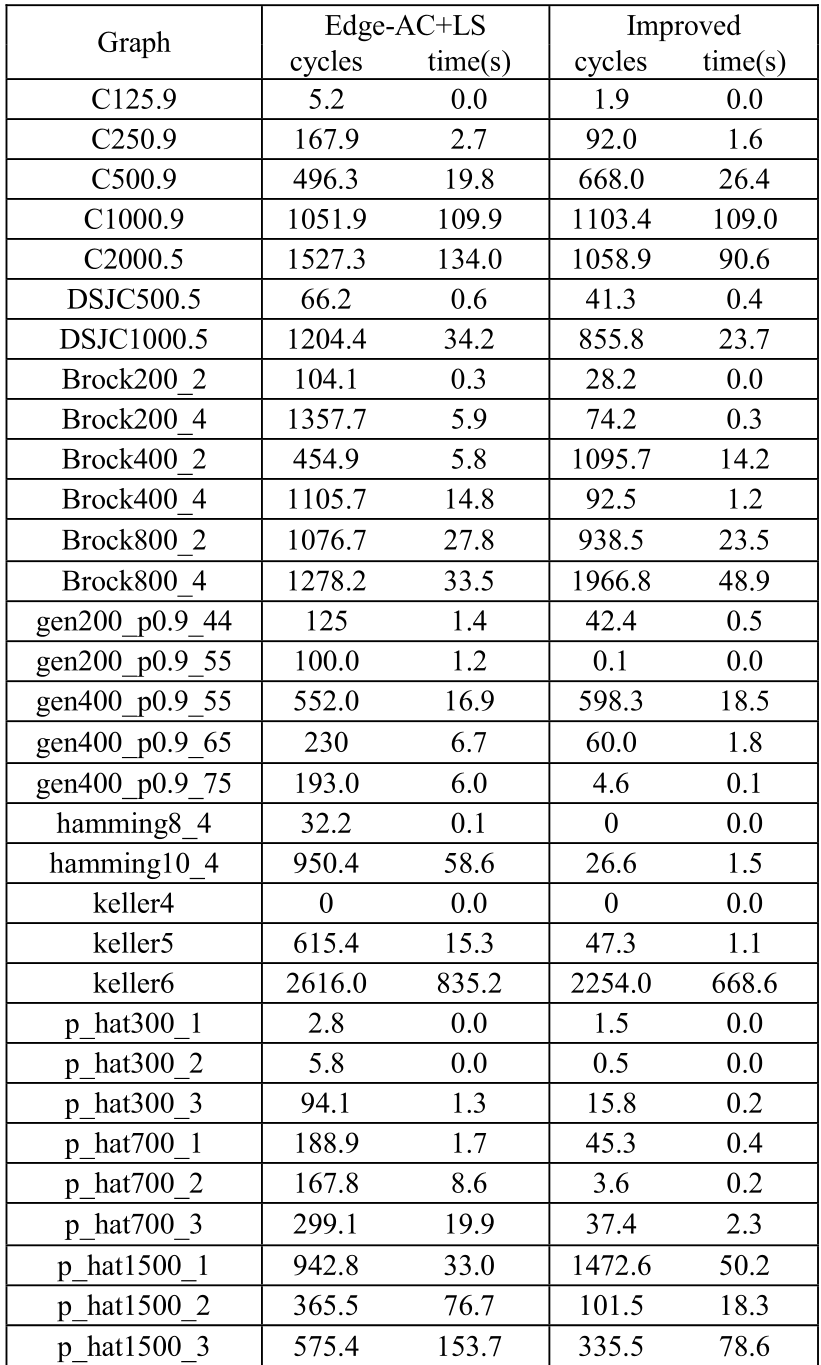 Table: Comparison of convergence cycles and time. Note the drastic reduction in cycles for the 'Brock' series.
Critical Analysis & Conclusion
The real value of this work lies in the dynamic balance between the Complement Strategy (which prevents stagnation) and the Local Improvement (which accelerates optimization).
Limitations: Choosing the right hyperparameters ( and ) remains empirical. The authors suggest a ratio between 1:10 and 1:5, but extremely sparse or dense graphs might require more fine-tuning.
Future Work: As social networks evolve into the multibillion-node scale, a parallelized version of this improved ACO, possibly leveraging GPU acceleration for pheromone matrix updates, would be the next logical step in this research lineage.