
Beyond the "Brows" Tier: A Hierarchical Multi-Layer Framework for Natural Sign Language Generation
An Improved Framework for Layering Linguistic Processes in Sign Language Generation: Why There Should Never Be a “Brows” Tier
The paper proposes a novel architectural framework for Sign Language Generation (SLG) that utilizes a "sub-bone" hierarchical model to layer concurrent linguistic processes. By replicating skeletal joints for different linguistic tiers (Lexical, Affect, Role-shift, etc.), the system enables realistic, multi-channel avatar animation that remains legible to native signers.
TL;DR
Researchers have developed a breakthrough framework for sign language avatars that moves away from simple anatomical "tiers." By treating the avatar's skeleton as a stack of "sub-bones"—where each bone is duplicated for specific linguistic tasks like emotion, syntax, and lexical movement—the system can blend overlapping signals into fluid, natural motion that is legible to the Deaf community.
Context: The Multi-Channel Complexity of Sign Language
Unlike spoken language, which is primarily linear, sign languages are inherently multi-channel. A single utterance involves the hands, arms, torso, neck, and face simultaneously. Existing avatars often look "robotic" because they struggle to coordinate these channels asynchronously.
The core insight of this paper is that linguistic processes, not anatomy, should dictate the animation structure. In natural signing, different processes (like a "Yes/No" question marker and a "Sad" facial expression) might both target the eyebrows simultaneously. A single "Brows" track cannot handle this conflict; hence, the authors argue there should never be a single "Brows" tier.
The Problem: The "Joint Conflict" Challenge
Current SOTA methods in sign synthesis often fall into two camps:
- Linguistic Synthesis: Flexible but results in stiff, robotic movement.
- Motion Capture: Highly realistic but extremely difficult to edit or combine into novel sentences.
The technical bottleneck is asynchronicity. The onset of a facial expression may not align with the start of a hand sign. When multiple processes affect the same part of the body, standard animation systems often overwrite one with the other, losing the "layered" nuances that native signers rely on for legibility.
Methodology: The Sub-Bone Revolution
To solve this, the authors introduced an elegant software engineering feat: Sub-Bone Hierarchies.
Instead of a single bone for the "Waist" or "Brows," they split each joint into a chain of sub-joints. For example, the "Waist" becomes:
- Waist_Lexical: Handles the base movement of the sign.
- Waist_Liven: Adds procedural Perlin noise to make the avatar look "alive."
- Waist_RoleShift: Adjusts body orientation for reported speech.
- Waist_Affect: Layers emotional body language (e.g., joy or sadness).
Architecture Overview
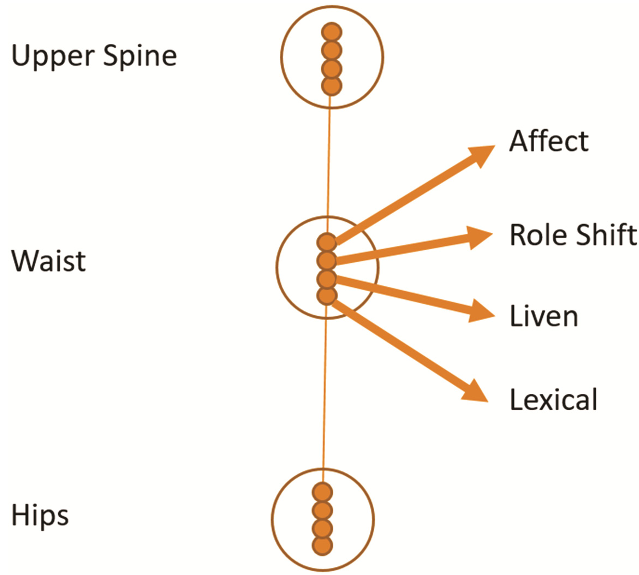 Fig 1: The sub-bone hierarchy allows each linguistic process to own an identical coordinate space, which is then blended via parent-child inheritance.
Mathematically, this is expressed as a product of transformation matrices:
By using this chain, the animation engine automatically calculates the sum of all influences without any extra specialized code. If one process raises the brows and another lowers them, the resulting matrix product accurately reflects the physical "net" result.
Experimental Results & User Experience
The framework was implemented in the "Paula" sentence generator. The UI allows linguists to enable or disable tracks (like "Affect" or "Role Shift") independently, facilitating a "Hypothesis-Testing" environment where researchers can see exactly how one linguistic parameter changes the output.
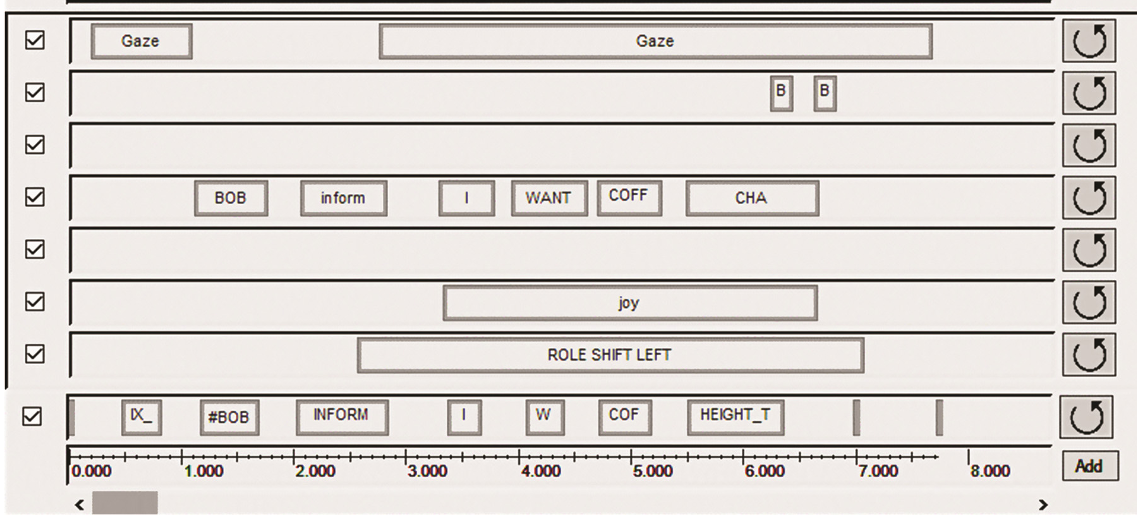 Fig 2: The sentence generator interface showing vertical tracks for different linguistic processes, allowing for asynchronous control.
Key Achievements:
- Flexibility: Supports Key-frame, MoCap, and Procedural animation within the same joint chain.
- Efficiency: Minimal memory overhead and no extra computational burden compared to traditional blending.
- Legibility: Solves the "conflicting brows" problem, allowing for complex expressions where syntax and emotion co-occur.
Critical Analysis & Conclusion
This work represents a significant shift from "animation-centric" to "linguistic-centric" avatar design. The "sub-bone" approach is remarkably parsimonious—it solves a complex layering problem by simply reorganizing the existing data structures of 3D engines.
Limitations: The current model assumes that bone transformations are mostly additive. However, as the authors note, real human biomechanics sometimes involve non-linear interactions (e.g., one movement might restrict the range of motion of another).
Future Outlook: The next step for this technology is integrating it with Deep Learning-driven translation. If a Transformer model can output the "intensity curves" for these sub-bones, we could finally see real-time, high-fidelity translation from spoken text to naturalistic sign language.