
iLLaDA: Bridging the Gap Between Diffusion and Autoregressive Intelligence
Improved Large Language Diffusion Models
The paper introduces iLLaDA, an 8B masked diffusion language model (MDLM) trained from scratch with fully bidirectional attention. By scaling pre-training to 12T tokens and implementing structural optimizations like Grouped-Query Attention (GQA), iLLaDA achieves SOTA performance among non-autoregressive models, rivaling strong autoregressive baselines like Qwen2.5.
TL;DR
iLLaDA (improved Large Language Diffusion Model) is a new 8B parameter model that proves non-autoregressive, bidirectional diffusion can compete with the world's best causal LLMs. By scaling to 12 trillion tokens and refining the training/inference recipe, iLLaDA wipes out previous performance gaps, matching or exceeding Qwen2.5-7B on critical reasoning benchmarks.
The "Broken" Monopoly of Autoregression
For years, the LLM landscape has been a monoculture: Next-Token Prediction with Causal Attention. While successful, this paradigm has "reversal curses" (difficulty reasoning backwards) and fails to exploit the full context of a sequence during the learning phase.
The authors of iLLaDA argue that Masked Diffusion—where the model learns to fill in blanks in a sequence using fully bidirectional attention—is inherently more powerful. The bottleneck hasn't been the theory, but the execution and scale.
Methodology: High-Efficiency Diffusion
iLLaDA transitions from the original LLaDA architecture to a more "production-ready" stack. Key innovations include:
- Grouped-Query Attention (GQA): By using 8 KV heads for 32 Query heads, the model reduces the memory footprint during inference (which often involves KV-cache-like mechanisms in modern diffusion).
- Confidence-Based Scoring: Unlike AR models that use log-likelihood, iLLaDA evaluates multiple-choice answers by iteratively revealing the tokens it is most certain about. This heuristic proves significantly more accurate than raw likelihood.
- Variable-Length Generation: Using block-based sampling, the model can dynamically adjust output lengths, breaking the fixed-length constraints of early diffusion models.
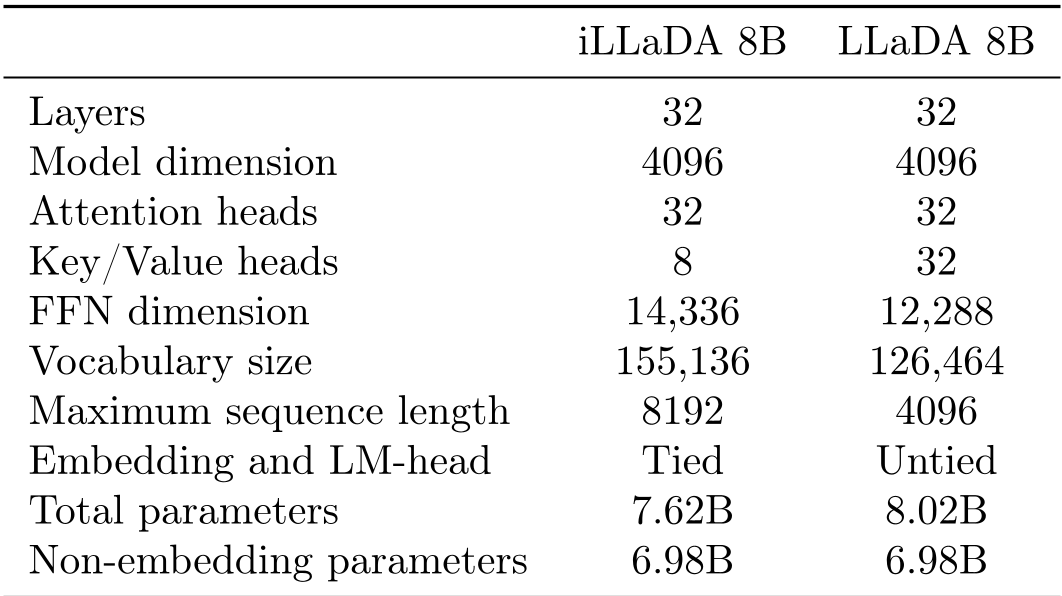 Table 1: Evolution from LLaDA to iLLaDA – Note the transition to GQA and larger max sequence length.
Experimental Breakthroughs
The most shocking result is iLLaDA's competitive edge against Qwen2.5 7B, one of the strongest AR models in the same size class.
- Reasoning Power: iLLaDA-Base hits 81.9 on GSM8K, outperforming Qwen2.5's 78.9.
- General Tech: On BBH (Big-Bench Hard), it scores 71.3, an massive leap from the original LLaDA's 49.7.
- The SFT "Magic": A key insight from the paper is that diffusion models are "super learners." While AR models can saturate quickly during Supervised Fine-Tuning, iLLaDA's performance on MMLU-Pro and MATH continues to climb even after 12 epochs of instruction tuning.
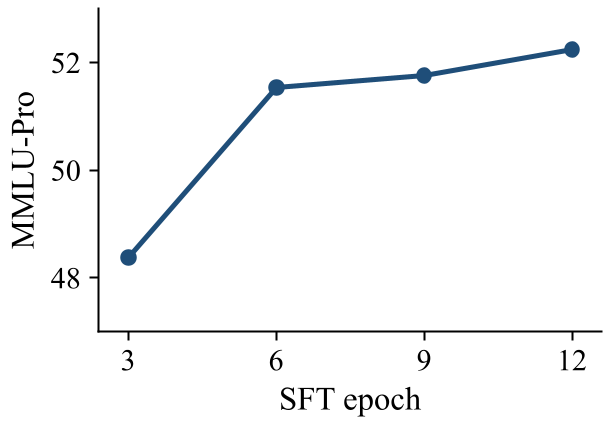 Figure 1: Performance scaling across SFT epochs – showing that diffusion models thrive on data repetition.
Critical Analysis & Future Outlook
While iLLaDA-Base is a triumph, the iLLaDA-Instruct version still trails Qwen2.5-Instruct. The authors attribute this to the lack of Reinforcement Learning (RL). Autoregressive models benefit from a mature ecosystem of RLHF (PPO/DPO), whereas RL for diffusion models is still an emerging frontier.
The Takeaway: The "AR-only" era of LLMs might be nearing its end. If a diffusion model can match a world-class AR model at the 8B scale, then the advantages of bidirectional context (better planning, easier multimodal integration, and immunity to certain reasoning biases) make it a formidable candidate for the next generation of Foundation Models.
Conclusion
iLLaDA represents a milestone for non-autoregressive modeling. It proves that with the right architectural tweaks and massive scale (12T tokens), bidirectional models are no longer "research toys" but serious contenders for SFT and general-purpose reasoning.