
SLABR: Optimizing DTN Efficiency via Social Link Awareness and Hybrid Forwarding
An Improved Routing Algorithm Based on Social Link Awareness in Delay Tolerant Networks
This paper introduces SLABR (Social Link Awareness Based Routing), a hybrid routing algorithm for Delay Tolerant Networks (DTNs) that leverages multi-dimensional social features (contact frequency, time, and regularity). It achieves superior routing efficiency by combining single-copy inter-community forwarding with multi-copy Binary Forwarding for intra-community spreading.
TL;DR
In the fragmented world of Delay Tolerant Networks (DTNs), message delivery relies on "Store-Carry-Forward" tactics. The SLABR (Social Link Awareness Based Routing) algorithm introduces a sophisticated way to measure social bonds between nodes to predict future encounters. By using a "single-copy" strategy between communities and a "multi-copy" strategy within communities, SLABR balances high delivery rates with low network overhead, outperforming both pure flooding and pure single-copy approaches.
Problem & Motivation: The Challenge of Social Selfishness
In DTNs, an end-to-end path rarely exists. Nodes must rely on others to carry their data. However, real-world nodes (often carried by humans) are "socially selfish"—they prioritize forwarding data for friends over strangers to save battery and storage.
Previous solutions generally fell into two flawed camps:
- Epidemic/Flooding: High delivery rates, but massive overhead that crashes limited-resource networks.
- Single-Copy: Minimal overhead, but extremely low delivery rates because they lack the "spread" needed to find a moving destination.
The authors recognized that a single feature (like how many times two nodes met) isn't enough to predict a reliable link. They needed a metric that considers regularity and indirect relationships.
Methodology: Quantifying the "Social Link"
The core innovation of SLABR is how it defines a social link (). It goes beyond simple contact counts by introducing mathematical "Pressure" metrics.
1. Social Pressure Metric (SPM) & RSPM
- SPM: Measures the average forwarding delay for direct one-hop contacts. It factors in meeting frequency and the uniformity of meeting intervals.
- RSPM (Relative SPM): Captures two-hop "friend-of-a-friend" relationships. This allows a node to realize it has a strong link to a destination even if it only meets it via a common intermediary.
2. The SLABR Hybrid Logic
SLABR operates via a dual-mode strategy based on the friendship community:
- Inter-Community (Single-Copy): If the destination is not in the current node's community, the message is passed only to a node with a stronger social link to the target. This prevents the network from being flooded with useless copies.
- Intra-Community (Multi-Copy Binary Forwarding): Once the message reaches a node in the same community as the destination, it switches to Binary Forwarding (BF). The message is split into copies, which are distributed like a balanced binary tree, ensuring the fastest possible diffusion with a controlled number of copies.
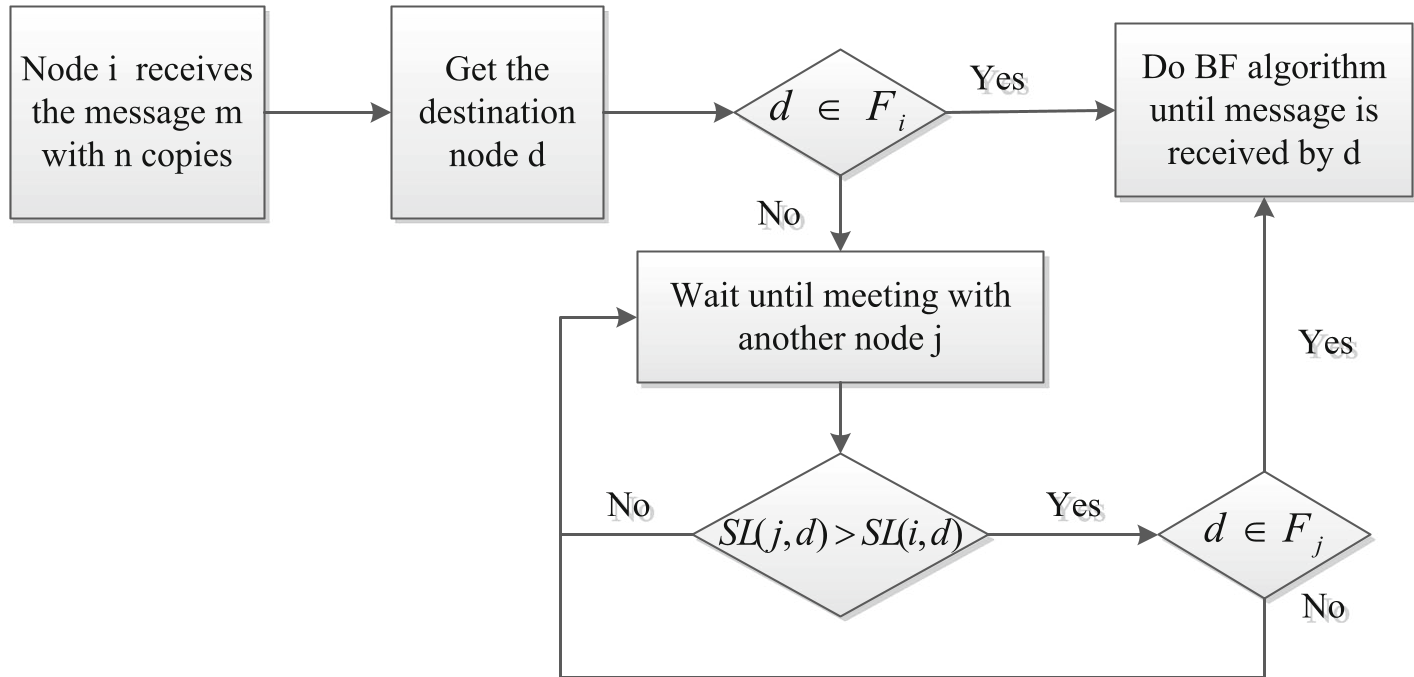 Figure 1: The logic flow of SLABR determines whether to spread or selectively forward.
Experiments & Results
The authors tested SLABR against IFR (High-dosage flooding) and FBR (Conservative single-copy) using the OPNET simulator.
Performance Gains
- Delivery Success: SLABR achieved nearly the same success rate as the resource-heavy IFR, and a 25% improvement over FBR.
- Overhead Control: While IFR's overhead skyrocketed as node density increased, SLABR's overhead remained stable—49% lower than IFR.
- Latency: By using Binary Forwarding inside communities, SLABR reduced the time-to-delivery by 16% compared to FBR.
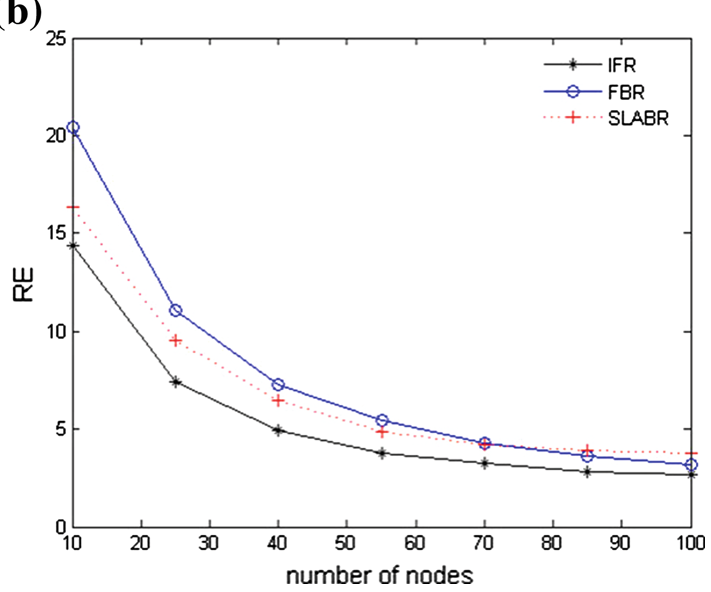 Figure 2: Routing Efficiency comparison shows SLABR (top blue line) outperforming competitors as the network scales.
Critical Analysis & Conclusion
Takeaway
SLABR proves that Social Awareness is not just a buzzword but a quantifiable routing metric. The most significant contribution is the mathematical proof that Binary Forwarding is the optimal way to "spray" messages once they are within the destination's "neighborhood" (friendship community).
Limitations & Future Work
- Complexity: SLABR requires computation for community construction, which might be taxing for low-power IoT devices.
- Congestion: The current study assumes infinite buffer space. In a real-world scenario, high-traffic nodes would need a cache-replacement policy (e.g., dropping the oldest message or the one with the weakest social link).
- Security: The algorithm assumes nodes report encounter history honestly. A malicious node could spoof high social links to "black hole" data packets.
In conclusion, SLABR offers a robust blueprint for future "human-centric" networks, where the movements of the nodes are as predictable—and as complex—as human social circles.