
Beyond Viral: Integrating ROI into SIR Models for Social Network Advertising
Improved SIR Advertising Spreading Model and Its Effectiveness in Social Network
This paper proposes an improved SIR (Susceptible-Infectious-Recovered) model specifically tailored for advertising propagation in social networks by introducing direct recovery and external infection parameters. It further integrates the Advertising Effectiveness Index (AEI) as a quantitative metric to evaluate the validity and performance of the spreading model.
TL;DR
Epidemiological models like SIR provide a strong foundation for understanding how information spreads, but they often ignore the "business" side of the equation. This paper introduces an Improved SIR Model that accounts for external influences and immediate disinterest, validated by a real-world commercial metric: the Advertising Effectiveness Index (AEI).
Context: Why Traditional SIR Is Not Enough
The classic SIR model (Susceptible -> Infectious -> Recovered) was designed for biology. When applied to social media advertising, it lacks two realistic dimensions:
- External Stimuli: Users don't just "infect" each other; they see ads on TV, billboards, or other platforms (External Infection).
- Instant Burnout: Some users see an ad and immediately decide not to buy or share, skipping the "Infectious" stage entirely (Direct Recovery).
This paper bridges this gap by modifying the transition logic to fit the "Social Network of Things."
Methodology: The Mathematics of Persuasion
The researchers redefined the states of the network nodes to align with consumer behavior:
- S (Susceptible): Users unaware of the ad.
- I (Infectious): Users who are aware, have purchased, and are actively sharing.
- R (Recovered): Users who know the ad but have lost interest or finished their journey.
The Core Evolution Equations
By introducing the external infection probability () and direct recovery probability (), the differential equations governing the system become more industry-aligned:
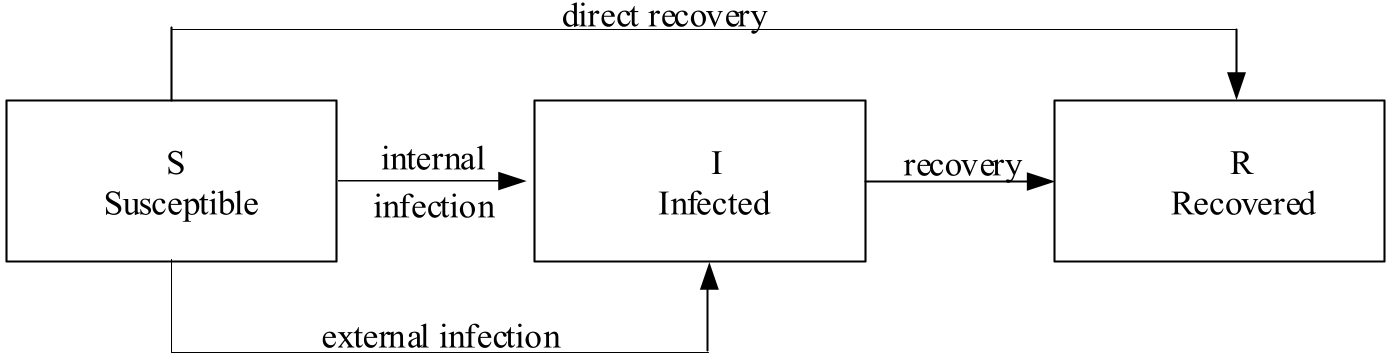 Figure 1: State evolution of the improved SIR model showing internal/external pathways.
The dynamic equations (Formula 2 in the paper) describe how the density of Susceptible nodes decreases not just through contact with Infectious nodes (), but also through independent external exposure ().
Measuring Success: The AEI Metric
One of the paper's most significant contributions is moving beyond mere "reach" to "effectiveness." They utilize the AEI: Where:
- A: Seen ad & Purchased.
- B: Haven't seen ad & Purchased (Organic).
- C: Seen ad & Not purchased.
- D: Neither seen nor purchased.
This index isolates the actual impact of the advertisement from organic purchasing behavior.
Experimental Results on Facebook Data
Using a subset of the Facebook social graph, the authors simulated the campaign. They found that by targeting "Hub" nodes (nodes with high degrees), the AEI spikes rapidly.
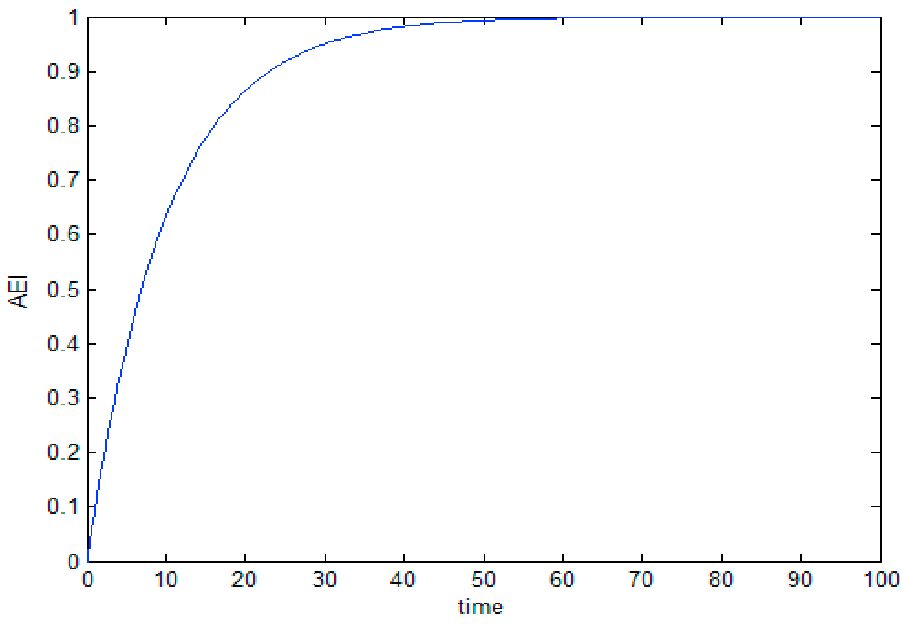 Figure 2: The trend of AEI over time showing rapid onset and long-term stabilization.
The results demonstrate that the model reaches a steady state, allowing marketers to predict the long-term saturation point of an advertising campaign.
Critical Insight & Conclusion
While the model is a significant step forward in making SIR models "commercially aware," it assumes static parameters for infection and recovery. In real-world scenarios, these probabilities often fluctuate based on the quality of the ad content or seasonal trends.
The Takeaway: If you are modeling information spread for a brand, don't just track how many people "saw" the content. Use an improved model that accounts for multi-channel noise and utilizes an effectiveness index like AEI to separate viral noise from actual conversion.