
Decoding the Social Shadow: Multi-Attribute Correlation for Stealthy Privacy Attacks
An improved social attribute inference scheme based on multi-attribute correlation
The paper introduces an improved social attribute inference scheme that leverages multi-attribute and behavior correlations. By combining the Apriori algorithm for data mining with Markov Random Fields (MRF) and Loopy Belief Propagation (LBP), the method achieves superior precision in deanonymizing hidden user traits on platforms like Facebook and Weibo.
TL;DR
Researchers from Beihang University have developed a sophisticated framework to infer hidden social media profiles. By analyzing the "hidden threads" connecting multiple attributes (like birth year and education) and behaviors (like tweeting patterns), they've created a model that outperforms existing SOTA methods. Using a combination of Apriori-driven data mining and Markov Random Fields, they demonstrate that your "hidden" information is less secret than you think.
Background: The Illusion of Anonymity
Most Online Social Networks (OSNs) try to protect users by hiding sensitive fields like exact location or gender. However, current research proves that social links ("who you know") act as a bridge to "who you are." While prior works like ReAI focused on the link between two attributes, and VIAL looked at single behaviors, they missed the bigger picture: Multi-attribute synergy. This paper argues that the intersection of multiple features provides a much higher resolution of your digital identity.
Methodology: The Hybrid Correlation Engine
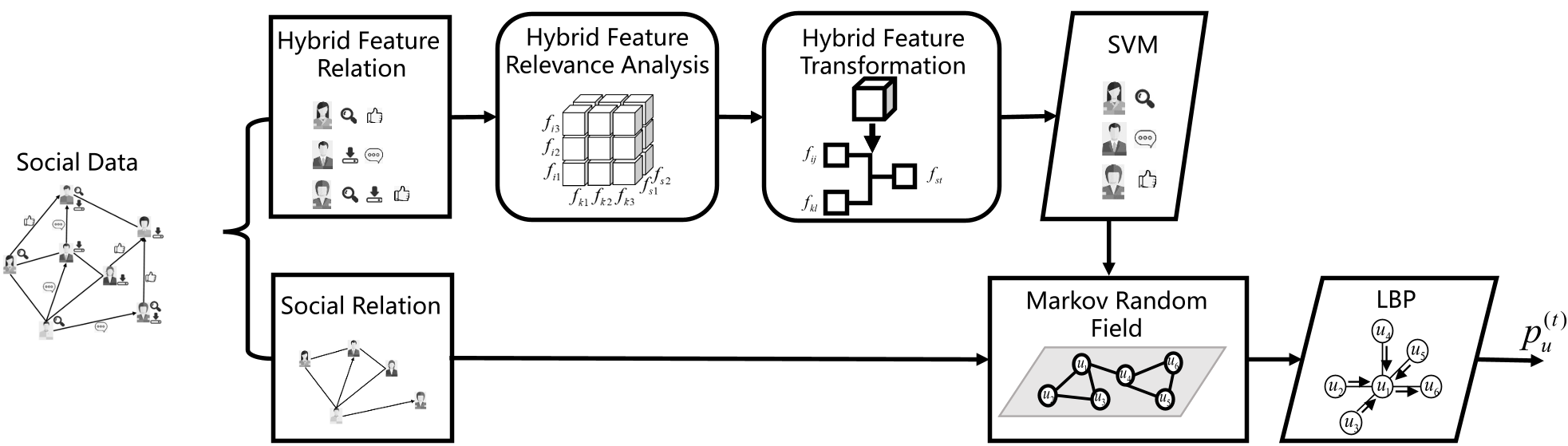
The core of this work lies in its three-stage pipeline: Mining, Transformation, and Propagation.
1. Mining Association Rules
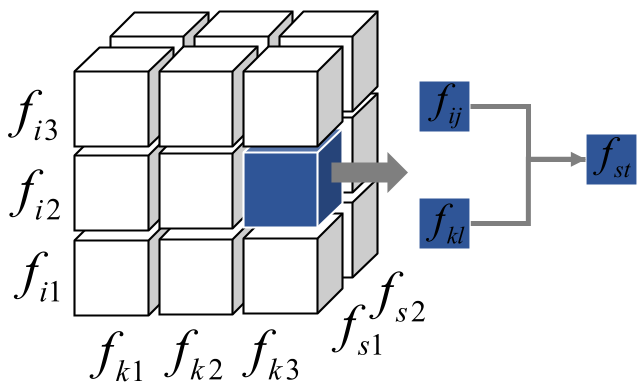
The authors don't just guess which features are related. They use the Apriori Algorithm on a multi-dimensional "Data Cube." This identifies strong association rules such as: (Gender: Male, Province: Guangdong) → (Behavior: High Retweet Frequency).
To quantify this "strength," they use the Kulczynski (Kulc) and Cosine coefficients, which are robust against "null-invariance"—a common problem in social media where data is often missing or sparse.
2. Feature Transformation
Once correlations are found, they perform a Feature Transformation. This converts a standard user feature vector into a weighted vector that emphasizes the most "telling" predictors for a specific target attribute (e.g., using "Education" and "Birthday" to predict "Gender").
3. MRF and Loopy Belief Propagation
The network is modeled as a Markov Random Field (MRF).
- Prior Probability: An SVM classifier processes the weighted features to get an initial guess.
- Posterior Probability: Using Loopy Belief Propagation (LBP), the model iteratively "spreads" information across social links until it reaches a consensus on the user's hidden attributes.
Experimental Showdown
The authors tested their scheme against two heavyweights: ReAI (Link/Relevance based) and VIAL (Behavior based).
- High Cardinality Success: In the Weibo dataset, predicting the "Province" (36 possible values) is notoriously difficult. The proposed method reached 0.852 precision, significantly beating VIAL's 0.657.
- Behavioral Boost: By adding "Emotional Polarity" (EP) to the inference of gender, the precision jumped from 0.763 to 0.832, proving that how you express yourself is as revealing as who you follow.
| Attribute | Values | ReAI | VIAL | Our Work |
|---|---|---|---|---|
| Gender (Facebook) | 2 | 0.607 | 1.000 | 0.683 |
| Edu_Type (Facebook) | 3 | 0.594 | 0.492 | 0.637 |
| Province (Weibo) | 36 | 0.833 | 0.657 | 0.852 |
Deep Insights & Limitations
The Power of "Hybridity"
The paper confirms a crucial trend in cybersecurity: Hybrid attacks are the most potent. The combination of structural links (Graph theory), statistical correlations (Data mining), and content analysis (NLP/Behavior) leaves very little room for privacy.
Limitations
- Iterative Complexity: LBP and Apriori are computationally expensive as the network size grows to millions of nodes.
- Null Data: While Kulc helps, extreme data sparsity in newer, more private social networks might still pose a challenge.
Conclusion: A Wake-up Call for OSN Providers
This research highlights that privacy protection cannot be a "piecemeal" effort. Hiding a single attribute is useless if the surrounding web of behaviors and secondary attributes remains visible. For researchers, this work opens a path toward using more advanced Deep Embedding techniques to capture even subtler non-linear correlations in the future.