
Bridging the Identity Gap: Improving Cross-Network User Identification via Semantic Tagging
An Improved User Identification Method Across Social Networks Via Tagging Behaviors
The paper proposes a novel User Identification method across social networks (SNSs) that leverages semantic tagging behaviors. By introducing a symmetric variant of the BM25 algorithm integrated with Word2vec, the method successfully identifies the same individual across Weibo and Douban even when their tags are linguistically inconsistent.
TL;DR
As users migrate across diverse social platforms (e.g., from Weibo's micro-blogs to Douban's reviews), identifying that two accounts belong to the same person becomes a major challenge for recommendation engines. This paper introduces a Semantic-Based BM25 approach that uses Word2vec to bridge the gap between inconsistent tagging behaviors. By focusing on the meaning of tags rather than just the literal text, the researchers achieved a 30% boost in identification accuracy.
Problem & Motivation: The "Inconsistency" Trap
Current User Identification (UI) methods often hit a wall because profile attributes (like location or real name) are frequently hidden for privacy, and social graphs are often sparse. Tags—keywords users use to label their content—offer a rich alternative.
However, the authors point out a critical flaw in prior work: tagging inconsistency. A user might tag a photo as "Food" on Douban but "Cooking" on Weibo. Standard lexical matching algorithms like TF-IDF or basic BM25 treat these as entirely different entities (), failing to recognize the underlying behavioral pattern.
Methodology: Semantic BM25 & Stable Matching
1. The Semantic Upgrade
The core innovation is the modification of the BM25 retrieval function. Instead of binary term matching, the authors define a semantic similarity function using Word2vec:
- Physical Intuition: If a user frequently uses tags that are close in a high-dimensional vector space (calculated via cosine distance), they are likely the same person.
- Formula Integration: The frequency in the BM25 formula is replaced by a sum of semantic weights , allowing "Food" to contribute to the score of "Cooking."
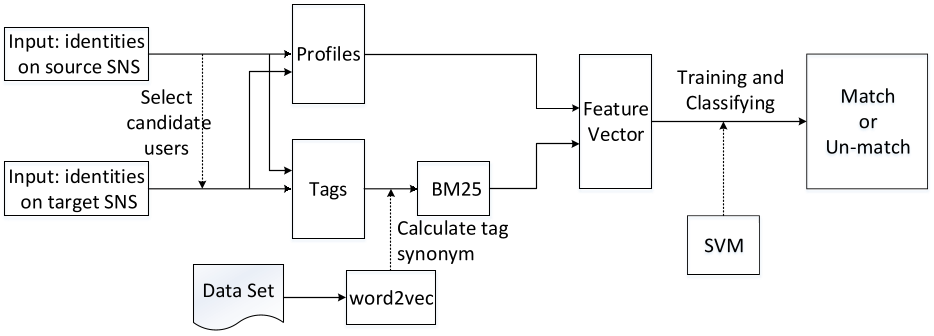 Figure 1: The dual-layered framework combining profile matching and semantic tag analysis.
2. Bi-directional Stable Matching
To avoid "collision" (where multiple source accounts claim the same target account), the authors implement a Greedy Stable Matching Algorithm. Inspired by the Stable Marriage Problem, it ensures that an identity is matched to only if they are mutually optimal candidates based on their similarity scores.
Experiments: Breaking the 30% Barrier
The team crawled over 6,000 verified linked accounts across Weibo and Douban. The results were striking:
- Semantic Power: Semantic-Based BM25 achieved an MRR of 0.77, vastly outperforming the 0.52 achieved by BM25 with specific IDF.
- Robustness: When tags were missing, the authors used LDA (Latent Dirichlet Allocation) to extract keywords from user-generated content, maintaining high accuracy (approx. 85% at ).
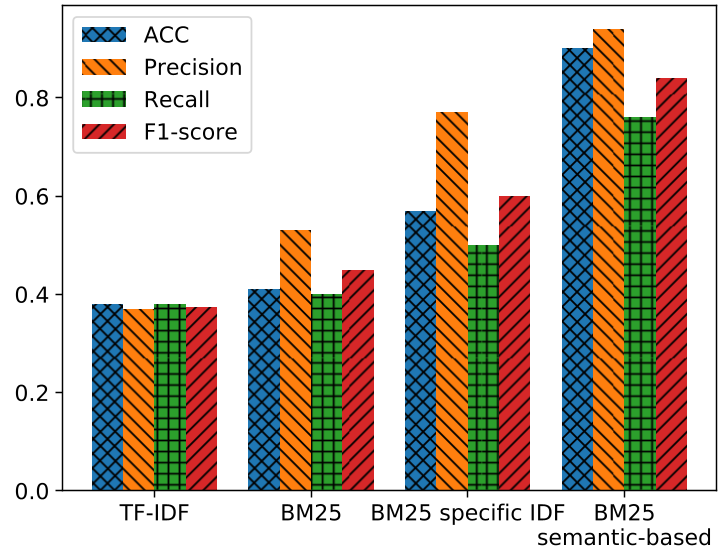 Figure 2: Performance metrics showing the superiority of the semantic approach in Accuracy, Precision, and Recall.
Critical Insight & Conclusion
This work shifts the focus from "what the user typed" to "what the user meant." By treating tags as semantic vectors, the model gains a form of Behavioral Invariance—it recognizes the person regardless of the specific vernacular used on a platform.
Future Outlook: While highly effective for text-heavy platforms like Douban, future iterations could benefit from integrating Multi-modal embeddings (images + text) to further solve the identity puzzle across platforms like Instagram or TikTok where tags are less frequent than visual content.