
Improving DP Kronecker Social Networks: The Power of Clustering and Averaging
Improving Accuracy of Differentially Private Kronecker Social Networks via Graph Clustering
The paper introduces a pre- and post-processing framework using graph clustering to enhance the accuracy of social network anonymization. By partitioning networks into clusters and averaging the localized Kronecker probability matrices, the method significantly improves the utility of -differentially private graph releases.
TL;DR
Publishing social network data while protecting user privacy is a balancing act between "hiding edges" and "preserving structure." This paper presents a novel framework that improves the accuracy of Differentially Private (DP) Kronecker Graphs. By clustering the network before applying DP and averaging the results after, the authors achieve higher structural utility and faster computation while maintaining rigorous mathematical privacy guarantees.
The Motivation: When Privacy Destroys Utility
Differential Privacy is the gold standard for data anonymization, but it has a notorious reputation for being "too noisy." In the context of social networks:
- Node/Edge DP requires adding noise proportional to the sensitivity of the graph metrics (like edge counts or triangles).
- For complex models like Stochastic Kronecker Graphs, this noise often results in a published graph that looks nothing like the original—losing its power-law degree distribution or small-world characteristics.
The authors' key insight is simple yet profound: Social networks are modular. If clusters share similar structural properties, we can treat them as multiple observations of the same underlying model.
Methodology: Divide, Anonymize, and Conquer
Instead of fitting one giant Kronecker model to the entire adjacency matrix , the paper proposes a three-step pipeline:
- Iterative Clustering: Use spectral clustering to partition the graph into clusters . This breaks the large adjacency matrix into sub-matrices.
- Parallel DP Estimation: Apply a private Kronecker estimator (like the moment-matching method) to each sub-matrix independently.
- Ensemble Averaging: The final output is the average of these estimators.
The Mathematical Intuition
Why does averaging help? DP methods effectively add noise to the underlying "true" parameters. By averaging across multiple clusters, the random noise components tend to cancel each other out, while the shared structural signal is reinforced.
Crucially, the authors prove Theorem 1: If each localized estimation is -DP, the averaged output does not leak any additional information. It remains -DP, providing a "free lunch" in terms of utility gain.
Note: The algorithm replaces a single global estimation with a localized cluster-based ensemble.
Experimental Results: Bridging the Gap
The authors tested their approach on four datasets including CA-GrQC (Co-authorship) and Wiki-Vote.
1. Structural Fidelity
The "Anon" (proposed) method consistently outperformed the "Private" baseline in:
- Degree Distribution: Better capturing the scale-free nature of social links.
- Hop Plot: Correctly modeling the "effective diameter" of the network.
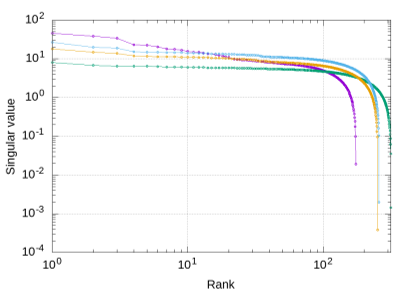 (Fig 1: AS-20 Overlayed patterns showing 'Anon' closer to 'Original' than 'Private')
2. Efficiency Gains
Traditional Kronecker fitting algorithms like KronFit scale with . By breaking the graph into clusters, the complexity drops to . This makes the method not just more accurate, but significantly more scalable for large-scale social graphs.
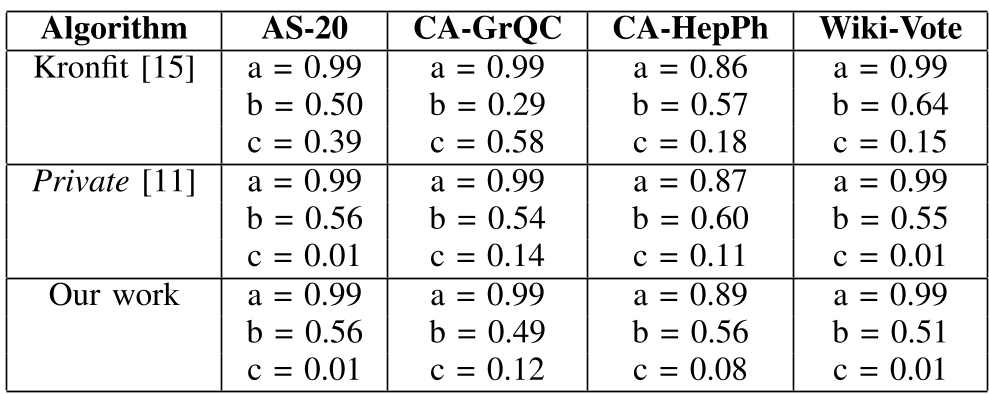 (Table 2: Comparison of estimated Kronecker parameters a, b, c across different methods)
Critical Analysis & Deep Insights
Why it works
The success of this method hinges on the homogeneity of graph clusters. Social networks often exhibit a fractal-like structure where sub-communities reflect the global organization. By exploiting this "local-to-global" similarity, the authors transform a single high-variance estimation problem into an ensemble of lower-variance ones.
Limitations
- Cluster Sensitivity: The performance depends on the quality of the initial clustering. If the clusters are highly heterogeneous, averaging might dilute unique local features.
- Metric Overfitting: While degree distribution and hop-plots improved, the "Average Clustering Coefficient" results were less impressive, showing that localized partitioning might still disrupt high-order cyclic structures.
Conclusion
This research demonstrates that Differential Privacy doesn't have to be a utility killer. By rethinking graph anonymization as an ensemble problem facilitated by clustering, we can release private social data that remains scientifically useful. For future work, applying this logic to non-Kronecker models or exploring the optimal number of clusters for different graph topologies remains an exciting frontier.