
Accurate Linguistic Modeling: Balancing Human Interpretability with SOTA Precision
15561_A proposal for improving the accuracy of linguistic modeling.
The paper introduces Accurate Linguistic Modeling (ALM), a two-stage methodology designed to enhance the precision of descriptive Mamdani-type fuzzy rule-based systems without sacrificing interpretability. It achieves SOTA-level accuracy by employing double-consequent rules and a genetic algorithm-based rule selection process.
TL;DR
Researchers Oscar Cordón and Francisco Herrera propose Accurate Linguistic Modeling (ALM), a framework that solves the "accuracy-interpretability" dilemma in fuzzy systems. By introducing rules with two consequents and using Genetic Algorithms (GA) to select the best "team" of rules, they achieve higher accuracy than neural networks in specialized engineering tasks while keeping the model readable for humans.
Background: The Interpretability Tax
In the world of system modeling, there is a famous trade-off known as Zadeh’s Principle of Incompatibility: as a system's complexity increases, our ability to make precise yet significant statements about its behavior diminishes. Traditionally, engineers had to choose between:
- Mamdani-type systems: Easy to understand ("If temperature is high, then power is low") but often inaccurate.
- TSK or Neural Models: Highly accurate but "black boxes" that are hard for humans to trust in critical applications.
ALM aims to break this dichotomy by refining how linguistic rules are structured and combined.
The Core Insight: Double Consequents and Global Cooperation
ALM is built on two pillars that improve Interpolative Reasoning:
1. Locally: Double-Consequent Rules
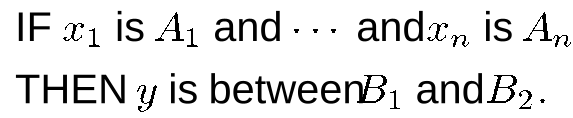
Standard fuzzy rules are rigid. If a value falls between two labels (e.g., "Medium" and "Big"), a single-consequent rule might force a choice that leads to error. ALM allows a rule to have two consequents, effectively saying "y is between B1 and B2." This mimics human nuances and smooths the transitions in complex areas of the data space.
2. Globally: The Selection vs. Generation Paradigm
Most fuzzy methods try to generate the "best" rule for every slice of data. ALM argues that a collection of "best" rules might not work well together. Instead, ALM:
- Generates a massive candidate set of rules.
- Uses a Genetic Algorithm to find the specific subset of rules that cooperate best to minimize total error.
Methodology: The Two-Stage Process
The ALM workflow is divided into two distinct variants, depending on how rules are initially sparked:
- WM-based ALM: Derived from the Wang and Mendel method.
- I-based ALM: Derived from Ishibuchi’s TSK-style logic but adapted for linguistic clarity.
After rules are generated, a Binary Coded Genetic Algorithm treats each rule as a "gene." The GA evolves a population of rule-bases, selecting those that provide the lowest Mean Square Error (SE) on the training data.

Experimental Showdown: Beating the Black Box
The authors tested ALM against 3D functions, rice taste evaluations, and a real-world electrical distribution problem.
The Electrical Distribution Challenge
The task was to estimate the length of low-voltage lines in Spanish rural villages. This is a highly non-linear problem where traditional regression fails.
Key Results (Seven Labels Experiment):
- Neural Network (Multilayer Perceptron): Test SE = 167,092
- ALM (I-based): Test SE = 167,061
- Classical Regression: Test SE = 209,656 (significantly worse)
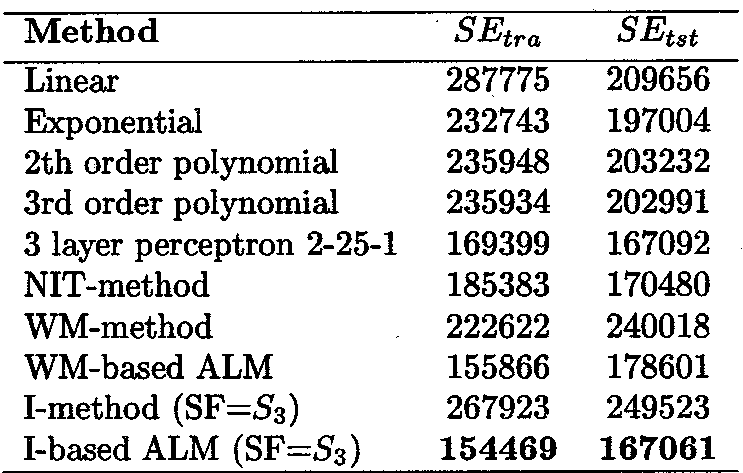
ALM not only achieved the highest accuracy but did so using a rule base that a human technician can actually read and verify—something a 25-neuron hidden layer in a neural network cannot offer.
Critical Insight & Conclusion
The true power of ALM lies in its pruning capability. Interestingly, the experiments showed that the GA often removes double-consequent rules if they aren't necessary, resulting in a simpler final model than those produced by standard "efficient" methods like the WM-method.
Takeaway: Accuracy in AI doesn't always require "black boxes." By focusing on how rules cooperate and allowing for slight structural flexibility (double consequents), we can build models that are both SOTA-accurate and fully transparent.
Limitations: The computational cost of the Genetic Process can be high for extremely high-dimensional datasets. Future work involving multi-objective GAs could further optimize the balance between the number of rules and the error rate.