
Breaking Flat Boundaries: Improving Crowdsourcing Accuracy via Hierarchical Task Design
Improving classification accuracy in crowdsourcing through hierarchical reorganization
This paper proposes a method to enhance multiclass classification accuracy in crowdsourcing by reorganizing flat tasks into hierarchical structures. By decomposing complex categories into sub-tasks and strategically assigning workers based on their specific strengths, the authors achieved higher overall accuracy compared to traditional flat classification approaches.
TL;DR
In crowdsourcing, we usually ask workers to pick one label from a long list. This "flat" approach is simple but inefficient. This paper demonstrates that by breaking a complex task into a hierarchy of sub-tasks and matching workers to their specific areas of expertise (e.g., someone who is great at identifying dog breeds but bad at wild canines), we can significantly boost the final classification accuracy.
The Problem: The Confusion of Choice
When a worker on a platform like Amazon Mechanical Turk (MTurk) is faced with seven similar categories (like different breeds of wolves and dogs), two things happen:
- Cognitive Overload: Choosing among many similar options increases the "fuzziness" of the decision-making process.
- Hidden Expertise: A worker might be an expert on domestic dogs but have no clue about wild dholes or coyotes. In a flat task, their errors in the wild category dilute the value of their perfect dog labels.
Current SOTA methods often focus on Worker Quality Estimation (like Dawid-Skene models) to filter out bad workers, but they rarely rethink the structure of the task itself.
The Insight: Hierarchical Reorganization
The authors suggest that any -class task can be reorganized into a tree. For a 7-class problem (Husky, Malamute, Samoyed, German Shepherd, Wolf, Coyote, Dhole), we can first ask: "Is this a Domestic Dog or a Wild Species?" and then branch out.
Strategic Worker Allocation
The core contribution is a Worker Allocation Algorithm. It doesn't just give workers the tasks they like; it treats worker assignment as a resource management problem.
- Calculate Expertise: For every worker, calculate their accuracy for the top-level split (A vs B) and their accuracy within sub-groups.
- Priority Assignment: The algorithm identifies which sub-task has the most "remaining work" and assigns the best available worker for that specific niche.

Experimental Results
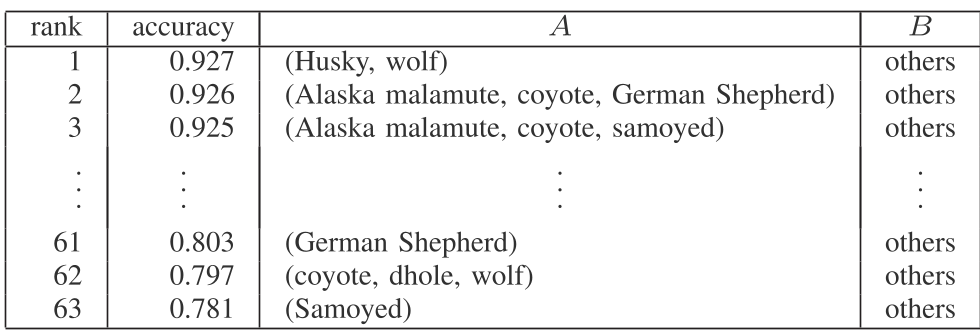
The researchers tested 63 different ways to split the 7-canine categories into a two-level hierarchy.
- Result: Every single one of the 63 hierarchical schemes outperformed the standard flat classification.
- Best Performance: The top scheme achieved 92.7% accuracy.
- Trade-offs: They observed a "competitive" relationship between sub-tasks—if you send all the best workers to identify "Dogs," the "Wild Species" accuracy might drop. The algorithm successfully balances this tension.
Critical Analysis & Conclusion
Why it works
This approach introduces a specialization gain. By narrowing the scope of a task, you reduce the "label noise" introduced by workers who are only partially knowledgeable about the domain. It essentially transforms a generalist workforce into a coordinated group of specialists.
Limitations & Future Work
- The "Cold Start" Problem: To assign workers to sub-tasks they are good at, you first need to know what they are good at. This paper used a simulation based on pre-collected data. Real-world applications would need a "warm-up" phase to estimate worker skills.
- Dynamic Hierarchies: The study only looked at 2-level hierarchies. In the future, deep hierarchies or DAGs (Directed Acyclic Graphs) could further refine accuracy for massive label sets (e.g., 1000+ ImageNet classes).
Final Takeaway
Don't just filter your workers; reorganize your work. Turning a flat classification task into a hierarchy is a powerful, structural way to elicit higher intelligence from the crowd.