
Digital Bridges for Autism: Automating ABA Therapy with Multimedia AI
Improving communication skills of children with autism through support of applied behavioral analysis treatments using multimedia computing: a survey
This survey explores leveraging multimedia computing and machine learning (ML) to enhance Naturalistic Applied Behavior Analysis (ABA), specifically Pivotal Response Treatment (PRT). It proposes an automated framework to evaluate intervention fidelity in parent-child interactions, aiming to improve communication skills in children with Autism Spectrum Disorder (ASD).
Executive Summary
TL;DR: This paper bridges the gap between behavioral science and computer science by proposing an automated feedback system for Applied Behavior Analysis (ABA). By utilizing machine learning to analyze video and audio data, the authors aim to democratize access to high-quality autism therapy, allowing parents to receive expert-level implementation feedback without the high cost or travel requirements of traditional clinical settings.
Positioning: This is a comprehensive visionary survey that maps the specific clinical requirements of naturalistic ABA (like PRT) onto the existing capabilities of Multimedia Information Retrieval (MIR) and Computer Vision (CV).
The Scalability Crisis in Autism Treatment
Naturalistic ABA techniques, such as Pivotal Response Treatment (PRT), are gold standards for improving social communication. The focus is on "natural motivators"—if a child wants a toy, the parent uses that toy as a reward for a communication attempt.
However, the "Human Bottleneck" is severe:
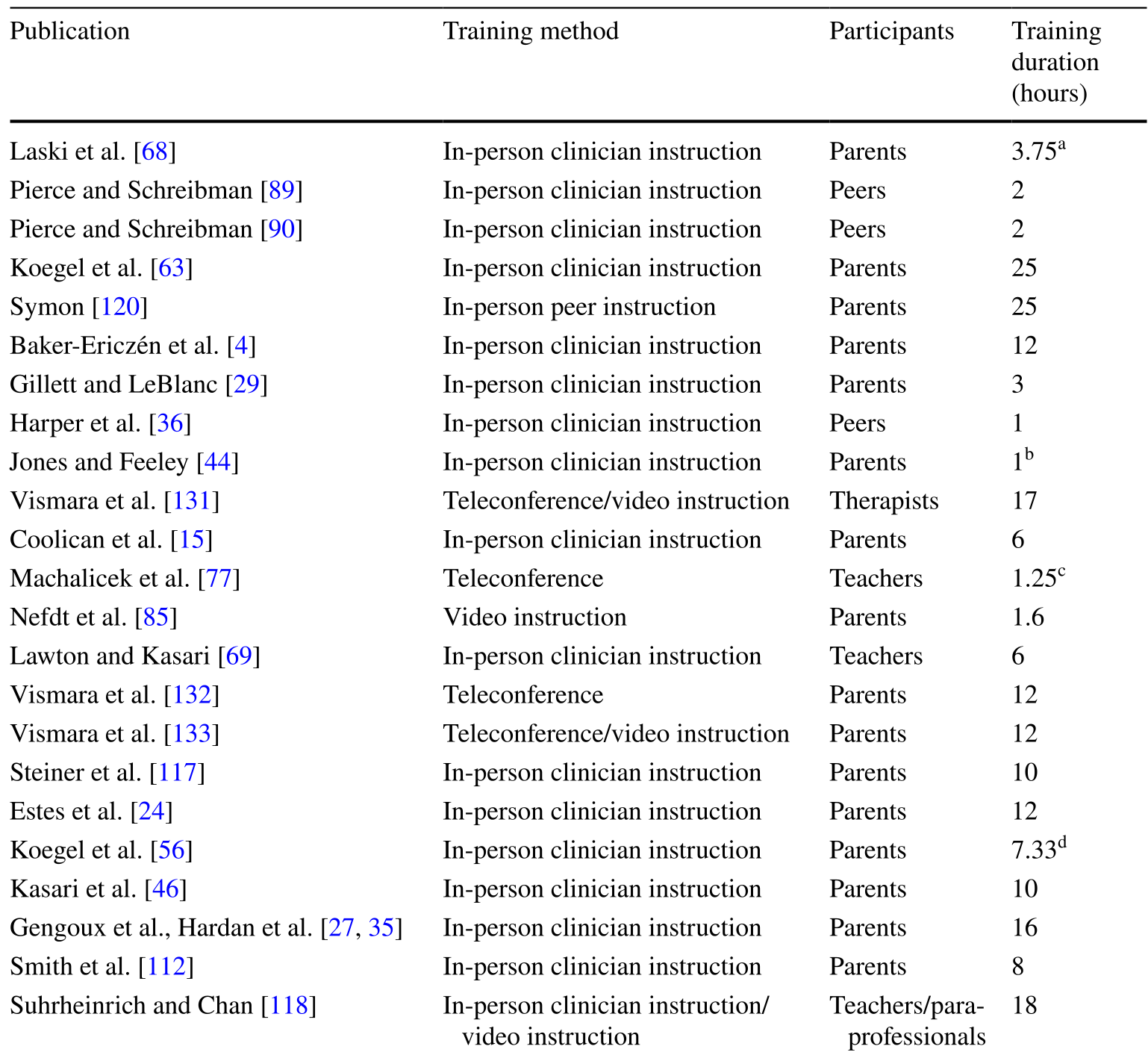
- Time Cost: Training a parent takes an average of 12 hours of one-on-one clinical time.
- Geography: Resource centers are concentrated in metropolitan areas.
- Feedback Latency: Parents record videos, send them to clinicians, and wait days for feedback, missing the critical window for behavioral adjustment.
Methodology: Translating Behavior to Bits
The authors propose a system that "sees" and "hears" therapy sessions to score Implementation Fidelity. This involves decomposing a session into three phases: Antecedent, Response, and Consequence.
1. Vision: Tracking Interest and Action
To evaluate if a parent is "Following the Child's Lead," the system must track objects and human poses simultaneously.
- Object Tracking: Identifying the "natural reinforcer" (e.g., a toy car).
- Attention Classification: Using head pose and body orientation to determine if joint attention is achieved.
2. Audio: Deciphering Child-Directed Speech
A major challenge identified is Speaker Separation. In therapy, parents use "baby talk" (high-pitched, elongated syllables), which can confuse standard ASR (Automatic Speech Recognition) systems into thinking the child is speaking.
- Instruction Analysis: NLP parses the parent’s speech to ensure instructions are clear and at the child's developmental level.
- Attempt Detection: For non-verbal children, even a single phoneme is a "correct" response, requiring sensitive audio processing beyond standard word-recognition.
Challenges and Feasibility
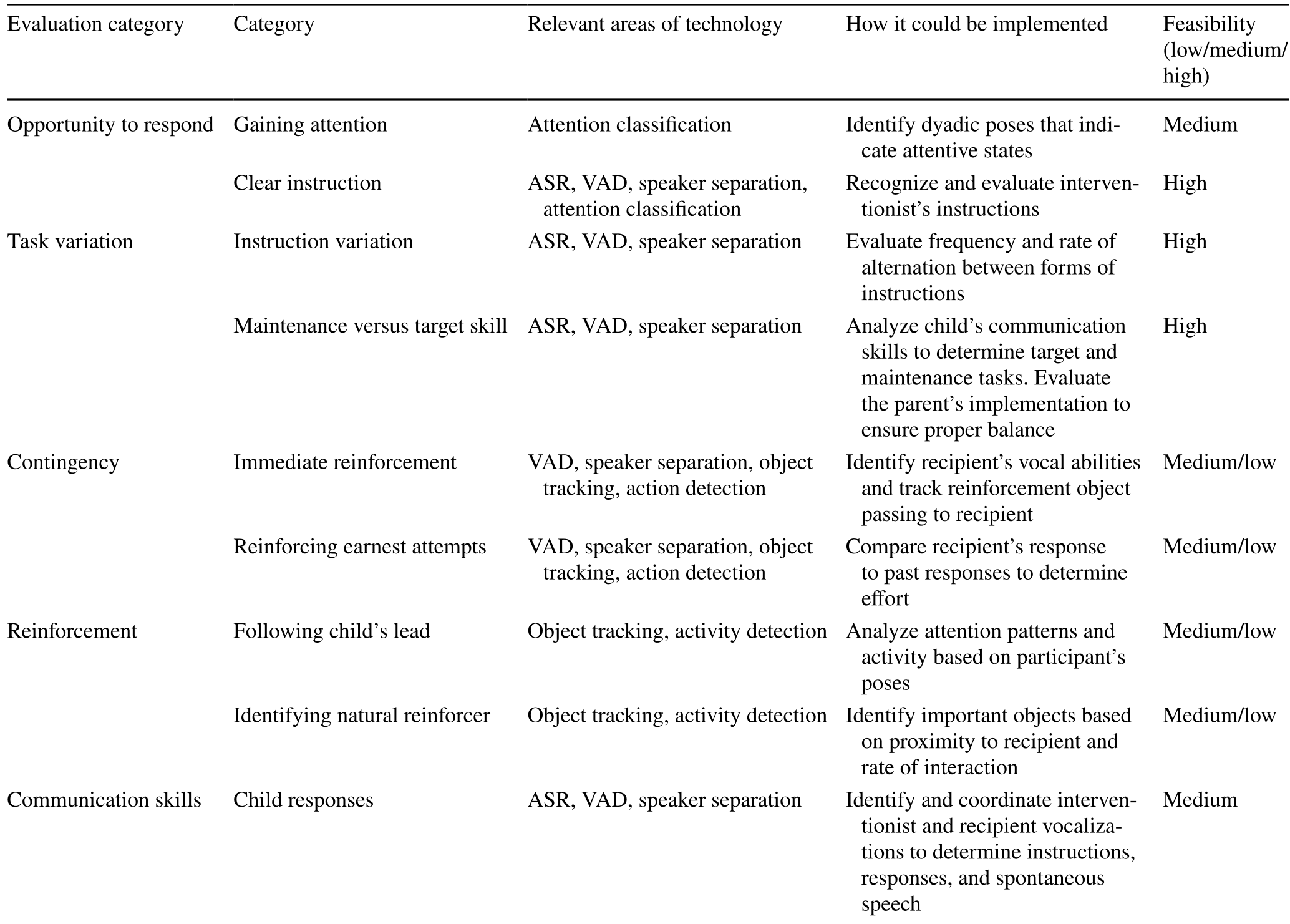
The authors categorize the difficulty of automating different therapy metrics:
| High Feasibility | Medium/Low Feasibility |
|---|---|
| Clear Instructions: Recognizable via ASR. | Immediate Reinforcement: Requires frame-perfect timing between audio (response) and video (giving the toy). |
| Task Variation: Analyzing instruction types over time. | Earnest Attempts: Highly subjective; requires deep personal history of the child's prior capabilities. |
Critical Insight: Beyond Current Practice
The paper doesn't just look at standard video. It suggests that the future of ABA lies in Enhanced Objects:
- 3D/Stereoscopic Cameras: To better handle "occlusions" (e.g., when a parent moves between the camera and the child).
- Smart Toys: Integrating inertial sensors (IMUs) or RFID tags in toys to automatically signal when a child has grabbed a reinforcer, providing high-fidelity data for "contingency" scoring.
Summary & Future Outlook
This work serves as a roadmap for the next generation of Telehealth. By reducing the "human cost" of evaluating fidelity, we can move toward a model where clinicians provide high-level strategy while AI provides the day-to-day tactical feedback.
Limitations: The primary hurdle remains the "diversity of play." Since naturalistic therapy can happen anywhere (a park, a cluttered living room), the CV models must be exceptionally robust to varied lighting and background noise—a common failure point for current SOTA models in "wild" environments.
Takeaway: The intersection of Naturalistic Developmental Behavioral Interventions (NDBI) and Multimedia Computing is not just an academic curiosity; it is a necessity for providing equitable care to the growing population of children with ASD.