
MD-U2G: Enhancing Group Cohesion through Multi-Dimensional Agent Matching
Improving the Compactness in Social Network Thematic Groups by Exploiting a Multi-dimensional User-to-Group Matching Algorithm
The paper introduces MD-U2G (Multi-Dimensional Users-to-Groups), a multi-agent system designed to optimize the formation of thematic groups in Online Social Networks (OSNs). By projecting the social network into multiple dimensions based on specific topics, it creates "compact" groups where members share high similarity in interests and behavior, as well as mutual trust.
TL;DR
Online Social Networks (OSNs) are often cluttered with "confusing" groups formed by random interactions rather than genuine shared interests. This paper introduces a Multi-Dimensional User-to-Group (MD-U2G) algorithm that leverages autonomous software agents to manage thematic groups. By using a novel Compactness metric—blending interest similarity, behavioral patterns, and social trust—the system creates tighter, more relevant communities while filtering out the noise of social spam.
The Problem: The Chaos of "Viral" and "Occasional" Socializing
In modern OSNs like Facebook and Twitter, groups are the heartbeat of interaction. However, many groups suffer from two primary issues:
- Spam and Noise: Occasional interactions lead to users joining groups that don't fit their long-term interests, resulting in irrelevant notifications.
- Lack of Trust: Group members might share a topic interest but lack the mutual trust required for safe and productive collaboration.
Current group recommendation systems often look at what you like or who you know, but rarely do they combine these with a dynamic, topic-specific agent architecture that evolves over time.
The Methodology: Multi-Dimensional Avatars
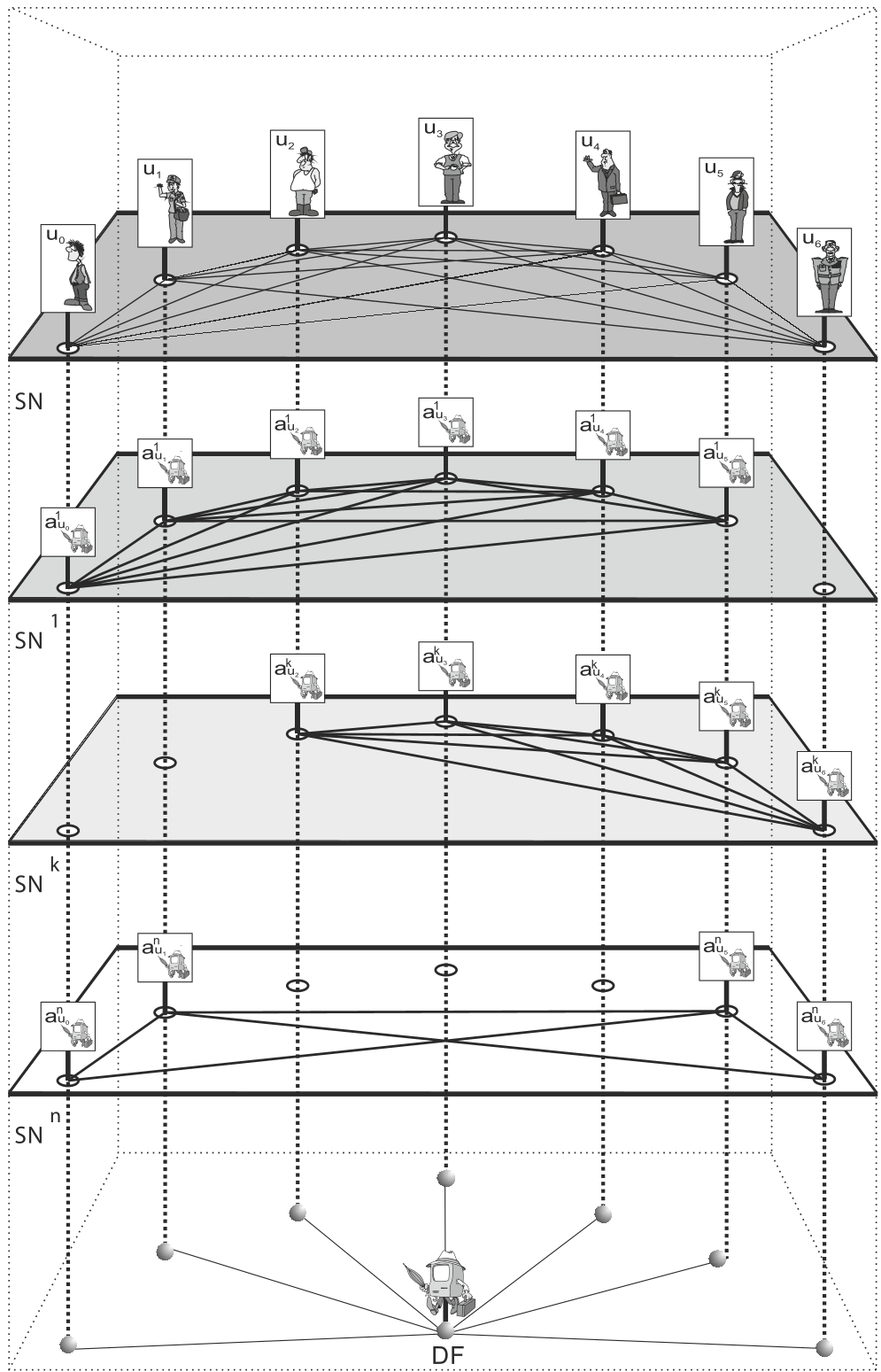
The core insight of the authors is to treat a Social Network not as a single graph, but as a set of Projections () onto specific topics (e.g., Politics, Sport, Arts).
1. The Multi-Agent Architecture
Every user identifies several "macro-topics" of interest. For each topic, a specialized software agent is created. This agent acts as a "twin" or avatar in that specific dimension, managing joining requests and content filtering without requiring constant manual input from the user.
2. The Compactness Metric
The paper defines a crucial measure called Compactness (). Unlike simple clustering, it is asymmetric (User A may trust Group B more than B trusts A). It is calculated as:
Where:
- (Dissimilarity): Measures the gap in interest levels and behaviors (e.g., posting frequency).
- (Trust): The average trust level derived from the underlying social network graph.
- : A weight coefficient allowing the user to prioritize similarity over trust or vice-versa.
MD-U2G Algorithm: How Agents "Match"
The matching process is a two-way handshake performed over discrete Epochs:
- User Agent Task: The agent periodically explores the directory for new groups, calculates compactness, and sends join requests to those exceeding a specific threshold ().
- Group Agent Task: The group's representative agent evaluates incoming requests and current members. If a member's compactness falls below a threshold (), they are evicted, ensuring the group remains "compact."
Experimental Validation
The researchers tested the system using the CIAO and EPINIONS datasets—platforms that uniquely provide both user reviews and explicit trust networks.
Performance Gains
The metric for success was MAC (Mean Average Compactness). The results were striking:
- CIAO: Achieved a 25% improvement in group compactness.
- EPINIONS: Achieved a 20% improvement.
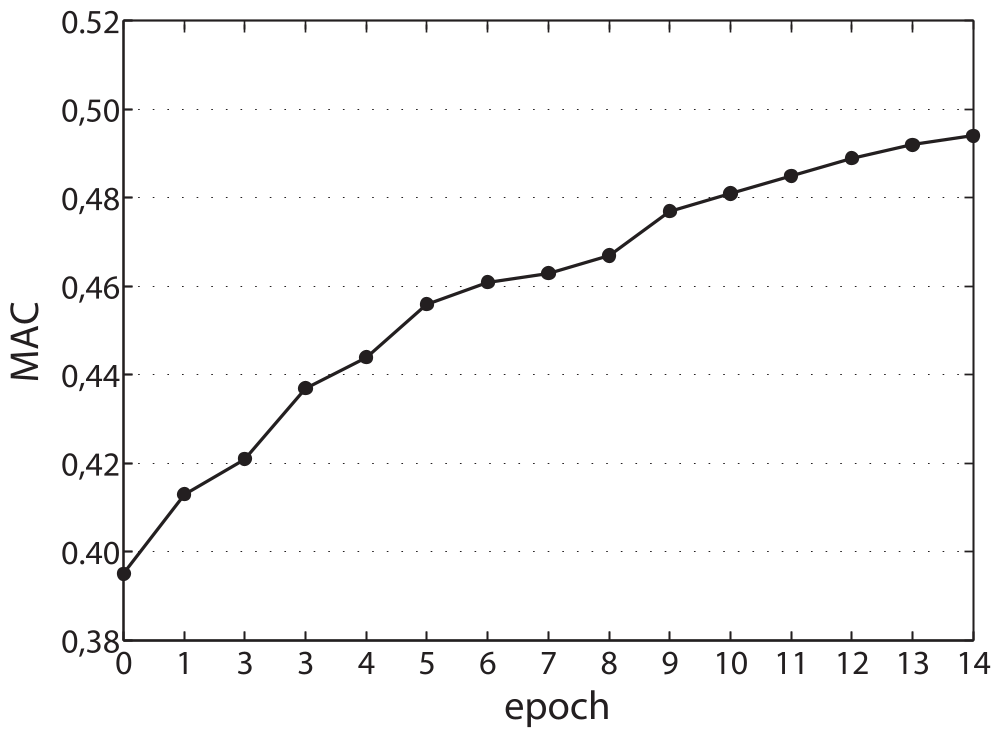 Figure: The steady increase of MAC over several epochs, demonstrating the algorithm's convergence.
Computational Efficiency
By assigning topic-specific agents to different threads, the system successfully simulated parallel execution. On a standard I7 processor, the algorithm processed thousands of users in just 2 seconds per epoch. This suggests the system is highly scalable for large-scale real-world OSNs.
Critical Insights & Future Directions
The MD-U2G approach represents a shift from passive recommendation to active autonomous management.
Key Strengths:
- Hybrid Logic: Integrating trust with similarity addresses the "expert vs. friend" dilemma.
- Automation: Using agents relieves the "cognitive load" of managing group memberships.
Limitations & Future Work: Currently, the behavior model (Boolean variables) is relatively simple. The authors aim to incorporate Natural Language Processing (NLP) to analyze text comments, providing a deeper layer of similarity based on the sentiment and nuance of user interactions.
Conclusion
By treating social organization as a multi-dimensional matching problem, MD-U2G offers a robust framework for building online communities that are not just large, but meaningful and trustworthy.