
Strengthening P2P Cooperation: A Social Network Approach to Reputation
Improving cooperation in peer-to-peer systems using social networks
The paper proposes a social-network-based incentive mechanism for Peer-to-Peer (P2P) systems to combat free-riding and various malicious attacks. By leveraging "small world" characteristics and local trust circles (coteries), the system implements a distributed reputation management model that achieves high cooperation rates with minimal memory overhead.
TL;DR
Peer-to-Peer (P2P) systems are notoriously plagued by "free-riders"—nodes that take but never give. This paper proposes a decentralized incentive mechanism that models P2P interactions as a Social Network. By utilizing "Small World" dynamics, "Consignable Requests," and "Transferable Interests," the system creates a self-organizing environment where cooperation is rewarded, and malicious actors are naturally isolated, all without the need for a global history or central server.
The Problem: The P2P Tragedy of the Commons
The fundamental challenge in P2P systems like BitTorrent or Gnutella is the "Tragedy of the Commons." Rational nodes seek to maximize their own utility, which often means being a "bad guy" who refuses to supply services.
- The Scalability Wall: Remembering every transaction in a massive network is impossible for local nodes.
- Identity Games: Attackers use "whitewashing" (changing IDs) or "collusion" (fake mutual praise) to bypass reputation systems.
- The Global Cost: Previous attempts at shared histories require every node to know everything—a communication nightmare.
Methodology: Coteries and the Multi-Hop Trust
The authors suggest that instead of trusting everyone, you should trust your friends (coteries).
1. The Credit-Payment Graph
Each node maintains two metrics for every friend:
- Credit Degree (): The service node has performed for you.
- Payment Degree (): The service you have performed for node . This relationship is balanced using a Social Balance () score, which influences a probabilistic Decision Function. If someone has helped you more than you've helped them (), you are more likely to serve their next request.
2. Consignable Requests & Transferable Interest
What if your immediate friends don't have the file?
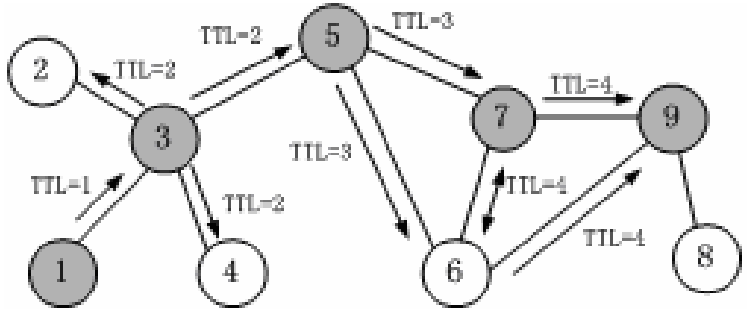
- Consignable Requests: You consign your request to a friend, who searches their friends, and so on, up to a Time-To-Live (TTL) limit.
- Transferable Interest: This is the "secret sauce." Instead of the server sending the file directly to the requester, the data is routed back through the path of friends. Each intermediary node earns credit from the next hop. This transforms a transaction between strangers into a chain of transactions between friends.
Immunity to Attacks
The social network model provides an elegant defense against common P2P exploits:
- Collusion: Even if "bad guys" praise each other, they cannot force "good guys" to trust them. The "friendship bottleneck" prevents their internal fake reputation from leaking into the wider network.
- Software Cracking: Since reputation is stored by the provider of the service (the coterie), a node cannot "hack" its own reputation score.
- Whitewashing: Building a "coterie" takes time and effort. Resetting an identity loses all social capital, making it more expensive to be a stranger than to be a honest node.
Experimental Results
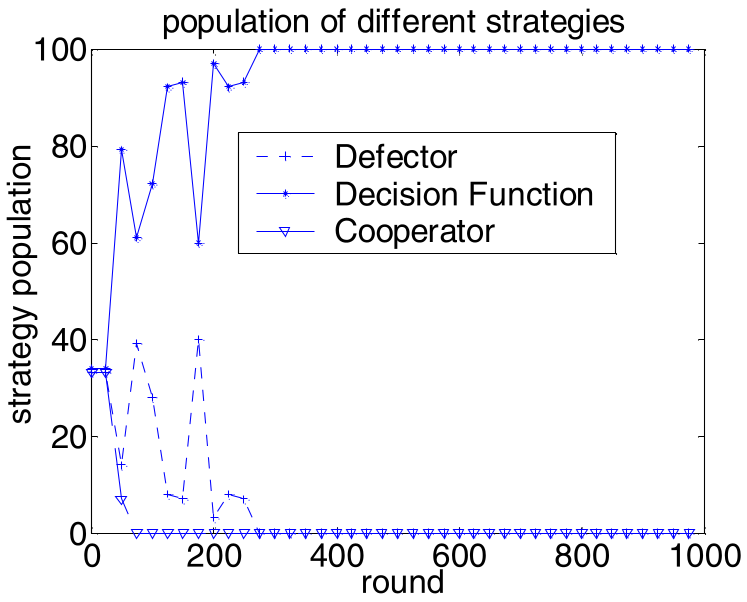
The researchers demonstrated that the Decision Function strategy is evolutionarily stable. In a mixed population of cooperators, defectors, and strategic nodes, those using the social network logic eventually dominate the system.
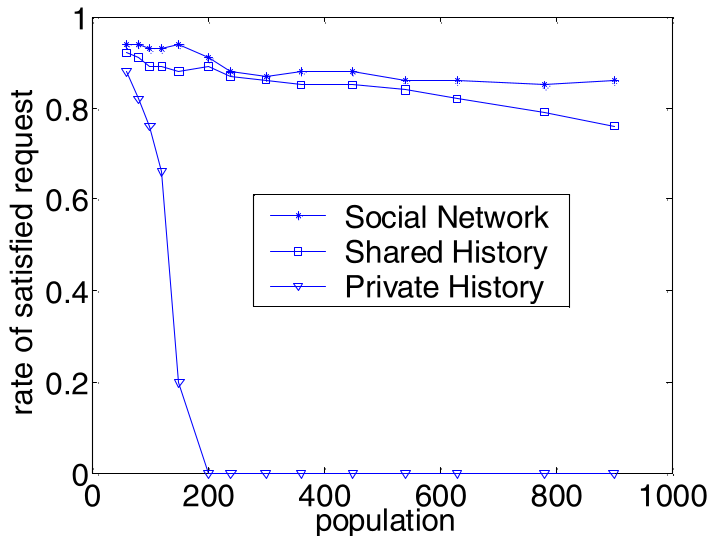
Furthermore, the Mean Rate of Satisfied Requests (MRSR) remains high even as the network scales to hundreds of nodes, whereas traditional private history systems see a performance collapse due to the "lack of history" problem.
Critical Insight & Conclusion
The brilliance of this work lies in its realization that P2P networks are, at their heart, social structures. By mimicking human social reciprocity—where we help friends of friends—the system achieves a "Small World" effect.
Limitations: The primary trade-off is bandwidth. Routing data through multiple intermediaries (Transferable Interest) consumes more network resources than a direct transfer. However, the authors argue that the "tax" paid in bandwidth is a necessary and justified cost for a robust, decentralized, and fraud-resistant reputation system.
Future P2P architectures might look to this model to balance the efficiency of direct transfers with the security of social-tied verification.