
Strategizing the Crowd: Improving Bug Detection Efficiency via Division Strategies
Improving Crowdsourcing Efficiency Based on Division Strategy
This paper introduces a "Division Strategy" to optimize crowdsourcing efficiency, specifically for software bug detection. By modeling the process as a three-stage all-pay auction, the authors demonstrate that partitioning workers into competitive groups can mitigate uneven task distribution.
TL;DR
Crowdsourcing bug detection often fails when too many workers chase the "easiest" bugs, leaving the rest of the system vulnerable. This paper treats the problem as a game-theoretical competition (an all-pay auction) and proves that Random Grouping of workers is surprisingly more efficient than segregating them by ability, as it ensures a balanced distribution of effort across all code submissions.
Background: The Efficiency Paradox
While crowdsourcing is praised for leveraging "Collective Intelligence," it has a major flaw: Uneven Distribution. Workers maximize their "hourly wage" by selecting tasks where the reward-to-effort ratio is highest. In software testing, this means low-quality code (rich in bugs) gets all the attention, while high-quality code is ignored.
The authors argue that we cannot simply fix this by lowering rewards (due to market wage floors). Instead, we must change the market structure through "Division Strategies."
The Methodology: Bug Detection as an All-Pay Auction
The researchers model the workflow in three distinct stages:
- Division Stage: The organizer splits the crowd into two groups.
- Coding Stage: Every participant acts as a "Coder" and submits a solution.
- Detection Stage: Every participant acts as a "Bug Detector," choosing a peer's code within their division to debug.
The core insight is that each piece of code represents a "contest." Because everyone exerts effort simultaneously but only the first person to find a bug gets the reward, it operates as an All-Pay Auction.
Mathematical Intuition
The "Expected Reward" () of a piece of code is tied to the coder's ability. High-ability coders produce fewer bugs (low ), while low-ability coders produce more bugs (high ). The efficiency () is calculated as the expected number of bugs detected across the system.

Experimental Analysis: Random vs. Ability Grouping
The study compares two primary strategies:
- Random Grouping: Participants are shuffled regardless of skill.
- Ability Grouping: "Elites" compete with "Elites," and "Novices" with "Novices."
Using simulations with 400 players and various ability distributions (Linear, Concave, Convex), the results were conclusive.
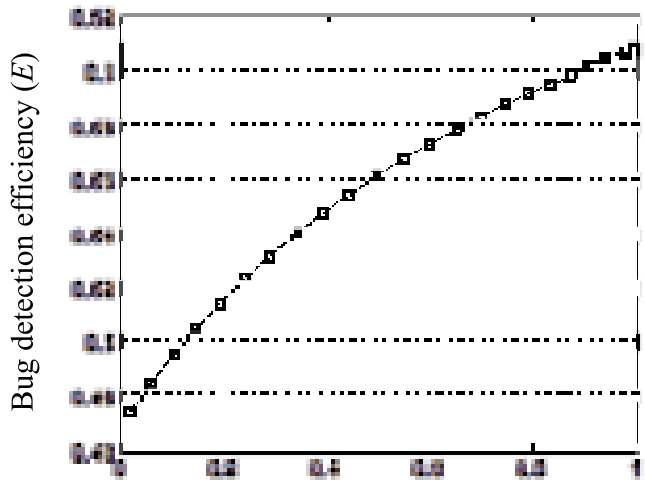
As shown in the figure above, efficiency rises as the Extent of Ability Mixing () increases.
Why does Random Grouping Win?
In Ability Grouping, the competition within the "Elite" division becomes so fierce that the incentive to solve low-reward tasks evaporates. In contrast, Random Grouping creates an environment where high-ability workers can efficiently sweep the high-reward tasks (buggy code) while lower-ability workers are still incentivized to tackle remaining tasks, leading to a more "Uniform Probability" of task selection.
Critical Insight & Practical Value
The real-world implication is significant for platform designers (e.g., Bugcrowd, HackerOne). To maximize the security of a project:
- Don't silo your experts.
- Mechanism Design over Reward Design. Relying on price signals alone is insufficient in crowdsourcing due to the heterogeneity of worker skill.
- The "Mixing" Metric. Platform health should be measured by how well different skill levels interact within the same task pool.
Conclusion
This paper moves beyond the "What" of crowdsourcing to the "How" of structural efficiency. By proving that random divisions lead to higher bug discovery rates through better ability mixing, it provides a counter-intuitive but mathematically sound strategy for managing collaborative software engineering.
Future Outlook: The next step is to expand this into an n-class model, where multiple tiers of difficulty and expertise can be fine-tuned to reach the theoretical maximum efficiency of the crowd.