
SNA-DCOP: Boosting Multi-Agent Coordination through Social Network Analysis
Improving the Distributed Constraint Optimization Using Social Network Analysis
This paper presents a novel pre-processing approach for Distributed Constraint Optimization Problems (DCOP) by integrating Social Network Analysis (SNA). It introduces centrality-based heuristics—specifically Closeness and Betweenness—to optimize the construction of pseudo-trees for top-tier DCOP algorithms like ADOPT and DPOP.
Executive Summary
TL;DR: This paper bridges the gap between Graph Theory and Multi-Agent Systems by using Social Network Analysis (SNA) to optimize the pre-processing phase of Distributed Constraint Optimization Problems (DCOP). By prioritizing agents with high Betweenness and Closeness centrality within a pseudo-tree structure, the authors achieved significant speedups in the ADOPT and DPOP algorithms.
Background: DCOP is a cornerstone of distributed reasoning, yet its NP-hard nature makes real-world scalability a challenge. Most "pseudo-tree-based" solvers rely on myopic ordering heuristics. This work positions itself as a structural optimization layer that rethinks agent hierarchy through the lens of influence.
The Bottleneck: Why Order Matters
In a DCOP, agents must coordinate variable assignments to minimize global cost using only local communication. Algorithms like ADOPT (backtracking-based) and DPOP (dynamic programming-based) organize agents into a pseudo-tree—a hierarchy where constraints only exist between a node and its ancestors/descendants.
The problem? A poor hierarchy leads to:
- ADOPT: High-priority agents changing values frequently, causing "ripple effects" and excessive cycles.
- DPOP: Massive message sizes (cost matrices) as dependencies accumulate down long, unbalanced branches.
Methodology: Identifying the "Influencers"
The authors suggest that not all agents are created equal. Some are "hubs" or "bridges" within the constraint graph. By using SNA, they identify these prominent agents and place them at the top of the pseudo-tree.
1. Closeness Centrality
Measures how "near" an agent is to all other agents. An agent with high closeness can propagate constraint information faster across the network.
2. Betweenness Centrality
Identifies agents that act as bridges on the shortest paths between others. These agents are critical "gatekeepers" of constraints.
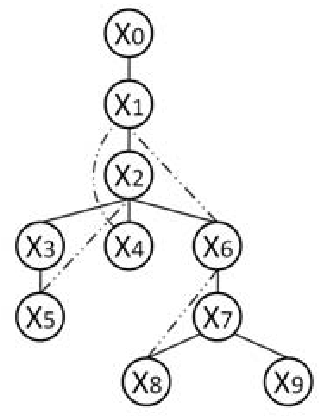 Figure 1: Comparison of pseudo-tree arrangements. (b) Lexicographical, (c) Closeness-based, and (d) Betweenness-based. Note how SNA heuristics promote central nodes like x2 and x62 to the root.
Experimental Insights
The research tested these SNA metrics against traditional heuristics like Max-Degree, Min-Width, and Max-Cardinality.
ADOPT Performance
In ADOPT, the primary bottleneck is the number of cycles. By placing high-betweenness agents at the top, these influential agents stabilize their values earlier, preventing the lower-level agents from constantly restarting their search.
DPOP Performance
For DPOP, the focus is message size. SNA-based ordering tends to create more balanced trees with shorter branches, which prevents the exponential growth of the cost matrices passed between agents.
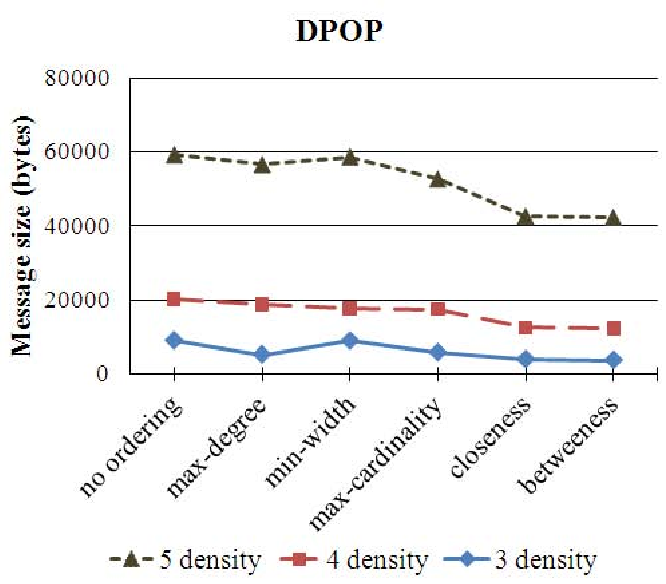 Figure 2: Results for 15 agents. The Betweenness heuristic (darker bars/lines) consistently requires fewer cycles in ADOPT and smaller messages in DPOP compared to traditional methods.
Critical Analysis & Conclusion
Why it works
The physical intuition is simple: if you solve the most "constrained" or "central" part of the puzzle first, the remaining pieces fall into place with less friction. Traditional heuristics like Max-Degree only look at immediate neighbors (local), while Betweenness looks at the agent's role in the entire network (global).
Limitations
- Pre-processing Cost: Calculating Betweenness Centrality is computationally more expensive than simple degree counts. For massive networks, the overhead of SNA might offset the search gains.
- Static Assumption: The paper assumes a static constraint graph. In dynamic environments where agents join/leave, re-calculating SNA metrics could be a bottleneck.
Summary
This work proves that structural intelligence in the pre-processing phase is a "force multiplier" for DCOP solvers. Moving forward, integrating these SNA insights into dynamic or asynchronous tree-reconfiguration protocols could open doors for DCOP in massive-scale IoT and robotics applications.