
Emoticon Vectors: Decoding the Hidden Language of Japanese SNS via Word2vec
Improving Awareness of Emotional Meaning of Emoticon by Representing as Numerical Vectors
This paper proposes a method to represent Japanese vertical emoticons (Kaomoji) as numerical vectors using word2vec to capture their emotional meaning. By training on a large-scale Twitter corpus, the authors achieve effective emoticon clustering and emotion recognition, reaching a purity of 0.77 in classification tasks.
TL;DR
Communicating emotion via text is notoriously difficult, especially in context-heavy cultures like Japan. This paper introduces a robust method to map the "emotional DNA" of Japanese emoticons (Kaomoji) into a numerical vector space. By training a word2vec model on 600,000 tweets, the researchers successfully clustered over 2,000 unique emoticons by their actual usage and sentiment, rather than just their visual components.
Background: The Problem of 100,000 Faces
In Western digital culture, emoticons are often simple and horizontal (e.g., :-)). However, in East Asia, emoticons are vertical and incredibly complex (e.g., (ˆωˆ)). There are over 100,000 such emoticons in use, using thousands of different character codes.
The Challenge:
- Visual Diversity: Two emoticons might look completely different but mean the same thing.
- Manual Failure: It is impossible to manually list or categorize all emoticons.
- Context Sensitivity: The meaning of a symbol often depends on the words surrounding it, which traditional "part-based" analysis (analyzing just the eyes or mouth) fails to capture.
Methodology: Logic Over Appearance
Instead of trying to "look" at the emoticon’s face, the authors decided to "listen" to how they are used. They treated emoticons as words within a sentence and used the Skip-gram model of word2vec.
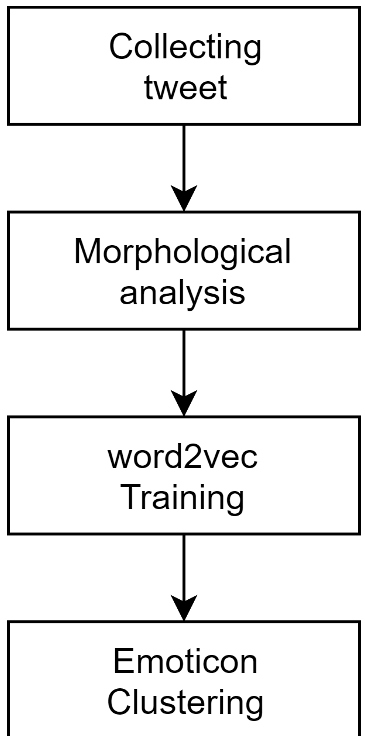
The Pipeline
- Data Collection: Randomly sampled 1% of the Twitter public stream.
- Morphological Analysis: Used a specialized Japanese analyzer (MeCab with NEologd) to separate words from symbols.
- Vectorization: Trained word2vec to create 200-dimensional vectors for each emoticon.
- Clustering: Applied K-means to group emoticons with similar vectors.
 The Skip-gram model used to predict surrounding context words from a center emoticon.
Experiments and Results
The study evaluated the clusters using Purity, a measure of how "clean" a cluster is in terms of a single emotion (Joy, Sadness, Anger, Surprise, etc.).
Key Findings
- Visual Invariance: In Class 1 (Joy), emoticons like
q(ω^ω)qand(≥∇≤)were grouped together despite having no shared characters. - Action Recognition: The model successfully identified "Postures" (e.g., Class 39 for lying down and Class 65 for flying) based purely on usage patterns.
- Frequency Matters: The model performed significantly better (Purity 0.77) when focusing on emoticons that appeared at least 100 times, as "rare" emoticons didn't have enough context to form stable vectors.
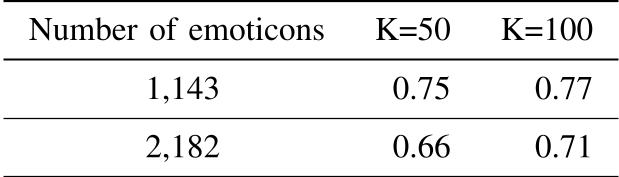 Table showing that purity improves when filtering out low-frequency emoticons.
Critical Insight: Beyond Simple Sentiment
What makes this work stand out is its ability to distinguish nuances. The model didn't just group "Happy" emoticons; it separated "sharp pleasure" from "blushing joy." This suggests that word2vec captures the social pragmatics of how we communicate—showing that emoticons are not just decorations, but essential grammatical markers of tone in Japanese digital discourse.
Limitations
- Low Frequency: Rare or one-off emoticons remain a "cold start" problem.
- Ambiguity: Emoticons used sarcastically or those representing multiple emotions (e.g., "laughing while crying") can confuse the hard-partitioning K-means algorithm.
Summary
By shifting the focus from visual structure to contextual distribution, the authors have provided a scalable way to decode the emotional landscape of SNS. Future work using soft-clustering or transformer-based models could further refine our understanding of how these digital "faces" modulate the meaning of our words.