
Bridging the Human-Machine Gap in Verb Sense Disambiguation
Improving English verb sense disambiguation performance with linguistically motivated features and clear sense distinction boundaries
The paper presents a high-performance supervised Word Sense Disambiguation (WSD) system for English verbs using a smoothed Maximum Entropy (MaxEnt) model. By integrating linguistically motivated features and utilizing coarse-grained sense groupings from the OntoNotes project, the system achieved a state-of-the-art accuracy of 82.7% on 217 verbs, reaching performance levels comparable to human inter-annotator agreement (ITA).
TL;DR
This research tackles the long-standing challenge of Word Sense Disambiguation (WSD) for English verbs. By moving away from hyper-fine WordNet senses toward coarse-grained groupings (OntoNotes) and employing linguistically motivated features (MaxEnt), the authors developed a system that matches human performance (~82.7% accuracy), effectively solving the "ambiguity ceiling" that hampered earlier NLP applications.
Background: The Granularity Trap
For years, WSD was stuck. Using fine-grained sense inventories like WordNet often meant that even human experts couldn't agree on the "correct" sense more than 70% of the time. If humans can't agree, how can a machine? This paper argues that the problem isn't just the algorithm—it's the sense boundaries. By grouping senses into logically distinct clusters based on syntactic and semantic criteria, the authors create a target that is both learnable for machines and consistent for humans.
Methodology: Feature Engineering with Linguistic Intuition
The authors reject "linguistically impoverished" models. Instead, they argue that a verb’s meaning is inextricably linked to its syntactic behavior (e.g., Does it take a direct object? Is it a person or an object doing the action?).
1. Robust Feature Extraction
The system uses a Maximum Entropy (MaxEnt) model, which is excellent at handling overlapping features. The core enhancements include:
- Subject Recall: Sophisticated rules to find subjects in complex structures like relative clauses.
- Semantic Unification: Linking Named Entities (e.g., "John") to semantic categories (e.g., "Person") so the model generalized better to unseen names.
- Sentential Complements: Distinguishing between meanings based on the structure of following clauses (e.g., "I called him [Name]" vs. "I called the meeting [Noun]").
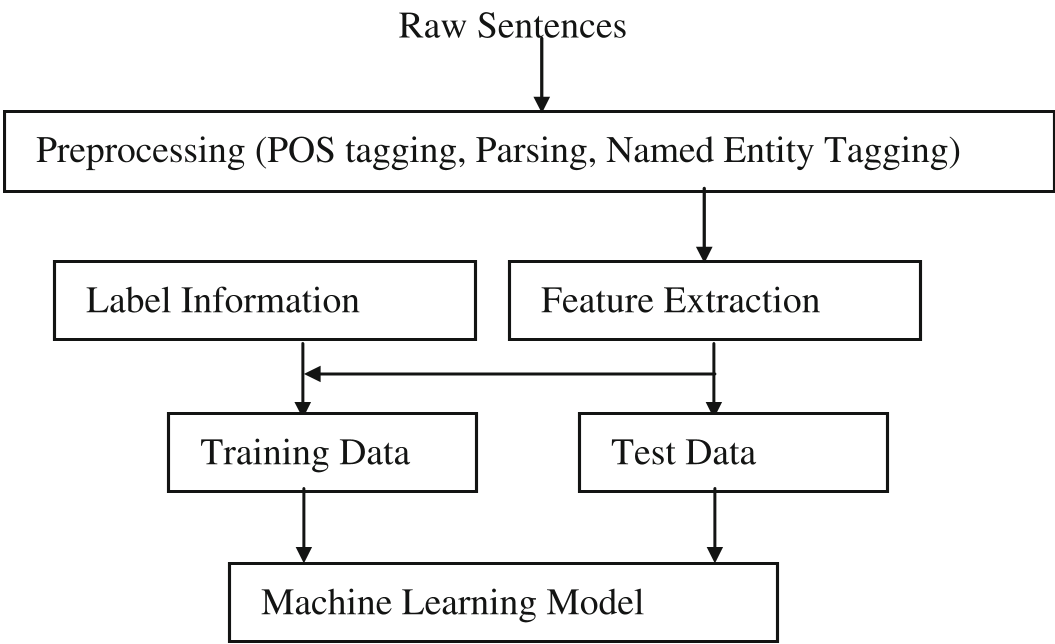 Figure 1: Overview of the supervised WSD pipeline, integrating POS tagging, parsing, and Named Entity recognition.
Experiments: Crossing the 80% Threshold
The system was tested on the OntoNotes dataset. The shift from WordNet's fine-grained senses (avg. 10.4 senses per verb) to OntoNotes' coarse-grained clusters (avg. 5.1 senses) was a game-changer.
Performance vs. Humans
In a massive test involving 217 verbs, the system reached 82.7% accuracy. Critically, the human Inter-Annotator Agreement (ITA) was 82.5%. For the first time, a supervised WSD system was performing on par with human taggers across a broad vocabulary.
| Metric | SENSEVAL-2 (Fine) | OntoNotes (Coarse) |
|---|---|---|
| Baseline (MFS) | 40.7% | 68.0% |
| System Accuracy | 64.6% | 82.7% |
| Human ITA | 71.3% | 82.5% |
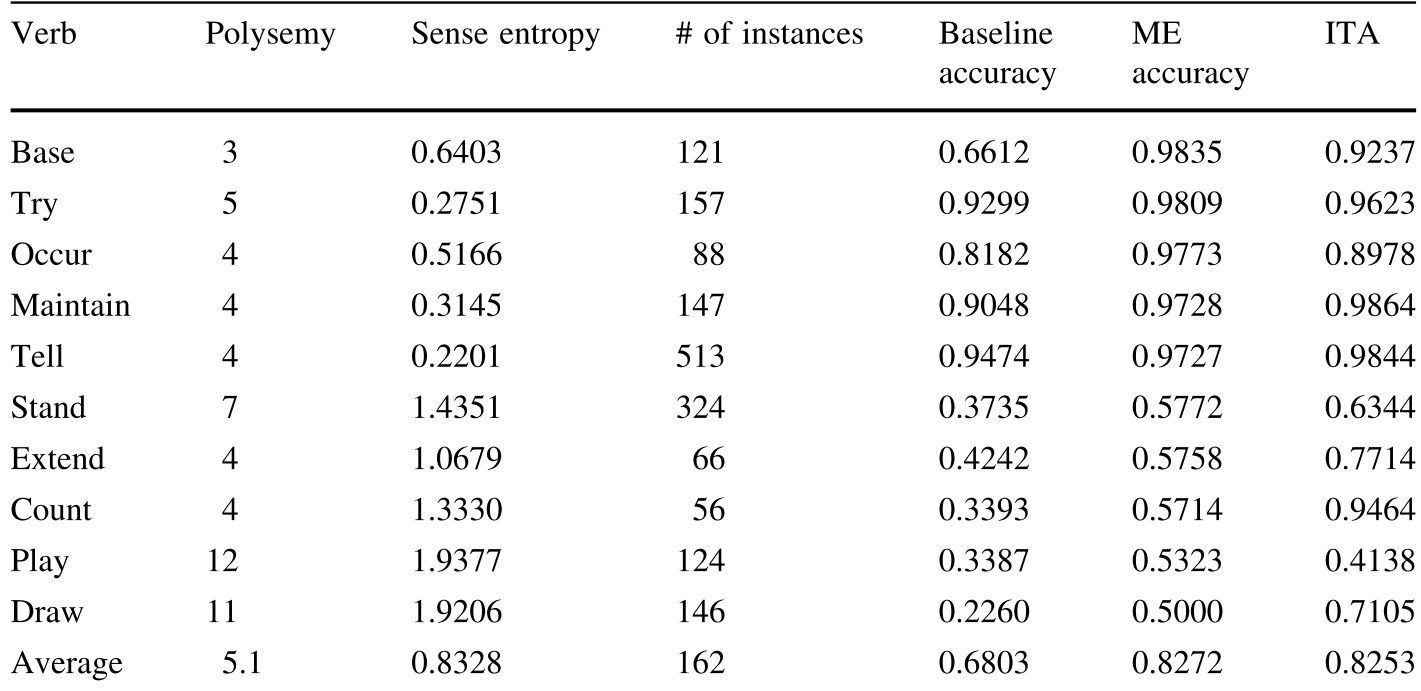 Table 1: Performance across specific verbs, showing the significant jump in accuracy when sense entropy is managed.
Deep Insight: What Predicts Success?
One of the paper's most valuable contributions is the statistical analysis of WSD performance. The authors found that Sense Entropy (a measure of how evenly distributed a word's meanings are) is the single best predictor of system accuracy (correlation of -0.81). If a verb has one dominant sense, the problem is easy; if it has many balanced, subtle meanings, it remains a challenge even for "rich" models.
Critical Analysis & Conclusion
Why this matters
This work proved that the "WSD bottleneck" was largely a data-modeling issue. By providing clear sense distinction boundaries, the authors provided a roadmap for making semantic interpretation a viable component of MT (Machine Translation) and IR (Information Retrieval).
Limitations
Despite the success, the system still relies on heavy preprocessing (parsers, taggers). Errors in the initial parse tree cascade through the feature extractor, leading to "unforced errors" in sense assignment. Furthermore, some verbs (like treat or draw) remain stubborn due to a lack of deep "world knowledge" in the feature set.
Future Outlook
The authors suggest that Active Learning—teaching the model to ask humans for labels on only the most confusing instances—is the next frontier for scaling this to all-words WSD across diverse domains.