
Socially Aware Face Clustering: Bridging the Gap Between Pixels and People
Improving face clustering using social context
The paper introduces a social-context-aware face clustering algorithm that leverages automatically discovered social networks from photo collections. By combining facial similarity with social closeness metrics, the method generates ranked recommendations for merging fragmented face clusters, significantly improving recall.
TL;DR
Face clustering in personal photos is notoriously difficult due to "messy" real-world conditions. This paper from HP Labs proposes a clever solution: don't just look at faces; look at friendships. By building an automatic social network from photo co-occurrences, the authors improve the recall of face clustering by 13.7% without sacrificing precision, providing users with a smart "recommendation list" for merging fragmented identities.
Background & Positioning
In the era of massive personal digital photo libraries, organizing people is a killer feature. However, "in the wild" faces vary wildly in pose and lighting. While algorithms like Viola-Jones made detecting faces easy, grouping them (clustering) remains hard. Currently, most systems take a conservative approach: they use tight thresholds to ensure clusters are "clean" (High Precision), but this results in a person's photos being scattered across dozens of tiny clusters (Low Recall). This paper sits at the intersection of Computer Vision and Social Network Analysis, acting as a bridge to solve specifically this fragmented-cluster problem.
The Core Insight: Why Social Context?
The authors observe a simple human truth: if you are in a photo with Tom, you are more likely to be his wife than a random high-school classmate. Prior works used simple metadata like time or location. This paper goes deeper by quantifying Social Closeness. It assumes:
- Proximity: Faces physically closer in a photo likely have a closer relationship.
- Frequency: People who appear together often are socially linked.
- Exclusion: Faces in the same photo cannot be the same person (a "CANNOT-link" constraint).
Methodology: The Fusion of Two Worlds
The system workflow follows a "Cluster-then-Refine" logic:
- Initial Face Clustering: Using Gabor LBP features and agglomerative clustering to get high-precision initial groups.
- Social Graph Construction: An undirected graph where vertices are people and edges represent co-appearance.
- The Likelihood Formula: The decision to merge Cluster into Cluster is driven by a posterior probability: Where is the Social Likelihood (based on whether they share common social neighbors) and is the Facial Similarity (visual distance).
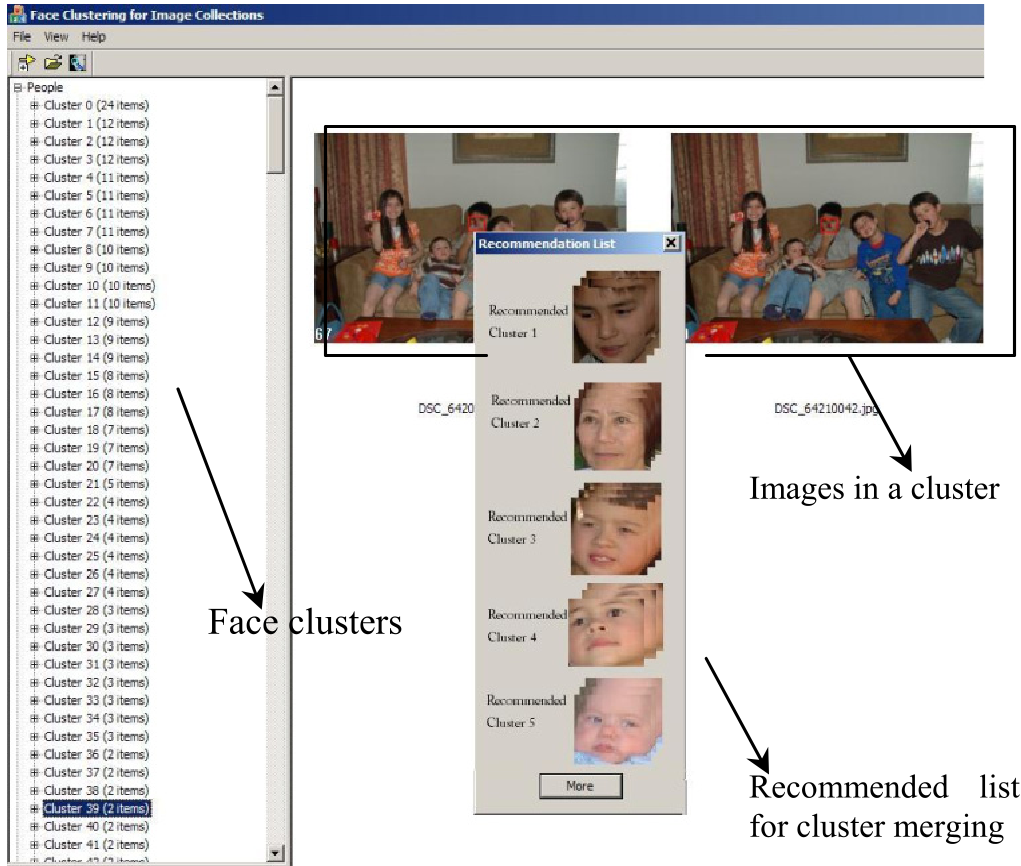 Figure 1: The user interface showing the recommendation system for cluster merging.
Experiments & Key Results
The authors tested their approach on 259 photos from varied social events (birthdays, family gatherings).
- Recall Boost: The social context helped merge small "singleton" clusters that were visually ambiguous but socially obvious. Average recall jumped from 33.6% to 47.3%.
- The Power of Social Neighbors: Even when facial similarity was low (e.g., a person wearing sunglasses or looking away), the "Social Closeness" factor pushed the correct cluster to the top of the recommendation list.
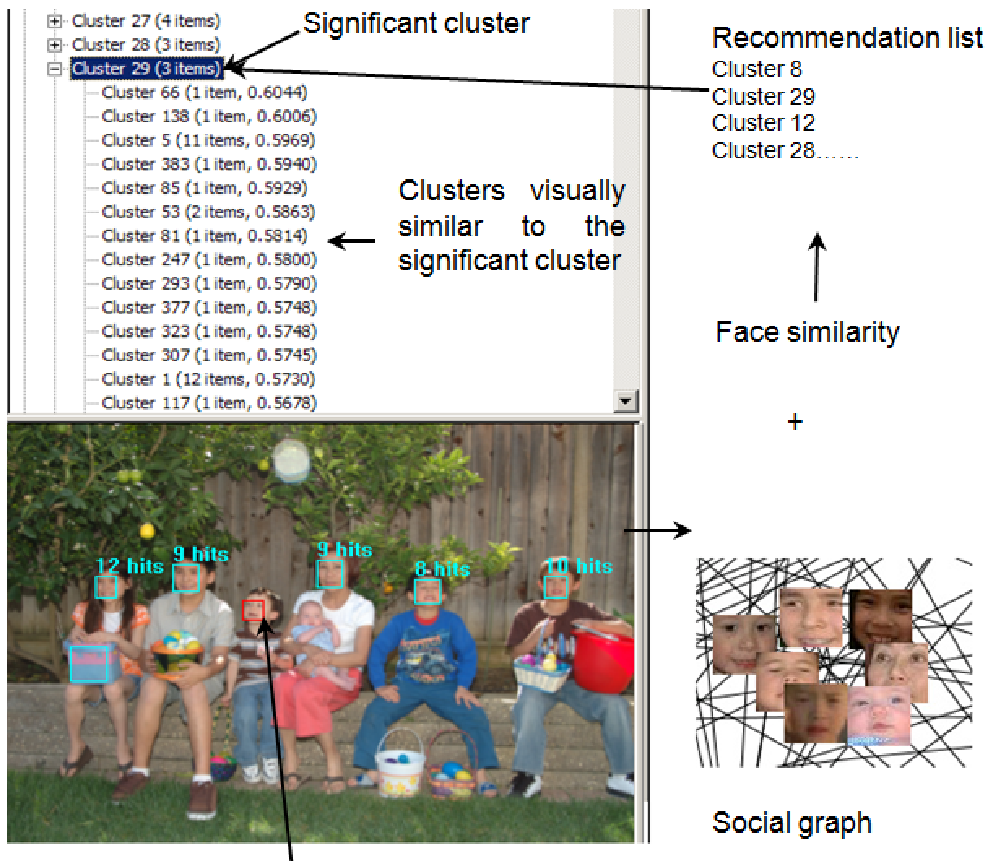 Figure 2: Examples where social context correctly identifies the person (Cluster 82) despite poor visual resemblance.
Critical Analysis & Future Outlook
Takeaway: This paper proves that identity is not just about what you look like, but who you are with. By formalizing social closeness into a mathematical likelihood, the authors significantly reduced the "manual labor" of photo organization.
Limitations:
- The method relies on "significant clusters" being correctly identified first. If the initial clustering is too poor, the social graph becomes a house of cards.
- Large-scale scalability (thousands of faces) might require more efficient graph-partitioning techniques than those used in 2010.
Future Impact: Today, modern AI photo apps (like Google Photos or Apple Photos) use variants of this logic. The next frontier involves Hierarchical Social Modeling—understanding not just "friends" but specific sub-groups (colleagues vs. family) to further refine identification.