
Coloc: Re-imagining Smartphone GPS through Social Collaboration and Acoustic Ranging
Improving GPS Service via Social Collaboration
The paper introduces Coloc, a social-aided cooperative location optimization scheme that enhances smartphone GPS accuracy and energy efficiency. By fusing coarse GPS data from multiple nearby users alongside acoustic relative ranging, it achieves sub-meter-level refinement in both stationary and mobile scenarios.
TL;DR
Building on the insight that "many heads are better than one," the Coloc system transforms a group of nearby smartphones into a collaborative sensor array. By combining coarse GPS signals with precise acoustic peer-to-peer ranging, Coloc improves localization accuracy to 1.2 meters—a massive leap from the standard 5-meter error—while simultaneously reducing the energy drain of frequent GPS polling.
The Problem: The Inefficiency of Solitary Sensing
Despite being essential for modern LBS (Location Based Services), mobile GPS remains flawed. It consumes excessive battery and struggles with signal attenuation in "harsh" environments. While previous academic works suggested "Cooperative Localization," they usually required raw physical-layer measurements or dense anchor nodes—neither of which are practical for a standard iPhone or Android developer.
The authors identify a critical gap: existing peer-to-peer ranging often suffers from high latency (due to TDMA-based signals) and fails to account for the mobility of users.
Methodology: Fusing Diversity with Law of Large Numbers
The core philosophy of Coloc is Application-layer Fusion. Instead of fixing the satellite signal, it fixes the result by looking at the neighborhood.
1. The Necessary Condition for Ranging
Not every pair of friends needs to range each other. The authors derived a mathematical bound where if users are already very close (within a certain variance-based radius), simple co-location fusion is enough. This "Sparse" approach saves significant battery and bandwidth.
2. Dual-Stage Optimization
- Sparse Steepest Descent (SSD): A global optimization that treats the group of users as nodes in a graph, iteratively adjusting their estimated coordinates to match measured inter-node distances.
- Polar Optimization: A local refinement that uses a "weighting center" between two users to stabilize random deviations, essentially "smoothing" the relative positions in a polar coordinate system.
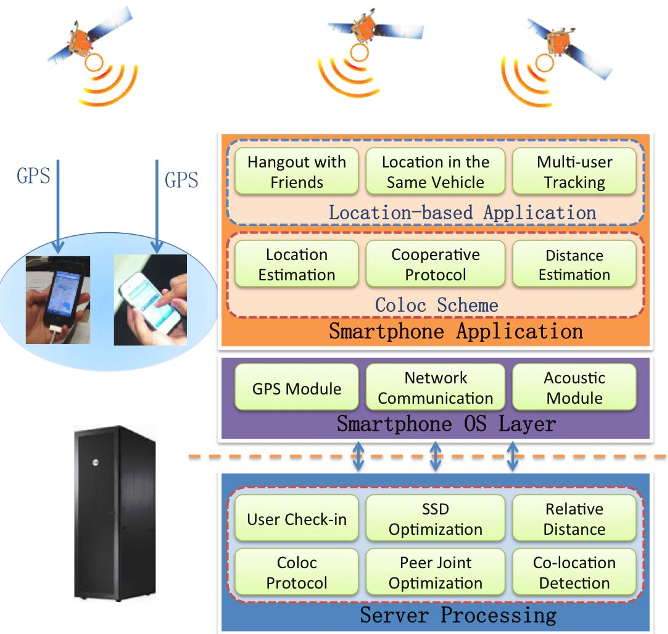 Figure 1: The Coloc architecture showing the middleware interface and server-side optimization.
Experimental Validation: From 5m to 1.2m
The team tested Coloc using a fleet of iPhones (4, 4S, and 5) in both stationary and moving scenarios.
Case Study: Stationary Accuracy
In a campus environment with 9 users, standard GPS produced scattered results with a typical error of 4.7 meters. By applying the "SSD+Polar" joint optimization, they flattened the error curve, reaching 1.2 meters at 80% confidence.
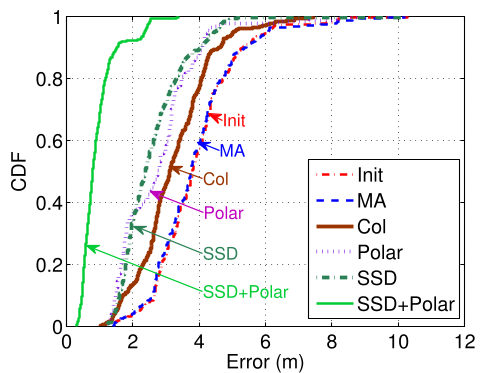 Figure 2: Performance comparison—(a) Initial GPS jitter, (b) Revisions after SSD, (c) Final pinpoint accuracy after SSD+Polar.
Case Study: Moving Users
One of the most impressive feats was tracking users walking in a parking lot. Even when the GPS update interval was doubled (to save power), the Coloc-refined trajectory remained smoother and more accurate than the high-frequency raw GPS stream.
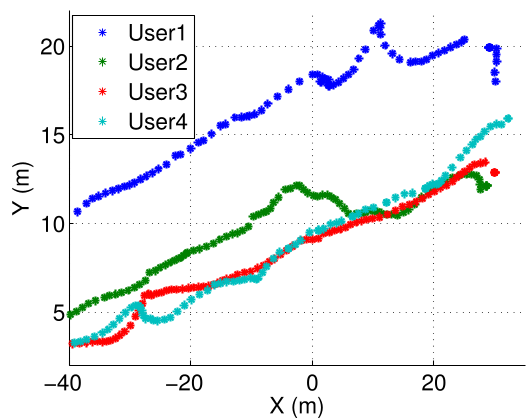 Figure 3: Tracking trajectories—Coloc effectively suppresses the "zigzag" noise typical of standard mobile GPS.
Critical Insight & Conclusion
Coloc is a masterclass in Software-Defined Localization. It acknowledges that smartphone hardware is imperfect and uses the "Social Network" as a virtual antenna.
Takeaways for the Industry:
- Energy/Accuracy Trade-off: You don't need a high-frequency GPS if you have peer-assisted data.
- Acoustic Ranging: Using modulated 2-PAM acoustic beeps allows for simultaneous ranging and ID identification, solving the "who-is-who" problem in peer detection.
- Scalability: The "Sparse" nature of the algorithm ensures it doesn't get bogged down as the number of users in a crowd increases.
While the system currently relies on a central server for optimization, the future of Coloc likely lies in Decentralized Edge Computing, where phones negotiate their positions locally via Bluetooth and Ultrasound without needing a "source of truth" from the cloud.