
Bridging the Relevance Gap: Leveraging Social Networking for Graduate Employability
Improving Graduate Employability by Using Social Networking Systems
The paper proposes a "Triple-Entity Learning Community Framework" centered on graduate employability and explores using Social Networking Systems (SNS) as an e-learning strategy. By integrating SNS into higher education, the authors aim to bridge the gap between academic theory and industrial requirements, ultimately improving the "work-ready" status of graduates.
TL;DR
Higher Education is facing a crisis of relevance. As the gap between academic theory and industrial practice widens, this paper proposes a Triple-Entity Learning Community Framework. By placing Employability at the center and utilizing Social Networking Systems (SNS) as an e-learning strategy, universities can transform from isolated knowledge silos into dynamic ecosystems that produce industry-ready graduates.
The "Value Crisis" in Higher Education
The digital era has created a paradox: while information is more accessible than ever, the relative value of a university degree—measured by the Graduate Starting Salary (GSS) against Average Weekly Earnings (AWE)—has seen a steady decline.
Specifically in ICT and Engineering, the "relevance" of a bachelor's degree to real-world work drops significantly within five years of graduation. The reason? A mismatch in perceptions:
- Students desire real-life case studies and workplace experience.
- Employers seek "work-ready" attributes and practical experience.
- Universities often remain stuck in traditional e-learning models that prioritize critical theory over collaborative practice.
Methodology: The Triple-Entity Framework
The researchers argue that a learning community is a closed-loop system of value exchange between three nodes: Universities, Students, and Industries.
The Role of Core Value
To prevent the system from becoming inefficient or recurring, the authors propose a "Core Value"—specifically Employability—as the starting point of the value cycle.
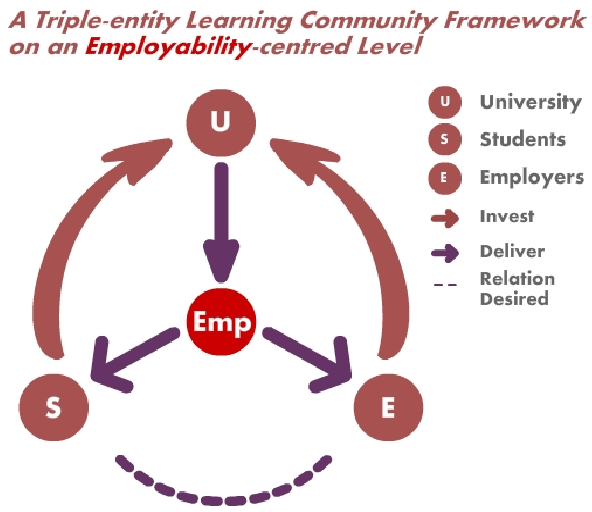 Figure: The Triple-Entity model showing how Core Value (Employability) glues Universities, Students, and Employers together.
Why SNS?
Traditional e-learning platforms like Blackboard often fail because they lack the "social component" of learning. In contrast, SNS (like the early forms of LinkedIn or professional forums) offers:
- Real-time interaction: Breaking the isolation of the classroom.
- Situated knowledge: Content that reflects current workplace realities rather than stagnant textbooks.
- Low-cost training: Allowing employers to engage with and "care for" students long before they graduate.
Experimental Evidence: The Salary Discrepancy
One of the most striking findings in the paper is the longitudinal analysis of Australian graduate salaries from 1977 to 2008.
 Table: Historical data showing the GSS/AWE ratio shrinking from 100% to roughly 80%.
The data suggests that while absolute salaries have increased, employer confidence in graduate quality—and thus their willingness to pay a premium—has diminished. Graduates in IT and Engineering particularly struggle with the irrelevance of their curricula, often finding their first "satisficing" job takes over 1.4 years on average.
Critical Insight: Higher Education on Demand
The authors suggest that HES must evolve toward "Higher Education on Demand." Rather than a top-down approach, education should be a "hybrid of cognition building modes" where:
- Theory is balanced by Live Feeds from the workplace.
- Social Networking acts as an extracurricular learning method to capture valuable peer comments and industry trends.
Conclusion & Future Outlook
This paper serves as an urgent call to action. By implementing SNS into curriculum development, universities can move beyond providing "computerized facilities" to actually fostering a community.
The Takeaway: To thrive in the 21st century, the Higher Education System must stop viewing SNS as a "notorious threat" and start using it as a bridge to the professional world. The goal is no longer just "learning," but sustainable employability.