
GTN: Bridging Graph Convolutions and Transformers for Social Recommendation
Improving Graph Convolutional Networks with Transformer Layer in social-based items recommendation
This paper introduces the Graph Transformer Network (GTN), a hybrid architecture that integrates Transformer layers into a Graph Convolutional Network (GCN) framework for social-based item recommendation. By combining GCN's local aggregation with the Transformer's multi-head attention, the model captures complex relational patterns and achieves SOTA performance on the Ciao and Epinions datasets.
TL;DR
Social-based recommendation systems rely on capturing the intricate interplay between user preferences and social influence. While Graph Convolutional Networks (GCNs) are the current standard for modeling graph-structured data, they often fail to capture deep latent patterns. In this paper, the authors present Graph Transformer Network (GTN), a model that stacks Transformer layers on top of GCN layers to refine embeddings, resulting in significantly lower error rates (RMSE/MAE) on major benchmarks.
Problem & Motivation: Beyond Simple Aggregation
Most recommendation engines treat data as a simple matrix (Matrix Factorization) or a local graph (GCN). However, social influence isn't just about who you are connected to; it's about the importance and patterns of those connections.
The authors identify two key limitations in existing work:
- Structural Rigidity: Standard GCNs aggregate features from neighbors using fixed or simple normalized weights, which might not reflect the true influence of a social peer.
- Latent Space Sparsity: In sparse social graphs (like Ciao and Epinions, with densities < 0.1%), GCNs struggle to find frequent patterns that signify user-item compatibility.
The Research Intuition here is elegant: use GCNs for what they are good at—structural neighborhood smoothing—and then use the Transformer's self-attention to "denoise" and "rearrange" those embeddings into a space more suitable for regression.
Methodology: The Hybrid Architecture
The GTN architecture follow a specific pipeline:
- GCN Encoder: Two layers of Graph Convolutions aggregate feature information from neighbors.
- Transformer Refiner: The output embeddings are fed into a Transformer encoder. Here, multi-head attention (MHA) calculates the compatibility between node representations, effectively allowing the model to focus on the most salient features regardless of their original graph distance.
- Prediction Head: Final embeddings of a user and an item are concatenated and passed through a linear layer to predict a rating (1-5 scale).
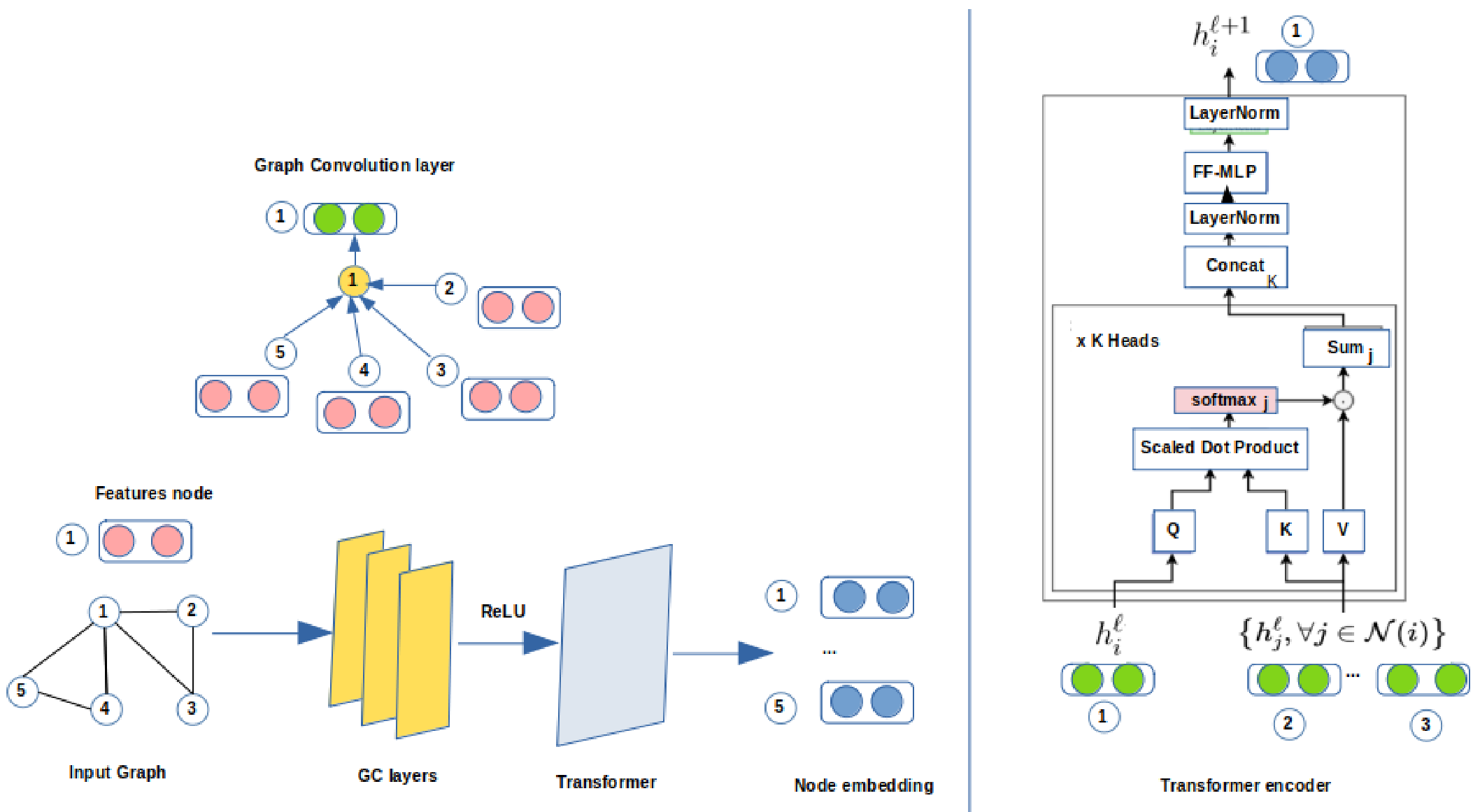 Fig 1: The proposed hybrid architecture combining GCN structural learning with Transformer attention.
Mathematically, the update rule for the Transformer layer is defined as: This allows the node to selectively attend to the most relevant information in its structural neighborhood .
Experiments and Results
The model was validated on two real-world datasets: Ciao and Epinions.
SOTA Performance
GTN outperformed traditional Matrix Factorization (PMF) and standard GCNs by a wide margin. In terms of RMSE (Root Mean Square Error), GTN achieved a score of 0.9732 on Ciao, significantly beating the baseline GCN's 1.0605.
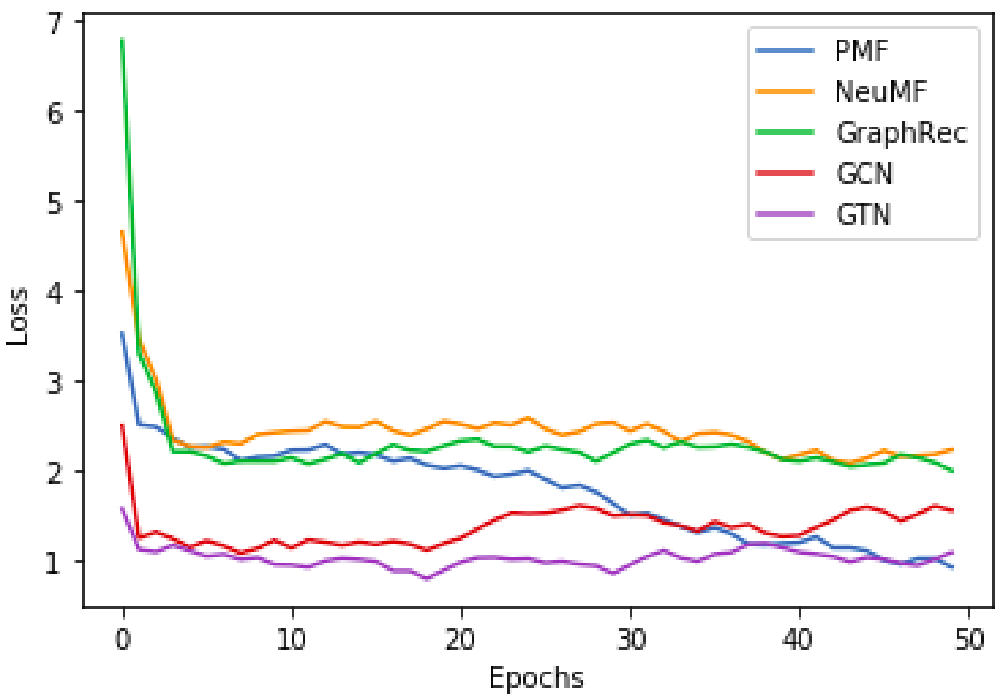 Fig 2: Loss curves demonstrate that GTN achieves faster and deeper convergence compared to baseline methods on the Ciao dataset.
Key Insights from Ablation
- The Power of Heads: Increasing from 1 to 3 attention heads consistently dropped the MAE from 0.84 to 0.81, proving that multi-view representation learning is vital.
- Depth Matters: The study found that 2 GCN layers are the "sweet spot." Adding a 3rd layer actually led to a performance drop (likely due to the "over-smoothing" problem common in deep GNNs).
Critical Analysis & Conclusion
Takeaway
The integration of Transformer layers provides a powerful Inductive Bias for recommendation: it assumes that while graph structure tells us who interacts, the attention mechanism tells us which interactions matter.
Limitations
- Computational Overhead: As shown in the paper's resource analysis, GTN uses significantly more GPU memory (11.4 GB) and time compared to a standard GCN. This makes it challenging for hyperscale real-time production environments without further optimization (like pruning or distilled attention).
- Position Encoding: The paper briefly mentions the difficulty of positional encoding on graphs. Current GTN relies on the GCN layers to provide structural awareness, but explicit structural encodings could further boost performance.
Future Outlook: The success of the "GCN + Transformer" stack suggests that future research might move toward Graph-Transformer Hybrids where the adjacency matrix is used as a hard mask within the Self-Attention mechanism itself, unifying the two modules into a single powerful operator.