
Formalizing Safety: How Petri Nets Can Prevent Fatalities in Medical Monitoring
Improving Interactive Systems Usability Using Formal Description Techniques: Application to HealthCare
The paper introduces a formal methodology to enhance the usability and safety of healthcare interactive systems, specifically wireless patient monitoring systems. It leverages the Interactive Cooperative Objects (ICO) formalism, based on Petri nets, to identify erroneous interactions and provide mathematically grounded usability proofs that surpass traditional empirical evaluations.
TL;DR
Medical technology has advanced at a breakneck pace, but its safety-critical interfaces often rely on subjective "expert reviews." This paper introduces a rigorous mathematical framework using Interactive Cooperative Objects (ICOs) and Petri nets to prove the usability of healthcare systems. By modeling every possible state, the authors can detect "mode confusion" and prevent interaction-led accidents before they occur in hospitals.
The Hidden Crisis in Healthcare Usability
In safety-critical domains like aviation, interface failure is treated as a systemic risk. In healthcare, it is often dismissed as "human error." However, statistics are sobering: the UK NHS reports ~850,000 adverse events annually, while the US estimates up to 100,000 fatalities.
The root cause is often Mode Confusion—where the system behaves differently from the user's expectation. Traditional usability testing (observing a few users in a lab) is insufficient for complex systems because it cannot explore every corner of the system's state space.
Methodology: The ICO Formalism
The authors propose moving beyond checklists to Formal Description Techniques (FDTs). They utilize the ICO formalism, which treats an interactive system as a collection of communicating objects.
The Core Components of ICO:
- Cooperative Object (The Brain): A Petri net describing the inner behavior and logic.
- Presentation Part (The Face): The actual widgets and windows the user sees.
- Activation/Rendering Functions (The Nerves): The bridge connecting user actions to the logic and vice versa.
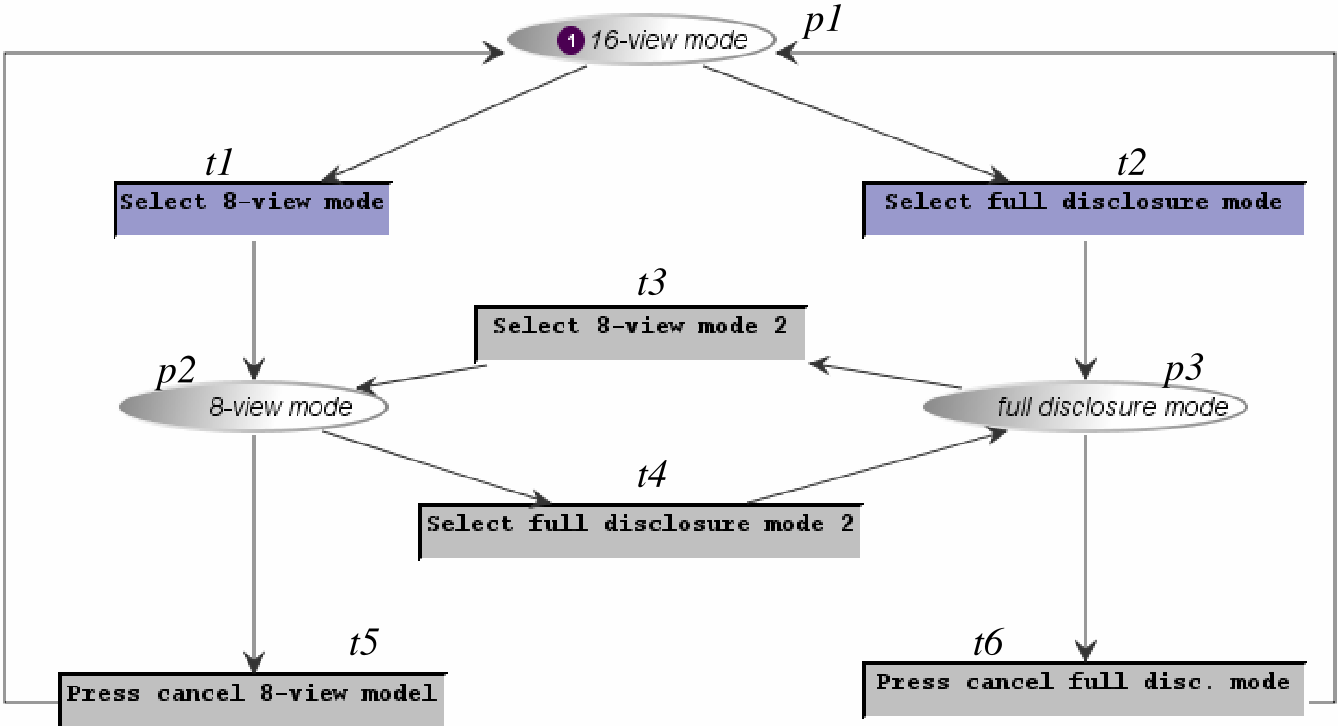 Figure: A Petri net model of a patient monitoring system, showing different viewing modes as distinct states.
Why Use Petri Nets?
Unlike simple flowcharts, Petri nets (specifically Marking Graphs) allow for exhaustive mathematical proof. If a designer wants to ensure that a "Cancel" button is always available to stop a dangerous treatment, they don't have to test every menu path; they can mathematically verify that there is no reachable state in the model where the "Cancel" transition is blocked.
Case Study: Analyzing the PatientNet System
The paper analyzes the PatientNet Central Station, a telemetry system used for wireless patient monitoring. By cross-referencing the FDA's MAUDE database, the authors found 22 reports of adverse events, including 10 deaths, related to this system.
1. Proof of Usability
Using ergonomics criteria from Bastien and Scapin, the authors noted the system lacked a universal "Undo/Cancel" function. By modeling the system in the Petshop environment, they generated a marking tree to prove how a redesigned interface would handle interrupts across all 16-patient and full-disclosure views.
2. Intelligent Contextual Help
Ever tried to click a button that was "grayed out" and didn't know why? In a hospital, that 5-second delay can be fatal. FDTs allow for Contextual Help that doesn't just say "feature unavailable," but analyzes the current Petri net token distribution to tell the user exactly what state they are in and what they must do to enable that feature.
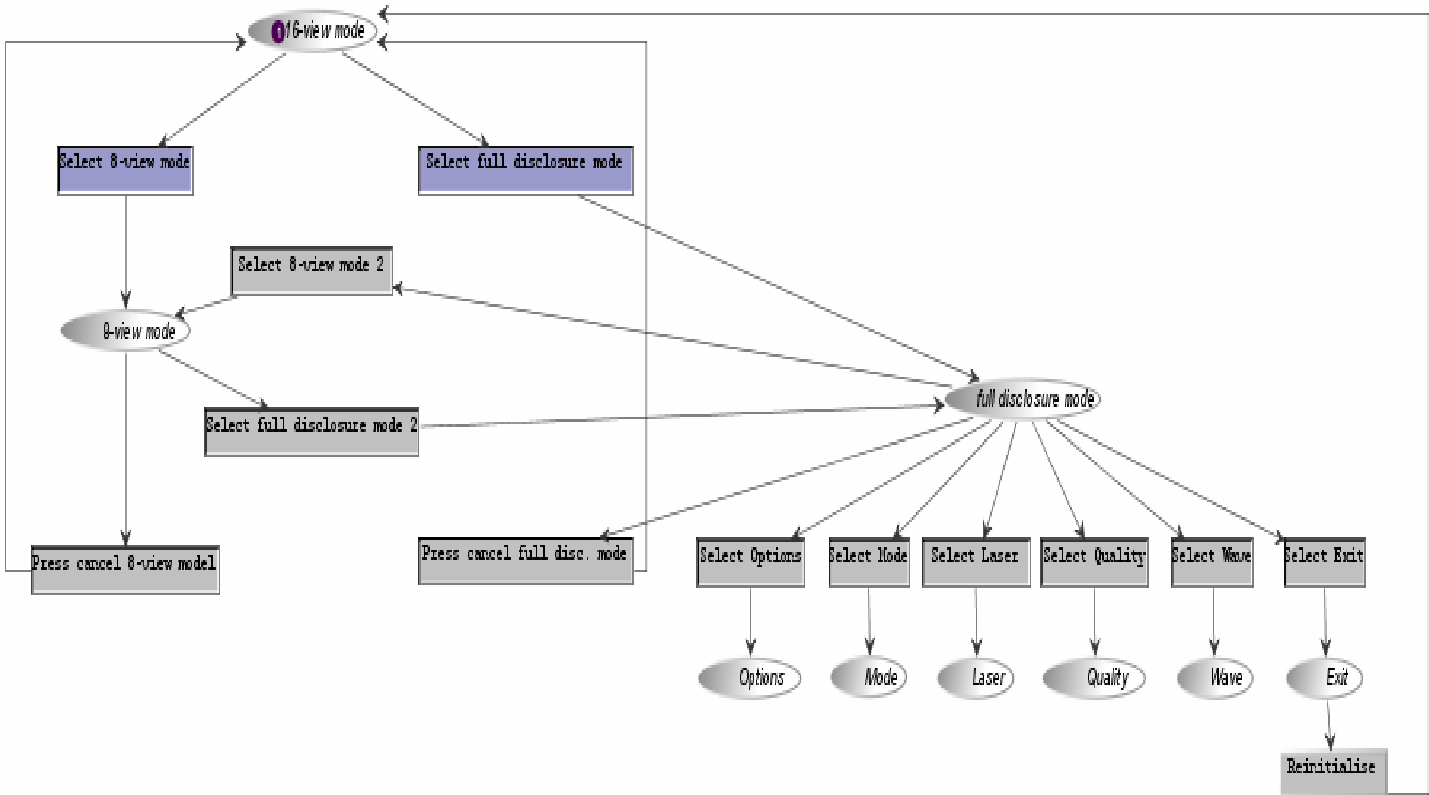 Figure: A model demonstrating how a "Laser" button only becomes active (transition fireable) when the system enters "Full Disclosure Mode."
Critical Insight: Preventing Recurrence
The most powerful application is Accident Investigation. By modeling the sequence of events reported in an accident, researchers can identify "Hazardous States." Once identified, these states can be "blocked" in the Petri net by removing the transitions that lead to them, effectively making the accident impossible to repeat in the software's logic.
Conclusion & Future Outlook
While formal methods are often seen as "too expensive" or "too academic," this paper argues they are a moral necessity in healthcare. As we move toward more touch-screen and haptic interfaces in operating rooms, the "feel" of a system must be backed by the "rigor" of mathematics.
Takeaway: Future medical devices shouldn't just be "user-friendly"; they should be "proven safe." Formal verification isn't just for code—it's for the interaction itself.