
Beyond Safe Bets: Integrating Credit and Profit Scoring for Smarter P2P Lending
Improving Investment Suggestions for Peer-to-Peer (P2P) Lending via Integrating Credit Scoring into Profit Scoring
This paper proposes a two-stage machine learning framework for Peer-to-Peer (P2P) lending that integrates Credit Scoring with Profit Scoring. Utilizing the LightGBM algorithm, the method first predicts the Probability of Default (PD) and then uses this as a feature to predict the Annualized Rate of Return (ARR), achieving superior investment selection over traditional single-stage models.
TL;DR
Maximizing profit in Peer-to-Peer (P2P) lending is not just about avoiding defaults; it's about finding the "sweet spot" where high interest rates outweigh technical risks. This paper introduces a two-stage LightGBM framework that feeds predicted default probabilities into profit models. The result? A significant jump in the Annualized Rate of Return (ARR) from 1.09 to 1.13 without increasing the portfolio's default risk.
The "Risk-Return" Paradox in P2P Lending
In the world of Lending Club and Prosper, investors face an inherent conflict. Traditional Credit Scoring aims to find the "safest" borrowers (Grade A), but these loans offer meager interest rates. Conversely, Profit Scoring looks for high returns but often flies blind regarding the catastrophic loss of principal during a default.
The fundamental insight of this research is that risk information itself is a powerful predictor of profit. A high-risk loan isn't just a "bad" loan; it’s a high-yield opportunity that requires more sophisticated calibration than a simple binary "yes/no" classification.
Methodology: The Two-Stage LightGBM Pipe
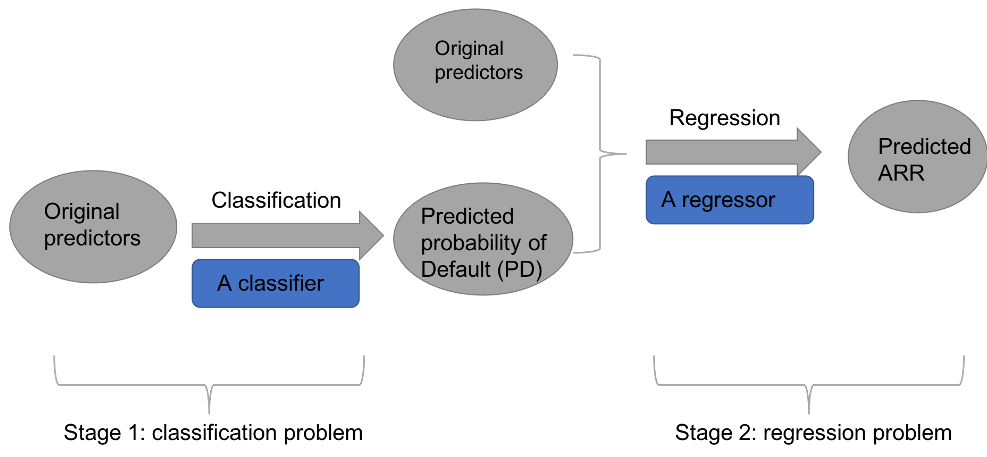
The authors propose a sequential architecture designed to capture the non-linear interaction between risk and reward.
- Stage 1 (The Gatekeeper): A LightGBM classifier is trained on historical loan data to predict the Probability of Default (PD).
- Stage 2 (The Maximizer): A LightGBM regressor predicts the Annualized Rate of Return (ARR). Crucially, the outcome of Stage 1 (the predicted PD) is injected into Stage 2 as a primary feature alongside traditional borrower data (DTI, FICO, Income).
Why LightGBM?
The choice of LightGBM is strategic. As a Gradient Boosting Decision Tree (GBDT) variant, it handles high-dimensional categorical data (like "loan purpose" or "home ownership") with extreme efficiency and excels at capturing the non-monotonic relationships between credit variables and actual financial outcomes.
Experimental Evidence: Finding Hidden Gems
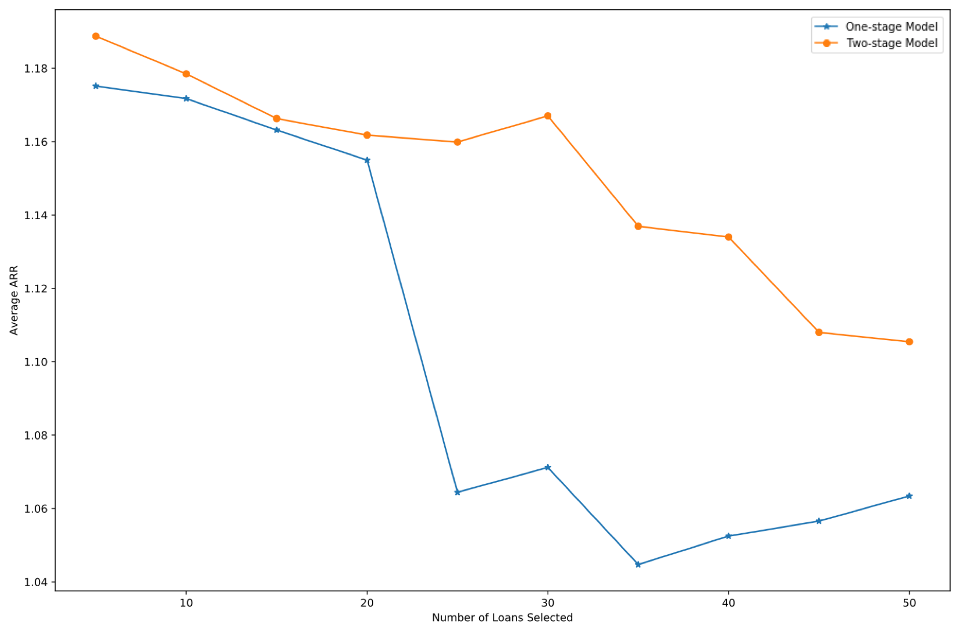
Using a massive dataset of 1,123,895 loans from Lending Club, the study compared the two-stage model against a standard one-stage profit regressor.
Performance Boost
The two-stage model consistently identified loans with higher average ARRs. When looking at the "Top 50" recommended loans, the two-stage model outperformed the baseline across the board.
Strategy Shift: Embracing "Risky" Profits
An analysis of the loan grades (A-G) reveals a fascinating shift in strategy. The two-stage model is more aggressive:
- It completely ignores Grade A and B loans (too safe, too low profit).
- It shifts heavily toward Grade F and G loans—the riskiest tiers.
- The Catch: Despite picking "riskier" grades, the model's actual default rate remained identical to the one-stage model (0.12).
This suggests that the two-stage framework is better at cherry-picking the specific "high-risk" loans that are actually likely to pay back, capturing the high interest rates that Grade F/G loans offer while filtering out the true losers.
Critical Insight & Conclusion
The value of this work lies in its rejection of the "siloed" approach to financial modeling. By treating Credit Scoring not as a final filter, but as a feature engineering step for Profit Scoring, the authors have created a model that understands the price of risk.
Takeaways for the Future:
- Beyond P2P: This multi-stage approach is highly applicable to insurance underwriting and venture capital, where the "probability of failure" is a critical component of "potential upside."
- Limitations: While powerful, the model relies on historical interest rate structures. If P2P platforms change their internal grading logic, the Stage 1 signals may require frequent retraining.
Ultimately, this research proves that in high-stakes lending, the most profitable path isn't avoiding risk—it's quantifying it accurately enough to profit from it.