
TaPaSCo Cascabel: Breaking the 8μs Barrier for FPGA Job Launches
Improving Job Launch Rates in the TaPaSCo FPGA Middleware by Hardware/Software-Co-Design
The paper presents a hardware/software co-design enhancement for the TaPaSCo FPGA middleware to increase job launch rates and reduce latencies. It introduces a new Rust-based software runtime and the "Cascabel" hardware job dispatcher, achieving up to 6x improvement in job throughput.
TL;DR
Integrating FPGA accelerators into High-Performance Computing (HPC) often suffers from a "Communication Tax." Every time the CPU tells the FPGA to start a task, PCIe overhead eats up precious microseconds. This paper introduces a hardware/software co-design for the TaPaSCo framework: a high-efficiency Rust-based runtime and the Cascabel hardware dispatcher. Together, they boost job throughput by 6x (up to 6 million jobs per second) while consuming less than 2% of FPGA logic resources.
The Bottleneck: The Host-Centric Tax
In the modern heterogeneous landscape, FPGAs are no longer just for low-speed glue logic; they handle complex pipelines like DNA sequencing and ML inference. However, frameworks like Xilinx XRT or the original TaPaSCo are host-centric.
Before a task can run:
- The CPU prepares memory and parameters.
- The CPU writes to registers via PCIe.
- The CPU waits for an interrupt.
This cycle creates a latency floor (typically >8-30μs). If your hardware task only takes 1μs to execute, the system spends 90% of its time waiting for the "paperwork" to finish.
Methodology: Moving the Dispatcher into Silicon
The authors tackled this through a dual-pronged approach.
1. Robust Rust Runtime
By rewriting the C-based middleware in Rust, they leveraged safe concurrency and compile-time checks. They replaced heavy interrupt handling with the Linux eventfd mechanism, significantly reducing context-switching overhead on the host side.
2. The Cascabel Hardware Dispatcher
The core "Aha!" moment is the Cascabel module. Rather than the host CPU micro-managing every Processing Element (PE), the host simply streams a list of "Jobs" and "Barriers" into a hardware-mapped command queue.
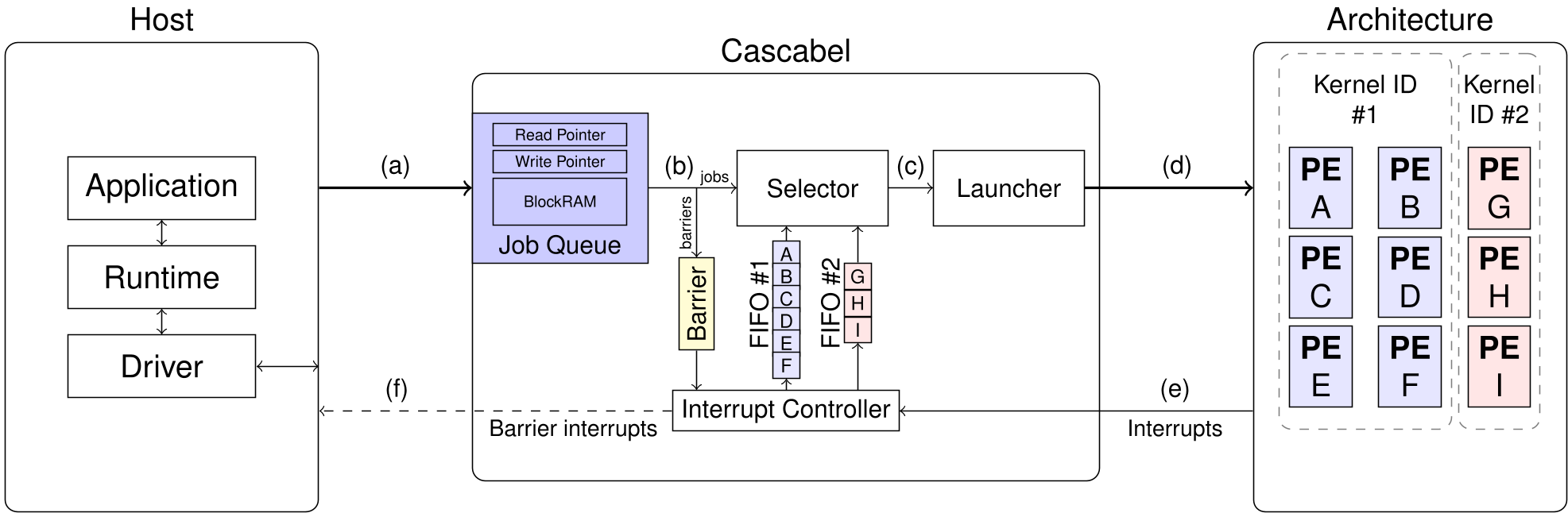
- Hardware Queue: Based on BlockRAM, it supports atomic read/write pointers for multi-threaded safety.
- Selector & Launcher: The hardware automatically finds an idle PE matching the requested Kernel ID and fires it off in roughly 167 nanoseconds—orders of magnitude faster than the CPU could.
- Hardware Barriers: These allow the FPGA to handle task dependencies on-chip. The CPU only gets "notified" once a whole sequence of complex jobs is finished.
Experiments: Performance at Scale
The evaluation focused on two platforms: the datacenter-class Xilinx Alveo U280 and the embedded Ultra96.
Throughput Gains
The results are striking. While the original runtime struggled at approximately 1 million jobs/s, the hardware-accelerated version soared past 6 million jobs/s.
Efficiency and Logic Footprint
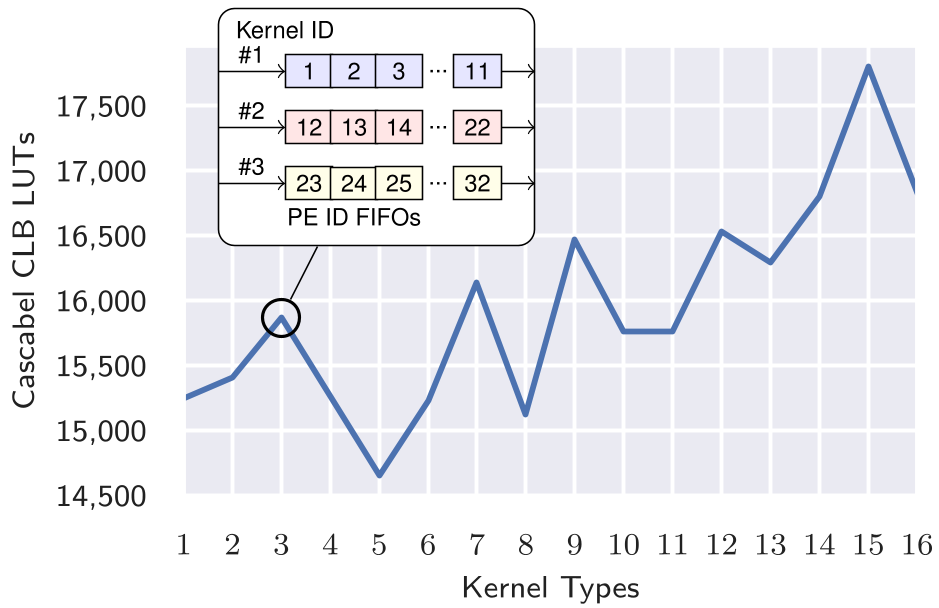
One might fear that adding a scheduler to the FPGA would consume space meant for accelerators. Cascabel proves this wrong: it consumes less than 2% of LUTs on the U280. It is a "lean and mean" orchestration layer that scales with the number of kernels without bloating the design.
Critical Analysis & Conclusion
Takeaway
The TaPaSCo extension proves that for fine-grained tasks, software is the bottleneck. By moving the "ready-to-run" logic into hardware, we unlock the true potential of multi-kernel FPGA SoCs.
Limitations
Currently, Cascabel has some architectural constraints:
- Parameter Limits: It supports a maximum of 4 parameters per job (limited by 512-bit queue entries).
- Static Scheduling: It follows a FIFO model; it cannot yet dynamically reorder jobs for optimal efficiency.
Future Outlook
The authors suggest a future where PEs can launch other PEs. Imagine an FPGA kernel that, upon finishing a calculation, directly enqueues the next stage of the pipeline without ever waking up the host CPU. This "on-chip autonomy" is the next frontier for truly high-performance reconfigurable computing.
The new runtime is already available on GitHub, signaling a move towards more robust, hardware-accelerated middleware in the open-source community.