
DCF: Elevating Crowdsourced Label Accuracy via Dynamic Worker Filtering
Improving Label Accuracy by Filtering Low-Quality Workers in Crowdsourcing
The paper introduces two novel algorithms, Cluster Filtering (CF) and Dynamic Classification Filtering (DCF), designed to improve the accuracy of crowdsourced datasets by identifying and removing low-quality workers. DCF uses supervised learning with a binary-search thresholding mechanism to outperform existing SOTA baselines like RY and IPW across multiple datasets.
TL;DR
Crowdsourcing is a powerful yet messy tool for data labeling. This paper introduces Dynamic Classification Filtering (DCF), a supervised learning approach that cleans datasets by identifying low-quality workers through their behavioral "fingerprints." By training on auxiliary data and dynamically adjusting filtering thresholds, DCF significantly outperforms traditional statistical methods, making it a robust tool for real-world ML pipelines.
Background: The Spam Problem in Crowdsourcing
Crowdsourcing platforms like Amazon Mechanical Turk provide cheap, scalable human intelligence. However, the quality is often compromised by:
- Spammers: Workers who click randomly for fast cash.
- Biased Workers: Individuals who favor specific labels regardless of the task.
- Unskilled Workers: Those who lack the domain knowledge to be accurate.
Existing SOTA methods, such as those by Raykar and Yu (RY) or Ipeirotis et al. (IPW), often rely on fixed thresholds (e.g., comparing worker performance against a majority-class baseline). This paper argues that these thresholds are often too passive, failing to capture the nuanced patterns of low-quality contributors.
The Core Innovation: Worker Characteristics
The authors identify four key metrics to quantify worker quality without knowing the "Ground Truth":
- Evenness: Measures how balanced a worker's label distribution is.
- Log Distance: Quantifies how far a worker's labels deviate from the statistical consensus. High distance often signals a spammer.
- Proportion: The volume of tasks completed by the worker.
- EM Accuracy: An estimated accuracy derived from the Dawid-Skene Expectation-Maximization algorithm.
Methodology: CF and DCF
The paper proposes two frameworks:
1. Cluster Filtering (CF)
An unsupervised approach using k-means clustering (). It treats workers as data points in a multi-dimensional feature space. One cluster is identified as "low-quality" based on its lower average EM accuracy and is subsequently purged.
2. Dynamic Classification Filtering (DCF)
This is the star of the paper. Unlike traditional classifiers that output a static prediction, DCF uses a Binary Search mechanism.
- Training: It builds a model using workers from other datasets (auxiliary data).
- Dynamic Sensitivity: It adjusts the "low-quality" definition in the training set until the classifier flags a specific proportion (e.g., the bottom 50% of labels) in the target dataset.
 (Note: Above represents the math behind the Spammer Score used as a feature in DCF)
Experimental Performance
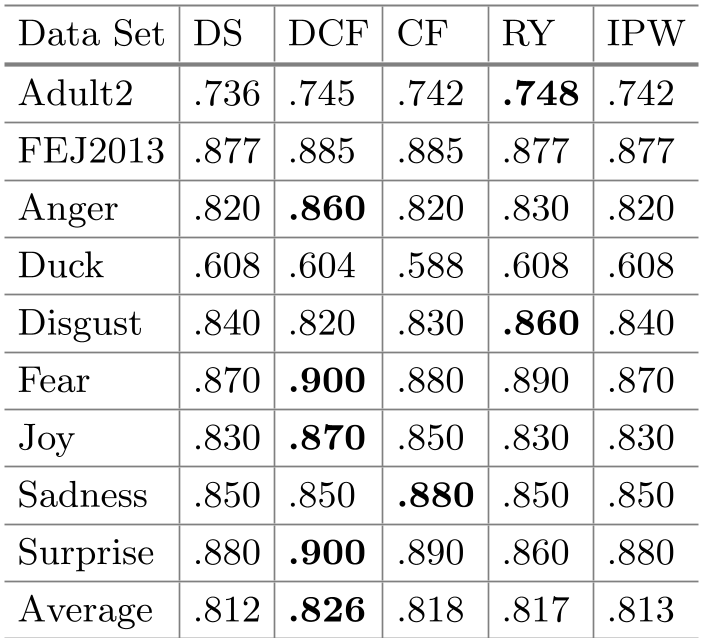
The authors tested their methods against 9 real-world datasets, ranging from image classification (Adult2) to sentiment analysis (Emotion sets like Anger, Joy, etc.).
Key Findings:
- DCF is the SOTA: It achieved the highest average accuracy (0.826) across all datasets.
- Robustness: On "Emotion" datasets, where worker quality varies wildly, DCF achieved gains of up to 4% in raw accuracy over the standard Dawid-Skene consensus.
- Failure of Baselines: Methods like IPW barely improved upon the raw baseline, suggesting their thresholds are too lenient for modern spamming schemes.
Critical Insights & Conclusion
The success of DCF highlights a critical shift in data quality management: context matters. A worker who looks like a spammer in a balanced dataset might look legitimate in a biased one. By using auxiliary datasets for training, DCF "learns" what bad behavior looks like across different contexts.
Limitations:
- DCF requires "Auxiliary Data," meaning you need previous crowdsourcing experience to handle a new project.
- The 50% filtering target is a heuristic; in some datasets, 80% of workers might be good, leading to unnecessary data loss.
The Takeaway: For researchers building large-scale datasets, static filtering is no longer enough. Adaptive, supervised filtering like DCF is the way forward to ensure that the "noise" of the crowd doesn't drown out the "signal" of the data.