
CMSG-EDM: Decoding the Emotional DNA of Crisis Management Training
Improving Learners’ Assessment and Evaluation in Crisis Management Serious Games: An Emotion-based Educational Data Mining Approach
The paper proposes an emotion-based Educational Data Mining (EDM) approach to evaluate learners' affective states in Crisis Management Serious Games (CMSGs). By analyzing facial expressions and text chat through a multimodal AI framework, the method assesses individual and collective engagement (Flow) during a fire evacuation simulation.
TL;DR
In high-stakes training, how we feel is as important as what we know. This paper introduces an Educational Data Mining (EDM) approach that uses AI to "read" the emotions of learners in crisis simulations without interrupting them. By fusion of facial expressions and text chat, the system maps the thin line between Flow (perfect engagement) and Boredom, providing a roadmap for adaptive training.
The Motivation: Why Questionnaires Fail in a Crisis
Crisis Management Serious Games (CMSG) are excellent for teaching soft skills, but evaluating them is a headache. If you stop a player mid-fire-drill to ask "How are you feeling?", you break their immersion (the "Flow"). If you ask them after the game, they might forget their fleeting moments of frustration or confusion.
The authors argue that we need "Stealth Assessment"—a way to use Artificial Intelligence (AI) to observe learners objectively and non-intrusively. Their insight? The key to a better game lies in the emotional transitions between states like anxiety and boredom.
Methodology: The Multimodal "Emotion Engine"
The core of this work is a sophisticated pipeline that turns raw human behavior into actionable data.
1. The Data Fusion Architecture
The system employs a dual-stream data collection method:
- Visual Stream: Uses OpenFace 2.0 to track 18 Facial Action Units (FAUs).
- Textual Stream: Uses Indico to analyze the sentiment of chat messages.
- The Weighting Logic: Recognizing that faces are more expressive in real-time, the authors assigned a 70% weight to visual data and 30% to text.
2. Mapping the "Affective Compass"
The researchers redefined how basic emotions (Joy, Sadness, Anger) translate into learning states. For instance:
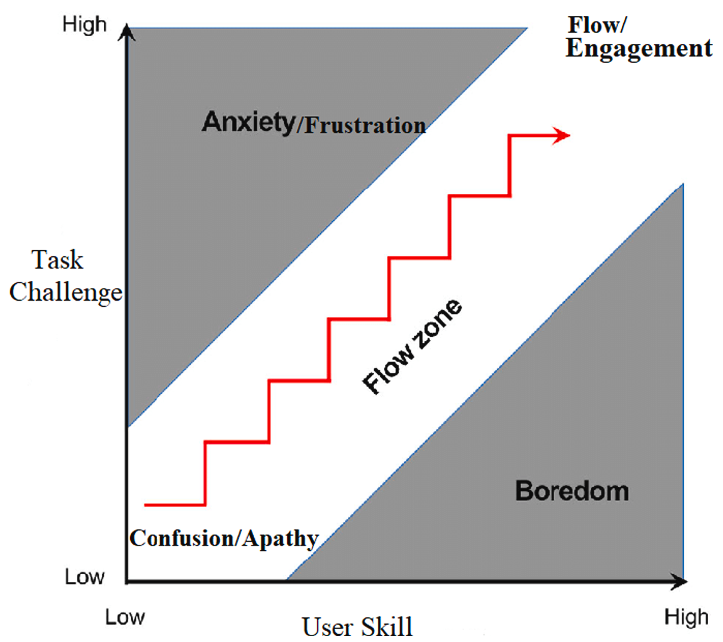
- Flow/Engagement = High Surprise + High Joy.
- Anxiety/Frustration = High Anger + High Sadness/Fear.
- Confusion = A state where all basic emotion levels are low (apathy).
Experiments: Fire Drills and Affective Dynamics
The team tested their method on 30 engineering students in a fire evacuation scenario built on the iScen platform.
Challenging the Cognitive Disequilibrium Model (CDM)
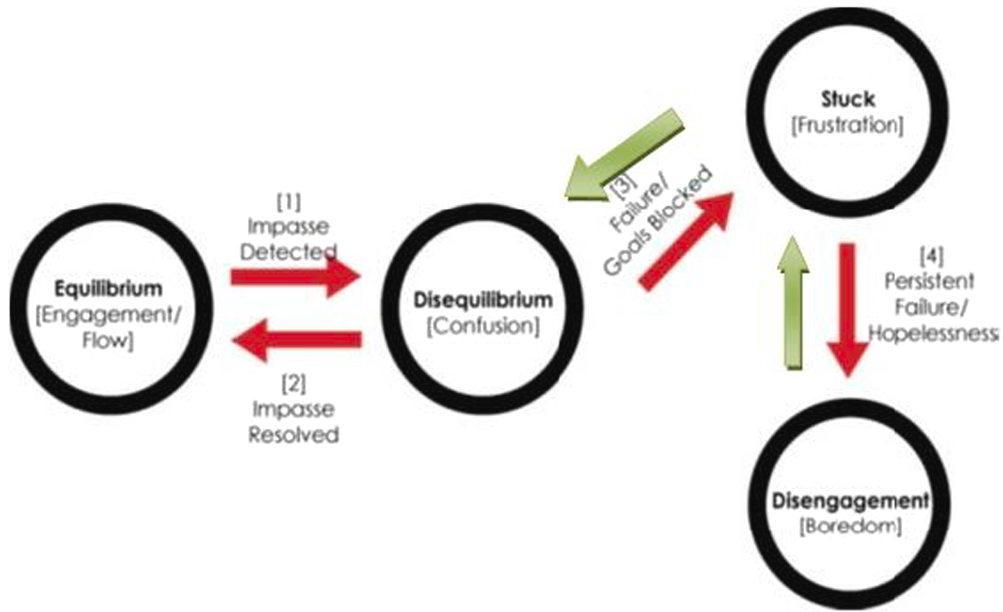
Standard educational models suggest a linear path from Confusion to Frustration. However, this study found something different. In the high-stress environment of a crisis:
- Boredom to Frustration: Students didn't just stay bored; they became frustrated when the "boredom" was caused by a lack of progress.
- Group Polarity: Using a J48 Decision Tree, they could predict the "mood" of the entire team with 81% accuracy, determining if the group performance was trending positive or negative.
Strategic Insights: The Future of Adaptive Training
The results were telling: 50% of the students experienced boredom, and the group emotion was ultimately classified as negative. While this sounds like a failure of the game, it is a goldmine for instructors.
- Ablation of Stress: The paper highlights that "Acute Stress" isn't a basic emotion but a persistent state that accelerates transitions to frustration.
- The "Challenge-Skill" Balance: By identifying these negative states in real-time, future CMSGs can automatically lower difficulty (to reduce anxiety) or inject new events (to break boredom).
Limitations and Outlook
While the sample size (30 students) limits global generalization, the technical framework is solid. The next step? Moving these algorithms into Unity3D engines and incorporating specialized scenarios for training people with mental and physical disabilities, ensuring that crisis management is inclusive and emotionally optimized.
Takeaway
This research moves us away from "guessing" how learners feel to "calculating" it. By integrating emotion-aware AI into serious games, we can create training environments that are not just safe, but psychologically tuned to help every learner reach the "Flow."