
CSI: Reimagining Software Model Inspection through Crowdsourced Micro-tasks
Improving Model Inspection Processes with Crowdsourcing: Findings from a Controlled Experiment
This paper introduces the Crowdsourced Software Inspection (CSI) process, a novel framework that adapts traditional software model inspection for micro-tasking platforms. By utilizing "Expected Model Elements" (EMEs) to guide inspectors, the method aims to scale the verification of large-scale engineering models like Extended Entity Relationship (EER) diagrams.
Executive Summary
TL;DR: The paper presents Crowdsourced Software Inspection (CSI), a process that breaks down the monolithic and expensive task of model verification into small, parallelizable micro-tasks. By using Expected Model Elements (EMEs) as anchors, the authors demonstrate that even non-expert crowds can improve defect detection efficiency and significantly reduce the noise of False Positives in complex models.
Strategic Positioning: This work bridges the gap between traditional Software Quality Assurance (SQA) and Human Computation. It moves beyond simple bug bounties into a structured architectural verification framework, making it a pivotal study for organizations dealing with massive Model-Driven Engineering (MDE) pipelines.
The Bottleneck: Why Manual Inspection Fails at Scale
In modern software engineering, models (like EER or UML) are often the "source of truth." However, as these models grow, they become "inspection-resistant." Traditional methods suffer from:
- Cognitive Overload: A single inspector cannot maintain a mental map of thousands of entities.
- Economic Constraints: High-level architects are too expensive to spend hours hunting for trivial naming or relationship mismatches.
- Lack of Focus: Without strict guidance, inspectors often report "False Positives"—perceived defects that aren't actually violations of the requirements.
Methodology: The CSI Blueprint
The heart of the paper is the transition from the Fagan Inspection (a rigid, meeting-heavy process) to a distributed, task-based workflow.
1. The Concept of EMEs
Rather than asking a worker to "find defects," the CSI process asks: "Based on the requirements, we expect an attribute called 'CreditLimit'. Does it exist in this model segment, and is it correctly defined?" These are the Expected Model Elements.
2. Process Orchestration
The CSI workflow involves four critical stages:
- Preparation: Scoping and crowd environment setup.
- Text Analysis: Extracting EMEs from requirements (manual or NLP-assisted).
- Model Analysis: The "Micro-tasking" phase where workers match EMEs to model segments.
- Aggregation: Consolidating crowd findings into a final defect list.
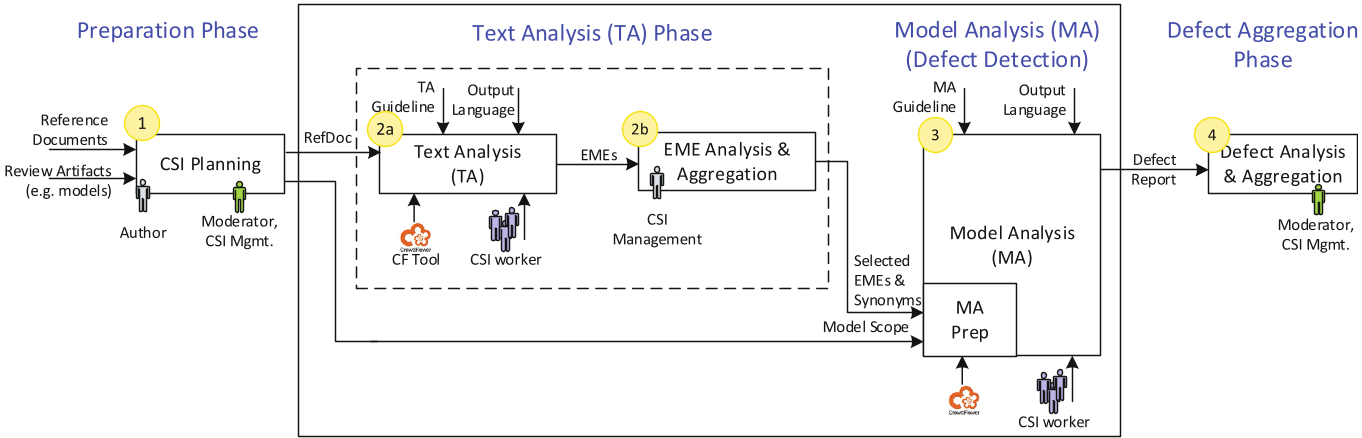
Experimental Insights: Efficiency vs. Effectiveness
The authors conducted a controlled experiment with 75 participants, comparing CSI against traditional Pen & Paper (P&P) methods.
Key Performance Indicators (KPIs):
- Efficiency: CSI inspectors were more "surgical." They found more true defects per hour (7.5) compared to the P&P group (5.7).
- The "False Positive" Shield: By focusing on specific EMEs, crowd workers were less likely to get distracted by stylistic choices, leading to fewer false alarms.
- Scalability: While the P&P group had higher overall "effectiveness" (total defects found), they also had double the time (120 min vs 60 min). The CSI model suggests that by simply adding more "crowd units," total effectiveness can surpass experts in a fraction of the clock time.

Critical Analysis & Conclusion
Takeaway
The CSI process proves that structure beats raw expertise in large-scale verification. By anchoring the inspection in EMEs, the process provides an "Inductive Bias" that helps distributed teams achieve high precision.
Limitations
- The EME Extraction Overhead: The performance of CSI is highly dependent on the quality of EMEs extracted during the Text Analysis phase. If the requirements are poorly parsed, the entire downstream inspection fails.
- Student Proxy: The study used undergraduate students. While "junior professionals" are a fair proxy for many crowd platforms, high-stakes industrial systems may still require expert oversight for "critical" severity defects.
Future Outlook
The next logical step is Hybrid Intelligence: using NLP (like LLMs) to automatically generate the EMEs from specifications and then using the human crowd purely for the visual verification of the models. This would create a truly scalable, low-cost SQA pipeline.