
FGMSI: Leveraging Social Influence and Topological Potential for Precision Music Recommendation
Improving music recommendation by incorporating social influence
This paper proposes a social-influence-aware music recommendation framework that leverages heterogeneous social networks and topological potential. By using a Factor Graphic Model (FGMSI), the system integrates social influence with personal attributes and spatial features, significantly outperforming traditional collaborative filtering and state-of-the-art methods.
TL;DR
Music choice is rarely a solitary act; it is deeply influenced by our social circles. This paper introduces a sophisticated framework that moves beyond simple similarity, using Topological Potential (a concept borrowed from physics) to quantify social influence within a Heterogeneous Information Network. By integrating these insights into a Factor Graphic Model (FGMSI), the authors achieve a ~19% precision boost over traditional collaborative filtering.
Problem & Motivation: The Missing Social Link
While most Music Recommender Systems (MRSs) focus on Collaborative Filtering (what similar users like) or Content-Based features (acoustic properties), they ignore the dynamic nature of social contagion.
The authors argue that social influence is a "side influence" currently untapped. For example, if a friend recommends an artist, you are likely to explore their entire catalog, triggering a secondary propagation of listening behavior among your other friends. Existing models struggle to quantify this "pull" because social networks are heterogeneous—they involve complex links between users, tags, albums, and artists that standard algorithms cannot easily navigate.
Methodology: From Physics to Playlists
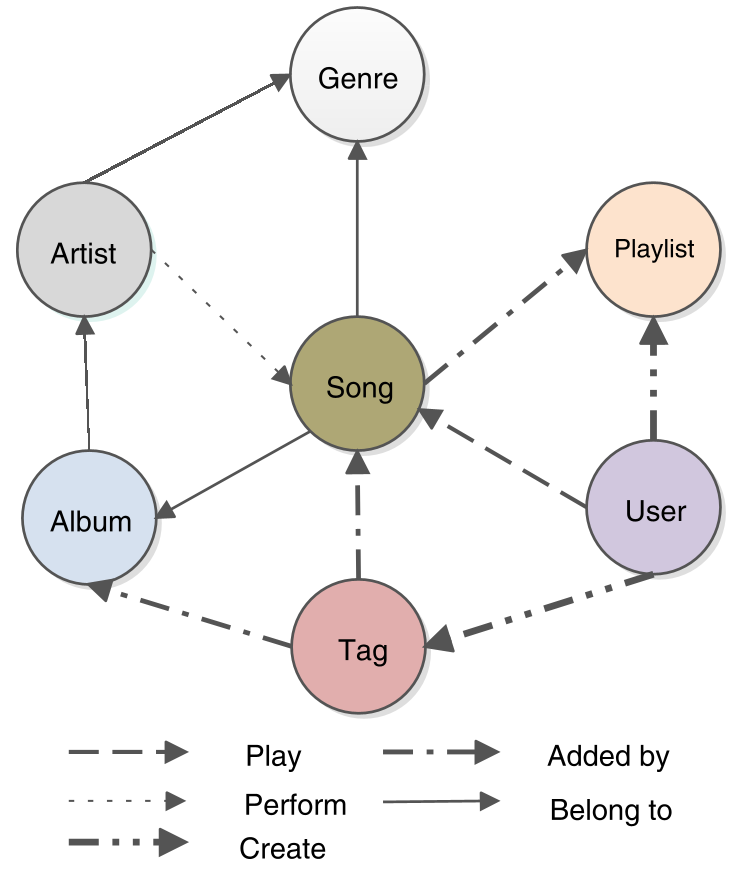
1. The Heterogeneous Music Network
The authors represent the music ecosystem as a directed graph where nodes aren't just users, but also Genres, Albums, Artists, and Tags. They define edge weights using a specialized TF-IDF variation to reflect the importance of a specific relationship (e.g., how vital a specific "Tag" is to a "Song").
2. Topological Potential: Measuring Gravity in Social Space
Inspired by physical field theory (like gravitational or electric fields), the authors treat every user as a "potential source." A user’s influence on another depends on:
- Mass (): The node's activity level.
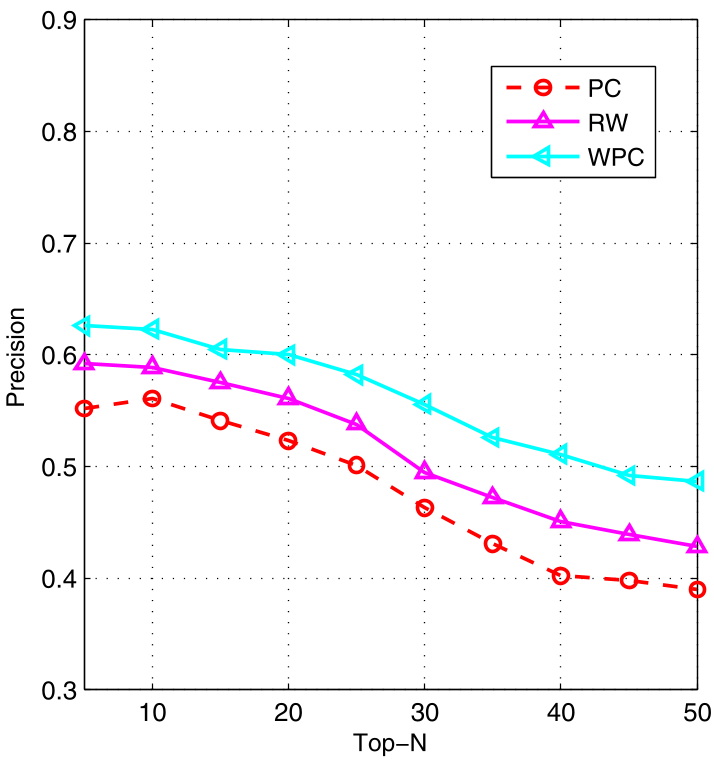
- Distance (): Calculated using a novel Weighted Path Count (WPC) on the meta-paths of the network.
- Influence Factor (): Optimized using Shannon Entropy to find the perfect "range" of influence.
This allows the system to distinguish between Direct (friends) and Indirect (friends-of-friends) influence, providing a far more nuanced view of "mainstreaminess" and "trend-setting."
3. Factor Graphic Model (FGMSI)
The final prediction engine uses a Factor Graphic Model to fuse five key features:
- Personal Attributes (Age, Gender, Occupation)
- Friendship Strength
- Personal Preferences (Artist/Genre affinity)
- Spatial Features (Geographic context)
- Social Influence (The calculated topological potential)
Experiments & Results
The model was tested on a massive Last.fm dataset (105k users, 891k songs).
SOTA Comparison
As shown in the charts below, the FGMSI model consistently maintains higher precision and recall compared to benchmarks like UCF (User-CF) and MMR (Multi-modal Music Recommendation).
Key Findings:
- Social Influence reigns supreme: In the ablation study, adding Social Influence (SI) yielded the highest jump in precision (+9.1%), even more than Personal Preference (+8.1%).
- Convergence: The learning algorithm, powered by Loopy Belief Propagation (LBP), stabilizes in roughly 15 iterations, making it computationally viable for large-scale data.
Critical Analysis & Conclusion
This work's brilliance lies in transforming an abstract social concept—"influence"—into a quantifiable physical property ("potential"). It acknowledges that our tastes are not static; they are pushed and pulled by the "fields" created by our peers.
Takeaway: Future recommendation engines should stop looking at users as isolated data points and start seeing them as participants in a social field.
Limitations: The model relies on explicit social ties (friends) and high-quality metadata (tags/albums). In "cold-start" environments where social networks are sparse, the topological potential might degrade. Future research could investigate "latent" social influence derived from shared behaviors alone, without explicit friendship links.