
Intelligent Ontology Evolution: Scaling University Knowledge via Semi-Supervised Learning
Improving Ontologies through Ontology Learning: a University Case
The paper presents a framework for Semi-Supervised Ontology Learning (OL) aimed at improving domain-specific ontologies. It utilizes open-source tools—Rapid-I (RapidMiner) for text mining and GATE for information extraction—to extend a Venezuelan University ontology through an incremental development process.
TL;DR
Building ontologies for complex institutions like universities is notoriously difficult to scale. This paper introduces an Ontology Learning (OL) framework that functions as a "Semi-Intelligent-Agent." By combining Rapid-I for text mining and GATE for semantic annotation, the authors demonstrate how to incrementally update and populate a university ontology using semi-supervised machine learning, turning a massive corpus of unlabelled PDFs into structured knowledge.
Problem & Motivation: The Knowledge Engineering Bottleneck
In the Semantic Web era, the value of an Information System (IS) is defined by its ontology—an axiomatic theory that structures a specific domain. However, the Ontology Development (OD) Life Cycle suffers from a high "manual labor" cost.
Previous work often relied on expert-driven, top-down modeling which fails to capture the dynamic evolution of domain-specific language (e.g., new educational technologies or administrative roles). Traditional supervised learning requires too much labeled data, while unsupervised methods often produce "noisy" results that lack domain relevance. The authors sought a middle ground: Semi-Supervised Learning (SSL), where a small amount of human expertise guides the processing of large, unlabelled document collections.
Methodology: The "Semi-Intelligent-Agent"
The core innovation is a meta-model that interprets AI tools as "agents" collaborating with human experts. The workflow is divided into three distinct stages:
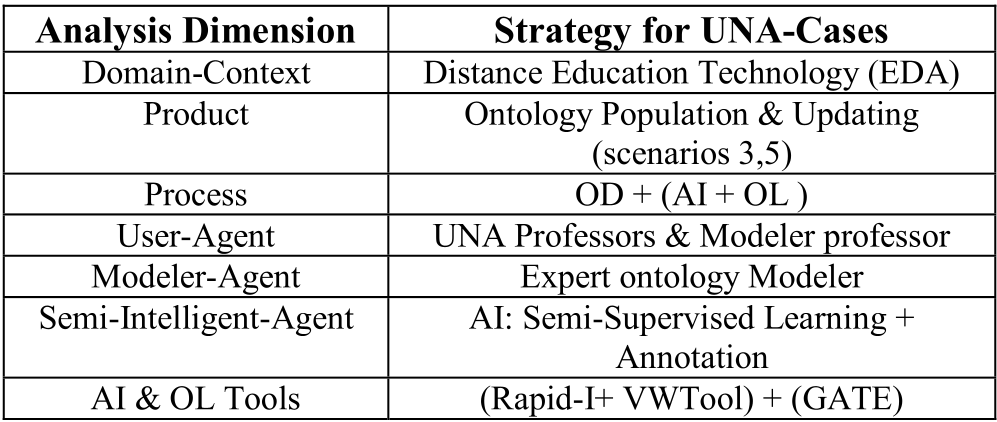
1. The Multi-Dimensional Strategy
The authors define a strategy where User-Agents (university professors) and Modeler-Agents (ontology experts) interact with a Semi-Intelligent-Agent (the software stack).
2. Implementation Pipeline
- Stage 1 (Preprocessing): A corpus of ~1000 web-scraped documents was filtered down to 480 relevant texts and converted to plain format.
- Stage 2 (Keyword Extraction via Rapid-I): Using TF*IDF and the WVTool plugin, the system performs document clustering. This "Significant Word" extraction acts as the "Learning" part of the process, identifying terms like Accredit, Faculties, and Learner.
- Stage 3 (Ontology Updating via GATE): The extracted keywords act as semantic "filters." By using the ANNIE (A Nearly-New Information Extraction) plugin, the system highlights potential instances or new classes within the texts for the human expert to approve.
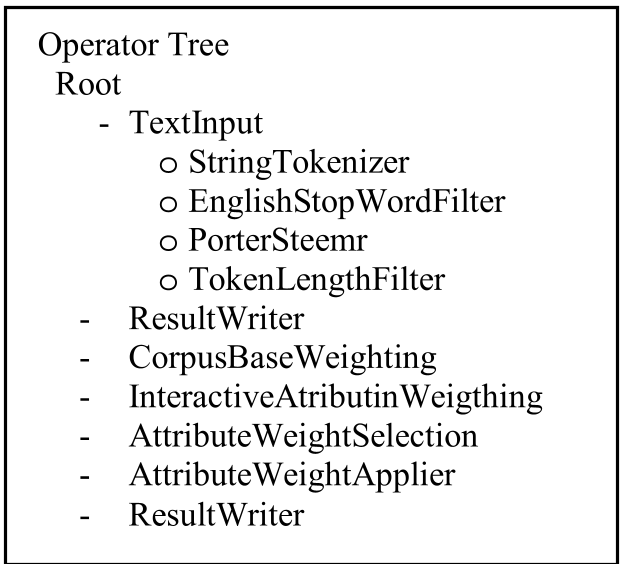 Figure 1: The Rapid-I + WVTool setup for clustering and keyword selection.
Experiments & Results: Bridging Spanish and English Domains
The researchers tested their framework on the EDA-University Ontology (focused on distance education in Venezuela). A key achievement was the successful Alignment and translation of this local ontology with the international LUMB (Lehigh University Benchmark) ontology.
Performance Evidence
- Instance Discovery: The agent discovered specific instances like "Athabasca University in Canada" from unlabelled text, which were then used to "populate" the ontology.
- Taxonomy expansion: The system allowed for the dynamic creation of new hierarchical classes (e.g., differentiating between Distance and Industrial administrative subclasses) based on text annotations.
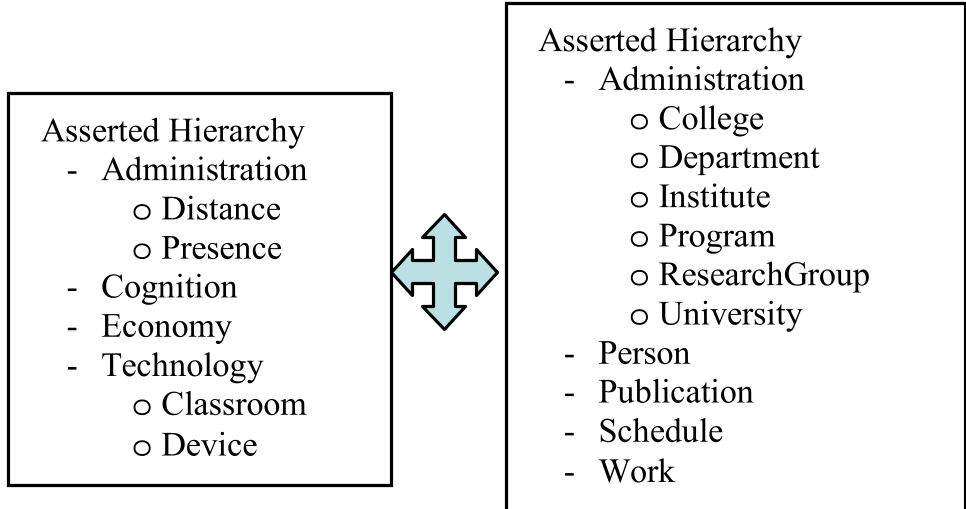 Figure 2: The initial EDA-University class hierarchy before the learning process.
Critical Analysis & Conclusion
Takeaway
The synergy between Text Mining and Information Extraction transforms the ontology from a static file into a "living" model. The "Semi-Intelligent-Agent" approach acknowledges that while AI can handle the heavy lifting of processing megabytes of text, the User-Agent remains essential for final validation and semantic accuracy.
Limitations & Future Work
The current experiment utilized a relatively small corpus (480 documents). While successful, the scalability of the human-in-the-loop validation (User-Agent interaction) as the corpus grows to millions of documents remains a challenge. Future research should explore Active Learning, where the system proactively asks the user to label only the most "uncertain" data points to further increase efficiency.
Editor's Note: This paper provides a solid blueprint for researchers looking to bridge the gap between raw unstructured data and formal semantic structures in specialized institutional contexts.